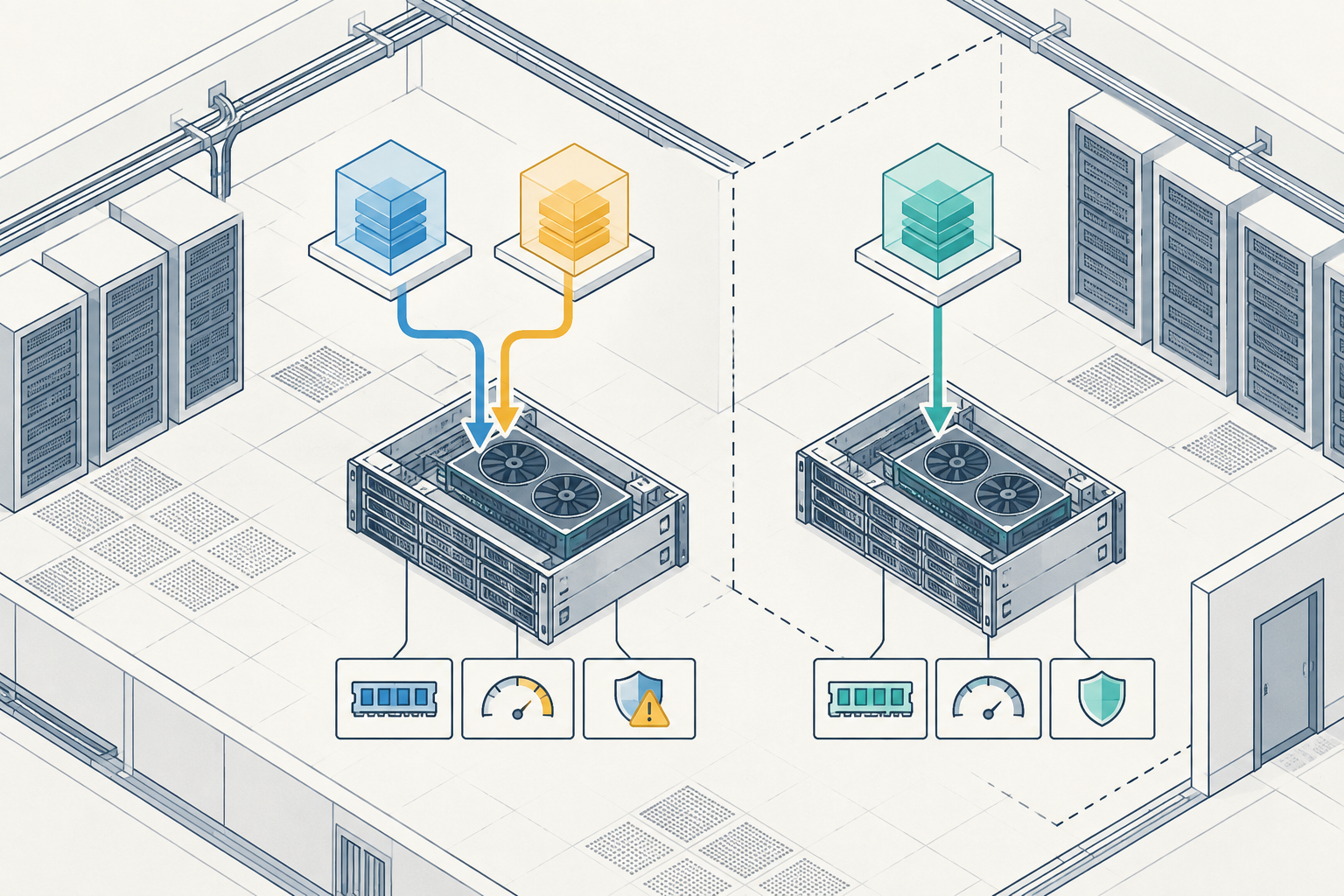
A public discovery, not a tenancy guarantee
On September 24, 2026, the experimental virtio-nvgpu project appeared on Hacker News. The consequential detail is not the attention: its repository explicitly says the planned isolation component is not yet implemented. That makes the unveiling a reason to investigate shared GPU access, not evidence that operators can safely sell it to mutually untrusted inference tenants.
The discovery channel matters. Hacker News is hosted by Y Combinator, but an appearance there is community discovery, not a YC company launch, endorsement or security review. The public signal changes what infrastructure teams might put on their lab shortlist. It does not change the burden of proving isolation, recovery and workload support.
For operators with a quarter rack to a few racks, the decision is therefore narrow: does virtio-nvgpu merit an isolated evaluation against dedicated GPU assignment? Headline graphics benchmarks cannot answer that. The useful evidence concerns tenant boundaries, fault propagation, memory accounting and the exact inference workloads an operator intends to host.
The bottleneck is stranded capacity with obligations
Small estates routinely have accelerators that look underused while remaining unavailable for another customer. One tenant reserves a device for a latency-sensitive service, another needs substantial model memory but computes intermittently, and a third runs short batch jobs. Average device activity can be low even when reservation commitments exhaust sellable capacity.
Sharing could reduce this fragmentation, but it also couples workloads. An inference tenant does not merely consume compute cycles. It occupies memory, moves data, creates contexts and queues work whose effects may outlive a request. Operators need enforceable admission limits and predictable recovery, not just a mechanism that lets two guests reach one accelerator.
Dedicated assignment is the comparison baseline, not a claim of perfect security. It generally gives operators a simpler ownership boundary and clearer device attribution, while host configuration, DMA protections, reset behaviour and management access still require review. Shared access must demonstrate which of those boundaries it preserves, replaces or leaves unresolved.
The commercial bottleneck follows directly: capacity cannot be sold responsibly unless its service boundary can be explained. If a customer's malformed workload can interrupt another customer's service, the operator has a shared failure domain. If usage cannot be attributed, utilisation improvements may create billing disputes rather than usable margin.
Separate access, partitioning and isolation
Treat GPU access, resource partitioning and security isolation as separate claims. Access means a workload can submit operations. Partitioning means resources are divided or scheduled according to some policy. Isolation means one tenant cannot improperly observe, modify or disrupt another within a defined threat model. Evidence for the first does not establish the other two.
The repository's stated isolation gap should govern the experiment. Do not put customer data, production credentials or unrelated users into the test environment. Keep the hosts off production management and storage networks. Use synthetic inputs and disposable images, and give the team a documented way to rebuild the entire environment.
Also avoid filling documentation gaps with assumptions about the implementation. Before testing, pin a repository commit and record the architecture actually present there: guest interfaces, host components, privilege requirements, supported software and resource controls. Where the project does not document a property, mark it unknown rather than importing expectations from other virtual GPU systems.
A successful lab result can establish that a specific workload ran under specific conditions. It cannot retrospectively turn an unimplemented isolation component into a supported security boundary.
Build a comparison that operators can use
Use the same physical accelerator sequentially where possible, or matched devices with recorded differences. Hold host firmware, driver versions, guest images, model files and request traces constant where the access methods permit. Record unavoidable differences explicitly. Otherwise, a runtime change or model-cache effect can masquerade as a sharing improvement.
Start with one dedicated guest and one representative inference service. Establish startup time, successful requests per second, latency distribution, device memory use, host memory use and wall-power behaviour. Then run the same service through the experimental path before introducing a second workload. This separates compatibility failures from contention failures.
| Test dimension | Dedicated baseline | Shared-path question |
|---|---|---|
| Tenant boundary | One assigned tenant per device | What prevents cross-tenant access? |
| Fault recovery | Record device and host effects | Does one failure reach a neighbour? |
| Memory accounting | Attribute the assigned device | Can allocations be reconciled per tenant? |
| Compatibility | Validate the target runtime | Do required operations remain correct? |
| Service quality | Measure latency under load | Does contention violate the service target? |
Set pass criteria before collecting results. For example, require no incorrect outputs in the selected correctness suite, no unexplained memory attribution gaps and no neighbour restart during specified recoverable fault tests. These are lab gates, not proof that every possible attack or failure has been excluded.
Test the boundary, then the failure domain
Begin with lifecycle boundaries. Create tenant A, allocate buffers containing recognisable synthetic patterns, terminate its workload and release its resources. Start tenant B and use authorised test instrumentation to check for residual data exposure. Repeat across process exit, guest restart, device reset and host reboot where supported. Document exactly which transitions were exercised.
A negative result means no exposure was observed in those tests; it is not a general confidentiality guarantee. Isolation also depends on host-side validation, control interfaces and privileged components. Review which processes can access device nodes and management sockets, which users can modify configuration, and whether any experimental component requires privileges outside the intended tenant boundary.
Next, run a steady inference workload beside a deliberately failing lab workload. Test allocation exhaustion, workload termination, guest crash and supported recovery procedures. Capture whether the neighbour sees latency inflation, request failures, device loss or a restart requirement. Stop when recovery becomes uncertain; repeatedly forcing resets can destroy the evidence you need.
Classify every observed fault by blast radius: process, guest, shared accelerator, host or dependent service. Measure time to restore service as well as time to detect the problem. A setup that recovers only after rebooting the host may still be useful for experimentation, but it has different economics from a service with tenant-scoped recovery.
Make memory accounting a first-class test
Memory is often the hard admission constraint for inference. Weights, runtime workspaces, request-dependent state and caches can occupy most of a device before compute utilisation becomes high. A sharing scheme that exposes access without enforceable memory budgets may admit a second tenant successfully and then fail when both reach normal concurrency.
Compare three views: what the application reports, what the guest can observe and what the host measures. Track reserved versus actively used memory where those concepts are available. Determine whether host-side allocations, shared buffers or caches are attributed to a tenant, charged as platform overhead or simply absent from the tenant ledger.
Test admission at the intended concurrency, not just after model loading. If an operator sets a tenant limit, establish whether exceeding it produces a predictable tenant-local error or threatens neighbouring workloads. Do not describe a scheduler label or an application setting as enforcement unless the actual resource boundary has been tested.
Metering must also survive restarts. Use stable tenant and workload identifiers, timestamped allocation events and reconciliation against host totals. If the sum of tenant allocations and documented overhead does not explain observed consumption, keep that discrepancy visible. An unknown accounting bucket is not free capacity.
Compatibility means your inference service
Graphics success is weak evidence for inference compatibility. Test the exact framework, runtime, precision, model architecture and execution features required by the service. Check model loading, custom operations, compilation paths, batching and concurrent requests. Include multi-device execution only if it is in scope and the project documents a viable path for it.
Validate output correctness alongside throughput. Use deterministic checks where practical and tolerances appropriate to the model and numerical format elsewhere. A service that starts and returns plausible text has not necessarily passed correctness testing. Also inspect whether unsupported operations cause explicit failures or unexpected fallback to host compute.
For latency-sensitive services, compare tail latency at a fixed arrival pattern and useful throughput at the same latency target. Unrestricted saturation benchmarks answer a different question. For batch services, compare completed jobs, retry rates and total wall time, including setup and recovery. Preserve failed runs rather than reporting only the fastest successful one.
A worked capacity and chargeback example
Consider an illustrative eight-GPU estate over a 30-day month. Its calendar capacity is 8 × 24 × 30 = 5,760 physical GPU-hours. Assume useful workload execution currently occupies 40% of that capacity: 2,304 GPU-hours. At an allocated estate cost of $11,520 per month, each available physical GPU-hour costs $2, while each useful GPU-hour costs $5.
Now suppose a controlled scheduling experiment raises useful occupancy to 60% without breaching the same correctness and service targets. Useful execution becomes 3,456 GPU-hours. With monthly cost held constant for illustration, cost per useful GPU-hour falls to $3.33, rounded. The gain is 1,152 useful GPU-hours, not additional physical devices and not a measured result for virtio-nvgpu.
That assumption needs discipline. Simultaneous tenant wall-hours are not automatically equivalent to physical GPU-hours: two guests can each run for an hour while sharing one device. Define the accounting unit before quoting a price. Where hardware-backed fractions are unavailable or unverified, allocated service time and measured physical occupancy should remain distinct ledger fields.
A simple chargeback policy could distribute the $11,520 monthly cost using documented allocation shares. A tenant responsible for 25% of billable allocation units would receive $2,880 of the charge. Storage, network and support charges should be separate if they are not already included. This arithmetic is a policy example, not evidence that the experimental path provides trustworthy allocation counters.
Higher occupancy can also increase electricity use and cooling demand, so the fixed-cost assumption may not survive measurement. The production business case must add those changes, operational effort and fault-related service credits before claiming a saving.
Put orchestration around proven mechanisms
A platform such as Clastiq Orchestrator addresses the operating model around GPU capacity: bare-metal provisioning, Kubernetes and VM tenancy, GPU partitioning, Ceph storage, per-tenant metering and chargeback, quotas and policy. These functions let an operator organise owned hardware into governed services rather than maintain disconnected allocation spreadsheets and host-specific procedures.
The boundary is important: orchestration cannot supply missing isolation inside an experimental device-access mechanism. Nor should this evaluation imply an existing Clastiq integration with virtio-nvgpu. A sensible policy is to keep experimental hosts in a separate pool, allow only approved lab identities and leave production tenants on mechanisms whose boundaries the operator has validated.
Use placement policy to distinguish dedicated devices, supported partitions and experimental shared access. Express workload requirements explicitly: memory budget, tenancy class, permitted host pool and recovery expectations. Hardware-agnostic operation means accommodating different capabilities through policy, not pretending every accelerator offers interchangeable partitioning or fault containment.
Storage needs equivalent separation. Ceph can provide the backing storage layer, but tenant credentials, pool or namespace design, access controls and snapshot handling still need deliberate configuration. Keep synthetic lab models and logs separate from production datasets. Measure model-loading and checkpoint traffic so a storage bottleneck is not misdiagnosed as accelerator contention.
Sovereignty includes evidence and recovery
For an operator running local infrastructure, sovereignty concerns where data, control and operational dependencies reside. Air-gap deployments require an offline supply chain for source, images, packages and documentation, plus a way to reproduce builds and retain logs locally. A downloaded repository alone does not establish that an experimental stack can be maintained without external services.
Cognition-AI is based in Muscat, Oman, and Clastiq Orchestrator includes air-gap deployment and human-led local support in its scope. Those are relevant operating capabilities, not substitutes for project-specific security evidence. The operator still needs ownership of incident response, vulnerability tracking, image promotion and rollback decisions.
At rack level, measure power and cooling headroom during concurrent workloads. Average GPU activity does not reveal circuit peaks or thermal throttling. Record server or distribution-level power where instrumentation exists, and identify shared electrical and cooling constraints before increasing admission limits. A capacity policy that ignores those constraints can move fragmentation from accelerators to the rack.
What to do this week
- Freeze the evidence. Record the Hacker News reference, repository commit, isolation warning and supported configuration. Separate documented capabilities from assumptions and open questions.
- Build an isolated comparison. Prepare disposable hosts or a segregated lab pool, synthetic datasets and a dedicated-assignment baseline. Exclude customer secrets and production storage credentials.
- Run boundary and recovery tests. Exercise lifecycle cleanup, allocation exhaustion, guest failure and recovery while a neighbour serves a fixed workload. Record blast radius and restoration time.
- Reconcile resource and service measurements. Compare guest and host memory, allocation records, output correctness, tail latency, useful throughput and power. Keep accounting gaps explicit.
- Make a gated decision. Continue lab work only where compatibility and operational value justify it. Keep production adoption blocked until isolation, enforcement, accounting and maintainability have evidence appropriate to the intended tenants.
Clastiq Orchestrator runs infrastructure orchestration on the operator's own hardware; request a demo.