SGLang changes the serving layer, not your capacity plan
SGLang v0.5.20, released on September 18, 2026, introduces serving, speculative-decoding and hierarchical-cache changes. For operators considering another GPU purchase, those are reasons to test the serving stack first. They are not evidence that an existing cluster can accept a particular percentage more traffic, nor that every supported model benefits equally.
The primary reference is the project’s GitHub release entry. This article uses that release as the news signal; it does not have verified, independent two-source corroboration of its performance claims. Any release-note speedup should be treated as a workload-specific maintainer result. Check the associated model, hardware, parallelism, context length and benchmark conditions before translating it into a procurement assumption.
The operational question is narrower: can this version complete more useful work on your hardware while preserving latency, answer quality and tenant boundaries? For a quarter rack to a few racks, the answer requires a controlled upgrade trial, not a fleet-wide package update. Arabic enterprise prompts, shared instruction prefixes and mixed context lengths should be part of that trial wherever they reflect actual demand.
Find the bottleneck behind the queue
A small GPU estate can show spare average utilisation and still have an unacceptable queue. Long prefills may delay short interactive requests. Repeated system prompts can consume work that a suitable cache might avoid. KV-cache pressure can constrain concurrency. A host-memory shortage can turn an apparent GPU scheduling problem into reclaim, stalled cache transfers or worker failure.
Speculative decoding tries to reduce generation time by proposing tokens and verifying them with the target model. Its benefit depends on proposal acceptance, verification cost and implementation details. Extra model state or proposal work can also consume memory and compute. A change that helps one conversational workload may hurt another with short answers or a different model configuration.
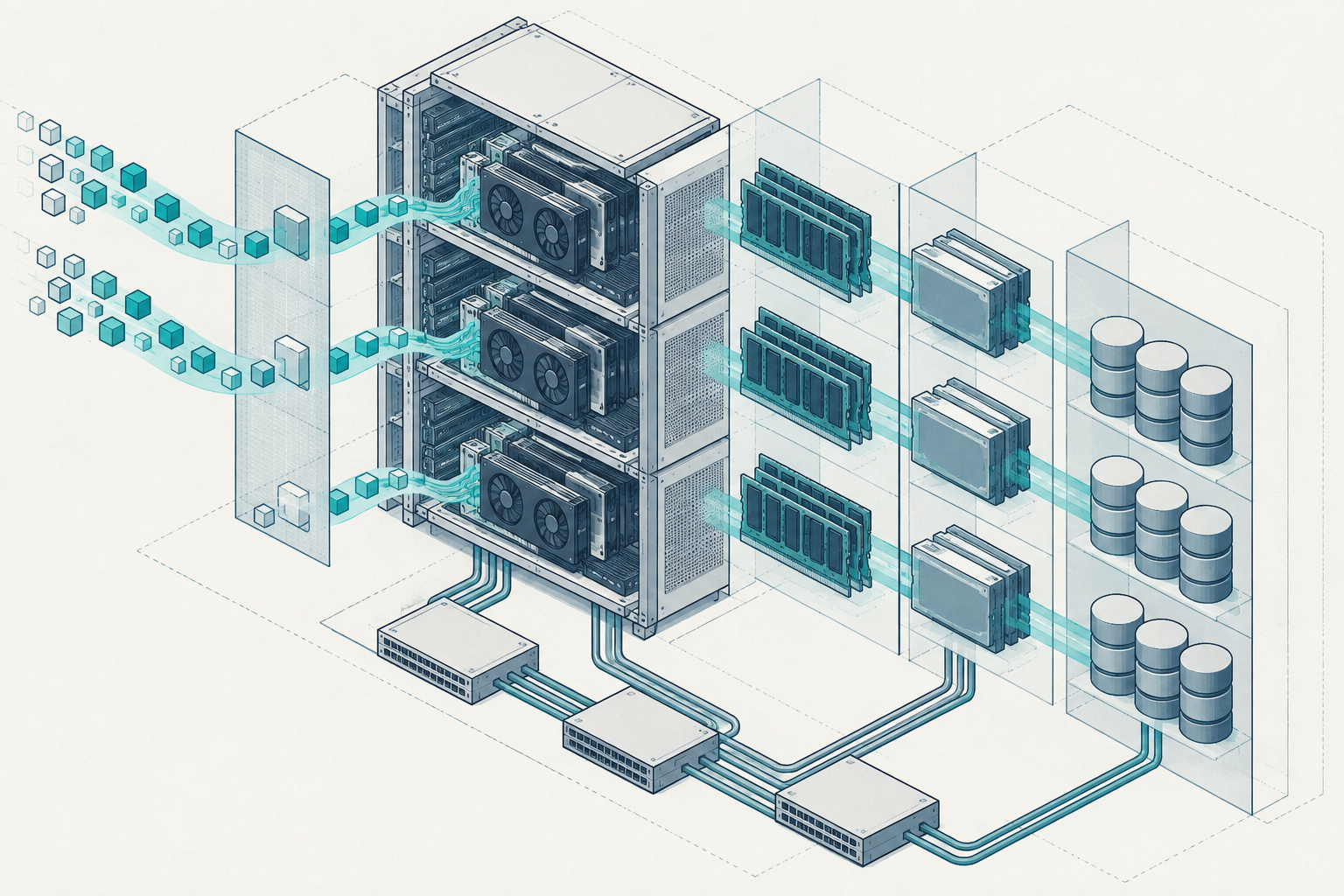
Hierarchical caching moves the question beyond device memory. Reusing prefixes across GPU memory, host memory and, where configured, a storage-backed tier can save computation. It can also introduce transfers, evictions and contention. Measure whether the cache removes the bottleneck or merely relocates it to memory bandwidth, the network or storage.
In a small GCC deployment, capacity planning may also be bounded by available electrical power, cooling and local support coverage. Arabic and bilingual traffic must therefore be tested directly rather than represented by English benchmark prompts. Token counts, shared-prefix structure and generated answer lengths can differ substantially between business applications, even when their users submit similar numbers of requests.
Build a comparison that can explain its result
Keep the current production version as the baseline. Record the model and tokenizer revisions, quantisation, runtime dependencies, GPU allocation, parallelism, scheduler settings, context limits and cache configuration. Save the image digest and configuration files. An upgrade comparison is not interpretable if the candidate also silently changes the model or doubles its memory allowance.
Use three stages: the pinned baseline, v0.5.20 with the closest supported equivalent configuration, and separate candidate configurations enabling the features you want to investigate. Do not switch speculative decoding and every cache tier together initially. Otherwise, an improvement or regression cannot be attributed, and rollback becomes a search through interacting settings.
Reserve the same hardware allocation for both versions. Prefer alternating runs on the same nodes when spare capacity is limited. If testing side by side, account for different hardware characteristics and shared dependencies. Separate GPU allocations do not prevent interference through host memory, network interfaces, storage pools or a common power envelope.
Run cold-cache and warm-cache phases, label them explicitly, and repeat each test. Include a sustained period long enough to observe cache eviction and memory stabilisation rather than reporting only an initial burst. Use both fixed arrival rates and a controlled load sweep. Closed-loop clients alone can hide overload by sending fewer requests when responses slow down.
Use Arabic prompts that represent real work
Construct a sanitised replay corpus from approved workload patterns. Include Arabic policy questions, bilingual correspondence, document-grounded answers and structured extraction if those applications exist in the estate. Preserve realistic punctuation, document boundaries and output constraints. Do not assume a translated public benchmark captures the distribution of your enterprise traffic.
Divide the corpus into short, medium and long context buckets using actual token counts from the pinned tokenizer. For example, you might test approximately 1,000, 8,000 and 24,000 input tokens, provided the model and deployment support those lengths. Those are test design choices, not SGLang capacity claims. Weight the buckets according to observed traffic, then add an explicit long-context stress case.
Create one set with genuinely identical system and reference prefixes, and another with unrelated prefixes. Include near-matches where a date, tenant identifier or document revision changes early in the prompt. Prefix reuse depends on implementation and matching conditions; semantically similar Arabic text is not necessarily a reusable token prefix.
Keep requested answer lengths and sampling settings comparable. Record actual output tokens, stop reasons, timeouts and validation failures. Review Arabic answer quality with competent human reviewers, supported by task-specific automated checks. A faster run that truncates responses or breaks extraction schemas is not higher productive capacity.
Treat the corpus itself as controlled enterprise data. Store its version, approval status and retention policy alongside the run manifest. Air-gapped operators should import the corpus, images and dependencies through their existing review process; a benchmark should not create a new external telemetry or package-download path.
Measure useful throughput and the displaced load
Use completed, valid requests per allocated GPU-hour as the primary efficiency measure, with p95 end-to-end latency as a separate service constraint. Also collect time to first token and inter-token latency: an acceptable total response time can conceal a poor interactive experience. Report each context bucket separately as well as the weighted aggregate.
| Measure | Record alongside it | Failure it can expose |
|---|---|---|
| p95 request latency | Arrival rate and context bucket | Queueing hidden by averages |
| Valid requests/GPU-hour | GPU allocation and output lengths | Apparent gains from less work |
| Host-memory pressure | Peak usage, reclaim and swap | Cache growth exhausting RAM |
| Storage traffic | Read/write volume and tail latency | Cache tiers overloading shared storage |
| Cache reuse | Tier, tenant and warm/cold state | Benefits confined to favourable prefixes |
Collect speculative proposal acceptance where the implementation exposes it, but do not mistake that diagnostic for a business outcome. A high acceptance rate is useful only if total serving time and resource consumption improve. Likewise, a high cache-hit rate can coexist with expensive cache retrieval or harmful eviction of another workload.
A minimal run manifest helps keep results reproducible. The following is an operator-maintained record, not a set of SGLang command-line flags:
cat > trial.env <<'EOF'
BASELINE_IMAGE=registry.local/inference:baseline-pinned
CANDIDATE_IMAGE=registry.local/inference:sglang-0.5.20-pinned
CORPUS_VERSION=arabic-enterprise-v3
ALLOCATED_GPUS=4
ARRIVAL_RPS=2
RUN_SECONDS=3600
CACHE_PHASE=cold
EOF
sha256sum trial.env arabic-enterprise-v3.jsonl > trial.sha256
Resolve those illustrative image tags to immutable digests before execution. Capture the real server arguments separately, using options documented for the installed version. Record client timing and server counters with synchronised clocks, and retain the raw request outcomes so that someone other than the tester can recalculate the result.
Work the economics without inventing GPU savings
Consider an illustrative four-GPU allocation tested for two hours per run. Each run consumes eight allocated GPU-hours. Suppose the baseline completes 9,600 valid requests within the chosen latency limit. That is 1,200 requests per GPU-hour. The candidate completes 12,000 comparable requests, or 1,500 per GPU-hour: a 25% throughput improvement on this particular test.
At an internal infrastructure rate of $2.40 per allocated GPU-hour, each run costs $19.20 for the GPU allocation. Baseline GPU cost is $0.002 per valid request; candidate GPU cost is $0.0016. That is a 20% reduction in the GPU component of unit cost, not 25%. A 25% increase in throughput and a 20% decrease in reciprocal unit cost are consistent.
For 120,000 comparable requests, the baseline would require 100 GPU-hours and the candidate 80, assuming the measured rates hold. The GPU allocation difference is $48. If the candidate requires an additional $12 of attributable host-memory and storage resources for that workload, the illustrative net saving falls to $36. Include those resources rather than presenting GPU savings as total savings.
Do not immediately remove 20% of physical capacity. Peaks, redundancy, maintenance windows and workload variation still need headroom. Nor does releasing allocated GPU-hours necessarily reduce the electricity bill proportionally: measure node power and facility constraints separately. The first usable benefit may be a shorter queue or room for another tenant, not a smaller rack.
Test isolation before rewarding cache reuse
Shared prefixes create a security and accounting question. Determine what identifies cached state: model revision, token sequence, adapter identity, tenant context and other execution settings may matter. Do not assume the required namespace boundaries exist simply because tenants authenticate through different API keys. Establish the actual behaviour of the selected SGLang configuration and its surrounding gateway.
Test two tenants using the same visible prompt with different private reference material. Repeat across two adapters, including an adapter update or reload. Verify that outputs reflect the correct tenant and adapter, and inspect available traces for unexpected reuse. Output checks alone cannot prove isolation; combine them with configuration review and implementation evidence where necessary.
Also consider timing leakage. A tenant learning that a private prefix was previously processed may be unacceptable even without direct content disclosure. If the required boundary cannot be demonstrated, use separate serving instances and cache domains. The lost reuse is a cost of the security policy, not a regression to optimise away.
Persistent cache tiers need a retention and deletion policy, access controls, encryption where required, and a documented response to tenant offboarding. Determine whether stored material contains KV state, metadata or other sensitive representations. Sovereignty means controlling where that material lives and who can operate the system, not merely locating the GPUs inside a national border.
Put orchestration around the serving experiment
A system such as Clastiq Orchestrator provides the infrastructure controls around this trial: bare-metal provisioning, Kubernetes and VM tenancy, GPU partitioning, Ceph storage, per-tenant metering, quotas and policy engineering. These are distinct from SGLang’s inference algorithms. The platform should establish repeatable resource envelopes; the serving runtime must still demonstrate correctness and efficiency inside them.
Place the baseline and candidate in defined tenant allocations. Apply CPU and host-memory limits as deliberately as GPU assignments, while allowing enough measured headroom for the intended cache. Where supported by the hardware and software stack, GPU partitioning can reserve a trial slice without handing over a whole device. It is not equivalent to testing a full-device production configuration.
If a supported cache backend is placed on Ceph, distinguish its traffic from model loading, tenant volumes and backup activity. Ceph does not become a supported SGLang cache backend merely because storage is available. Validate the access method and behaviour, then measure shared-pool effects. A local serving improvement that damages another tenant’s storage latency is an estate-level regression.
Meter allocated resources and useful work separately. Define whether shared-cache costs are charged by reservation, attributable usage or an agreed service rate; avoid billing the same stored prefix repeatedly without an explicit policy. Keep minimum reservations and burst quotas visible. Better throughput should expand the admission budget only after host memory, storage and power remain within their limits.
For an air-gapped deployment, stage the pinned images, model artefacts, manifests and rollback dependencies locally. Cognition-AI, based in Muscat, positions Clastiq Orchestrator around operator-owned hardware and human-led local support. That support model does not substitute for a tested runbook or imply any benchmark result, customer deployment or certification.
Set rollback criteria before the first canary
Agree the acceptance envelope before examining results. An illustrative policy might require no more than a 5% p95 latency regression in any production-relevant context bucket, no increase in invalid completions beyond a predefined tolerance, and a measurable gain in valid requests per GPU-hour. Set memory and storage thresholds from the estate’s existing operational limits, not from generic percentages.
Rollback immediately on suspected cross-tenant state reuse, unexplained adapter-dependent output changes, repeated out-of-memory events or storage latency that breaches another service’s objective. Investigate noisy measurements rather than declaring victory from one run. Retain the baseline image and configuration, and rehearse routing traffic back while draining or cancelling candidate requests according to application policy.
Version or discard cache state during rollback unless compatibility is explicitly established. Do not let a returning baseline consume candidate-written state by assumption. Promote through a small canary, a longer representative load window and then broader service exposure, keeping the previous allocation available until the acceptance window closes.
What to do this week
- Pin the baseline and candidate images, model revisions and configurations; archive the v0.5.20 release entry with the trial record.
- Build an approved Arabic and bilingual corpus with shared prefixes, unrelated prefixes and mixed token-length buckets.
- Reserve a bounded allocation and run repeated cold-cache and warm-cache comparisons at matched arrival rates.
- Test tenant and adapter isolation, then reconcile valid requests per GPU-hour with memory, storage, power and chargeback costs.
- Rehearse rollback, publish the acceptance thresholds and defer any GPU purchase decision until the representative trial is complete.
Clastiq Orchestrator runs this infrastructure on the operator’s own hardware — request a demo.