Ripple brings CPU deadlines into the consolidation decision
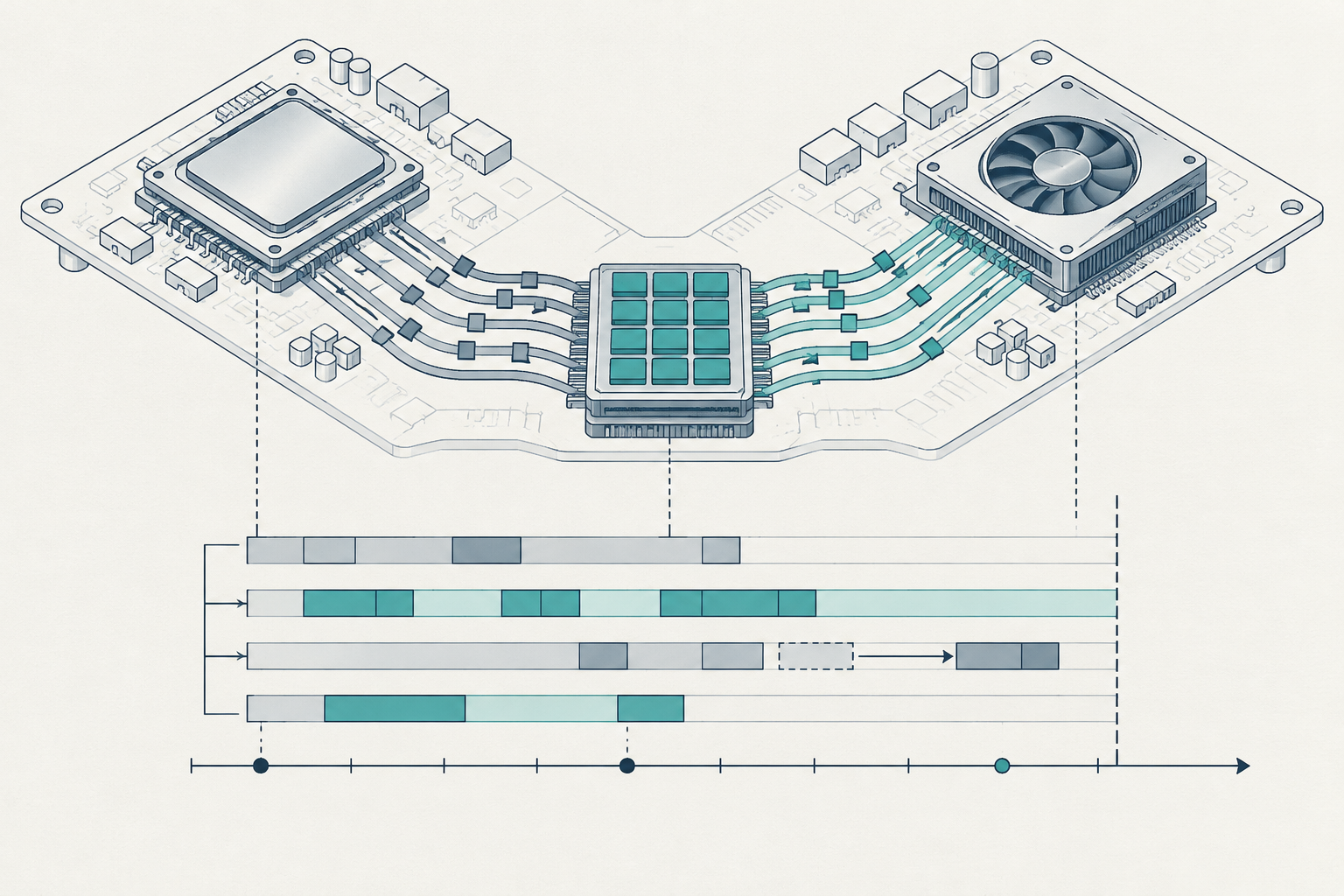
The Ripple research manuscript, dated October 31, 2026, examines a consolidation problem that GPU utilisation alone cannot explain: GPU memory traffic can interfere with time-critical CPU work on unified-memory edge devices. It proposes CPU–GPU co-scheduling, bringing CPU timing requirements into decisions about GPU execution. The reference supplied for this story is arXiv:2611.01067.
The change in perspective matters more than another utilisation target. A GPU can become busier while the application around it becomes less dependable. If CPU work must complete before a deadline, additional GPU activity may increase memory contention enough to turn otherwise acceptable execution into late results.
Ripple should be read as research, not as a Kubernetes release, a generally available scheduler capability or a production guarantee. This article draws an operational lesson from its stated problem and proposed approach; it does not attribute unverified performance improvements or implementation details to the manuscript.
For infrastructure teams, the question is concrete: when does consolidating workloads stop producing useful capacity? Answering it requires CPU deadline measurements, memory-interference evidence and application latency alongside GPU utilisation. It also requires distinguishing a scheduling experiment from a service commitment.
The contention domain is bigger than the GPU
On unified-memory devices, CPU and GPU activity can compete within a shared memory subsystem. The exact architecture varies, but the operating concern is straightforward: work on one processor can affect how quickly the other obtains data. Separate execution engines do not automatically mean independent performance.
A CPU task might perform sensor processing, prepare an inference request or validate an accelerator result. Its own computation can remain unchanged while its elapsed execution time increases under competing memory traffic. A dashboard showing spare CPU capacity would not necessarily reveal that dependency.
This is why average utilisation is an incomplete consolidation signal. It measures activity, not whether activity finishes in time. A system that delivers more aggregate work but misses critical deadlines may be less valuable than one that deliberately leaves some accelerator capacity unused.
Do not generalise the manuscript's setting to every server. A discrete GPU with local memory has different contention paths from an integrated edge device. Host memory, transfer paths, CPU preprocessing and shared infrastructure can still matter, but operators must identify the actual bottleneck rather than assume architectural equivalence.
Start with a dependency map: which CPU tasks feed each GPU workload, which tasks consume its output, and which resources they share? Record the memory architecture, workload priority and deadline owner. That map establishes the boundary within which a consolidation test has meaning.
Define success before changing placement
A deadline is a completion requirement, not a synonym for low average latency. Operators need to specify where timing begins, where it ends and what happens when the limit is exceeded. Otherwise, infrastructure and application teams may report incompatible versions of success.
For a periodic CPU task, measure release-to-completion time against its declared deadline. For an interactive application, measure the relevant end-to-end latency distribution. Include queueing, preprocessing, accelerator execution and postprocessing where they belong in the service contract. Do not silently exclude waiting time because it occurs outside a GPU kernel.
Agree on the permissible miss rate. Some workloads tolerate occasional late results; others require a stricter engineering process than percentile monitoring can provide. A successful finite test does not establish a hard real-time guarantee.
| Signal | What it establishes | Operational use |
|---|---|---|
| CPU deadline misses | Work completed too late | Reject unsafe consolidation |
| Application tail latency | User-visible delay | Check the service objective |
| Memory traffic and stalls | Possible contention mechanism | Guide controlled experiments |
| GPU utilisation | Accelerator activity | Assess capacity only with outcomes |
| Useful completed work | Results delivered within requirements | Compare configurations |
Collect these signals on a common timeline. A latency spike that coincides with GPU activity is a lead, not proof of causation. Repeat controlled tests before assigning the cause to shared-memory interference.
Build an interference test, not just a load test
Establish an isolated baseline for the time-critical application. Use representative inputs, realistic arrival patterns and the same software configuration intended for deployment. Record operating conditions such as power mode and thermal state; an edge device's behaviour can change during sustained execution.
Next, run the proposed background workload alone. Characterise its throughput, memory behaviour and demand pattern. A bursty workload may cause short deadline failures even when its average bandwidth looks modest. Long sampling intervals can hide exactly the overlap that matters.
Then combine the workloads and change one control at a time. Candidate controls include background concurrency, admission timing, batch size and placement. These are experimental variables, not claims that any particular platform exposes or automatically coordinates them.
Use both a steady-load phase and a burst phase. Include realistic input extremes and enough repetitions to see whether the result is stable. Retain a known-safe configuration and define rollback conditions before testing against any live service.
A simple deadline log can make the acceptance check reproducible. The following illustrative script assumes application instrumentation exports one row per CPU task, with release, finish and relative deadline values in milliseconds on a consistent clock:
import csv

with open("cpu_tasks.csv", newline="") as f:
    tasks = list(csv.DictReader(f))

misses = sum(
    float(t["finish_ms"]) - float(t["release_ms"])
    > float(t["deadline_ms"])
    for t in tasks
)
print(f"tasks={len(tasks)} misses={misses}")
if tasks:
    print(f"miss_rate={misses / len(tasks):.4%}")
This is an observation tool, not a scheduler. Its usefulness depends on complete instrumentation, correct deadline definitions and trustworthy timestamps. Pair the output with application latency and resource measurements from the same test interval.
Worked example: higher utilisation, fewer acceptable results
Consider an illustrative edge deployment, not a Ripple result or a product benchmark. A foreground CPU task is released every 20 milliseconds and must finish within 15 milliseconds. Over a 30-minute test, it therefore produces 90,000 task instances: 1,800 seconds divided by 0.020 seconds.
Assume the operator permits at most 0.1% deadline misses during this acceptance test, equivalent to 90 late tasks. A related application has a separate p99 end-to-end latency objective of 80 milliseconds. Both conditions must pass; success on one does not compensate for failure on the other.
With no background GPU job, GPU utilisation averages 32%, nine CPU tasks miss their deadline, and application p99 latency is 58 milliseconds. The observed miss rate is 9 divided by 90,000, or 0.01%. This is the baseline, not evidence that the system will always behave identically.
Adding an unrestricted background job raises GPU utilisation to 81% and completes 12,000 background items. However, 1,350 CPU tasks finish late, giving a 1.5% miss rate, and application p99 latency reaches 104 milliseconds. The configuration fails both acceptance conditions despite its busier GPU.
A third test reduces background concurrency. GPU utilisation averages 63%, the background job completes 8,400 items, 45 CPU tasks finish late, and application p99 latency is 72 milliseconds. The deadline miss rate is 0.05%, so this configuration passes the stated test criteria.
Compared with unrestricted sharing, the third configuration delivers 30% fewer background items but reduces observed deadline misses by approximately 96.7%. Compared with the baseline, it adds 8,400 background completions while remaining inside the illustrative acceptance envelope. That is a more defensible consolidation result than simply reporting the rise from 32% to 81% utilisation.
The next step is longer validation under changing conditions, not immediate promotion to a hard guarantee. If the service requires zero deadline misses, none of these observations alone establishes compliance, and the configurations with observed misses are plainly unsuitable.
Kubernetes sharing does not settle deadline isolation
Operators searching for GPU time-slicing versus MIG versus MPS are usually asking two different questions: how can workloads share an accelerator, and what prevents one workload from harming another? Those questions need separate answers.
GPU time-slicing enables workloads to take turns using execution capacity. It should not be treated as a hard GPU memory or bandwidth boundary. Advertising more schedulable shares does not create more physical capacity or establish an application latency guarantee.
MIG, on supported NVIDIA GPUs and configurations, partitions GPU resources into hardware-backed instances. It provides a different isolation model from time-slicing, but support and partition characteristics must be checked for the actual device. It is not a universal answer for unified-memory edge hardware or for contention outside the partitioned accelerator resources.
MPS enables cooperative sharing of supported CUDA workloads and offers controls whose behaviour depends on configuration and hardware. It is not interchangeable with MIG, nor does its use alone establish end-to-end deadline isolation.
Kubernetes GPU sharing with hard limits therefore requires precise language. Which resource is bounded: device allocation, GPU memory, execution access, host CPU, or something else? A Kubernetes extended-resource allocation is not by itself a hard performance limit. CPU and host-memory controls also do not automatically bound shared memory-bandwidth interference.
Use Clastiq's insights and in-depth infrastructure guides for the broader GPU-sharing evaluation, rather than treating this research story as a complete configuration manual. For each candidate mechanism, document what it isolates, what it leaves shared and how that remaining contention will be tested.
Paying for idle GPUs versus paying for failed work
An idle on-premises GPU still carries acquisition, support, power and operating costs. That makes consolidation attractive, especially where bursty workloads leave long gaps. But assigning background work to every gap can introduce retries, delayed responses and operational recovery that erase the apparent saving.
Separate unavoidable committed cost from incremental operating cost. The purchase price does not disappear when a background job runs. What changes is the useful work obtained from the asset, alongside any extra energy, support effort and impact on foreground services.
A useful accounting measure is cost per acceptable completion: the allocated operating cost divided by results delivered within their requirements. Keep foreground and background outcomes visible separately. A large volume of low-priority completions should not conceal failures in a critical service.
Reserved headroom can therefore be intentional capacity, not waste. Establish when it may be borrowed, which workload must yield and who can authorise exceptions. If interference cannot be bounded sufficiently, separate placement or dedicated capacity may be the economically rational choice.
Where Clastiq Orchestrator fits
Clastiq Orchestrator, part of Cognition-AI's rFactorial product family, provides private-cloud orchestration across compute, GPU, storage and networks. Clastiq Lite brings self-service AI and GPU sharing to teams. These verified capabilities make coordinated infrastructure management the relevant connection to the Ripple story.
The connection is not that Clastiq implements Ripple, CPU–GPU co-scheduling or deadline-aware scheduling. No such capability is established here. Instead, operators can organise their infrastructure workflow around the dependencies the research highlights: compute and GPU decisions belong in the same operational discussion rather than in separate utilisation reports.
In practice, begin by identifying the foreground application, its supporting CPU work and the proposed shared GPU workload. Associate the deployment with its storage and network requirements. Then establish approved placement choices and sharing conditions through the organisation's available platform controls and operating procedures.
Benchmark candidate configurations outside the critical service path. Promote only configurations that satisfy the agreed acceptance criteria, and retain the measurements and configuration record. Instrumentation, deadline evaluation and any specialised scheduling logic require separate verification; they should not be inferred from an orchestration product description.
Self-service also needs boundaries. Teams requesting shared GPUs should declare workload priority, expected duration and latency sensitivity. Infrastructure owners should decide which combinations are eligible for sharing and which require dedicated resources. These are governance responsibilities, not evidence of an undocumented Clastiq enforcement feature.
Measure outcomes after deployment: acceptable task completions, deadline miss rate, application tail latency, background throughput and recovery effort. GPU utilisation remains useful, but it becomes supporting evidence rather than the verdict. This approach applies globally wherever edge or private-cloud teams consolidate mixed-priority work.
What to do this week
- Inventory one contention domain. Select a device or node, map CPU–GPU dependencies, and record whether memory resources are shared. Identify the owner of each timing requirement.
- Write the acceptance contract. Define the CPU deadline, permissible miss rate, application latency objective and rollback trigger. State whether these are test criteria or stronger operational obligations.
- Run three controlled configurations. Compare isolated operation, unrestricted background sharing and reduced background concurrency. Use identical foreground inputs and preserve the configuration record.
- Audit isolation claims. For time-slicing, MIG, MPS or another mechanism, list the resources actually bounded and those still shared. Check hardware support before selecting a mechanism.
- Review useful capacity, not just activity. Present deadline misses, tail latency and acceptable completions beside GPU utilisation. Reject configurations that improve activity while violating the service contract.
Explore Clastiq Orchestrator for coordinated private-cloud compute, GPU, storage and network orchestration, and the rFactorial product family owned by Muscat-based Cognition-AI. Use the measured workload requirements to guide that infrastructure discussion, without assuming research scheduling capabilities are included.