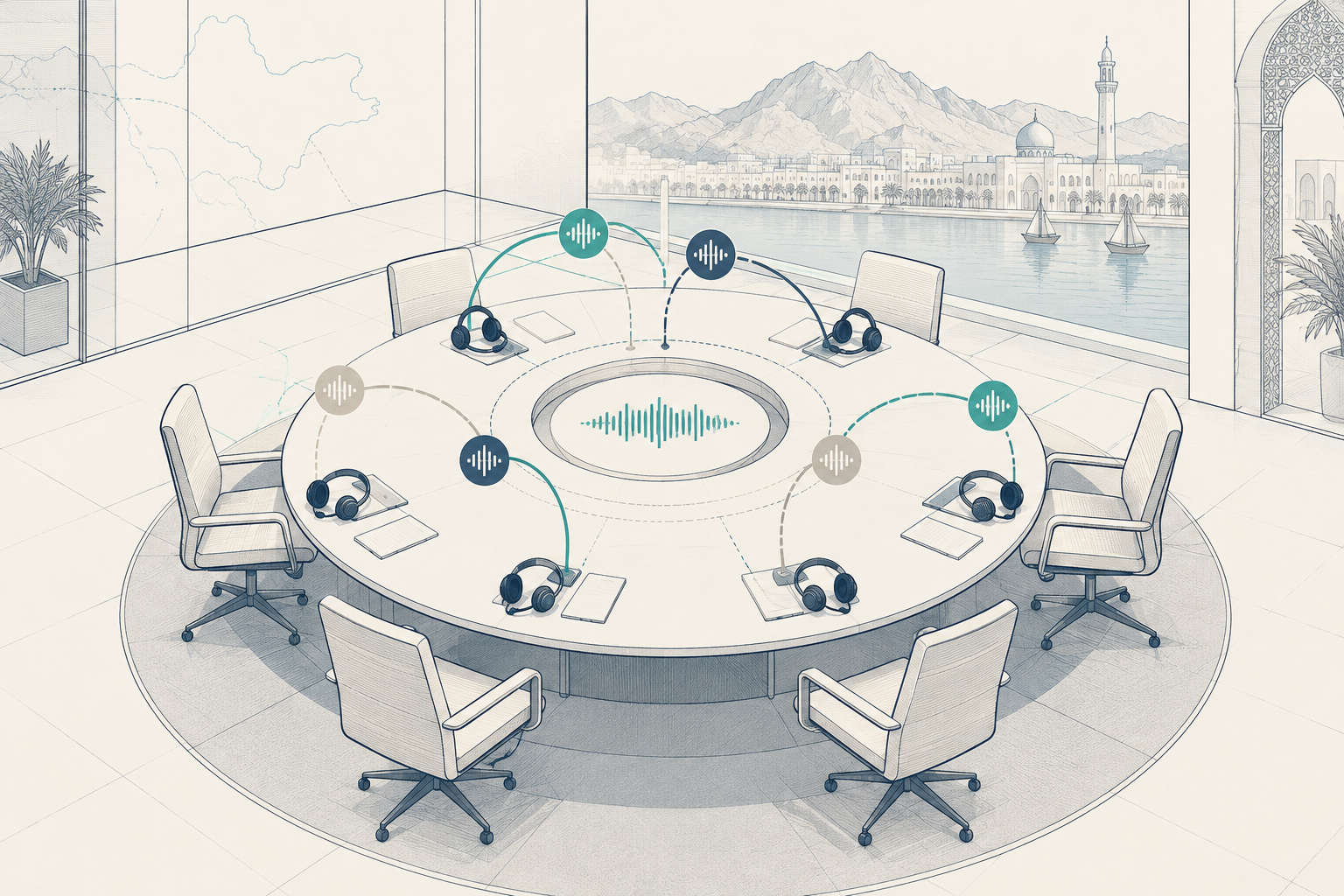
A realtime translation launch changes the evaluation question
ElevenLabs announced its enterprise realtime translation alpha on October 21, 2026. The announcement brings another supplier into an operationally demanding category: translating speech while a conversation is still unfolding. An alpha announcement is a reason to investigate availability and constraints, not evidence that a particular multilingual meeting will work reliably.
The useful question is not how many languages appear in a headline. It is whether participants can take turns, interrupt, understand terminology and leave with the same decisions when they speak different languages. Buyers should verify supported source-to-target directions, access conditions and operating requirements against current supplier documentation before scheduling a pilot.
For Cognition-AI, the AI development and innovation company based in Muscat, Oman, this is directly relevant to Risonour within its rFactorial product group. Risonour’s documented role is live voice translation: each participant speaks their language and hears the language they choose. That provides a concrete workflow to evaluate without assuming any unprovided implementation details.
The acceptance plan should measure conversation quality, not merely translated sentence quality. A system can produce an accurate sentence too late to prevent a mistaken interruption. It can also produce fluent speech that obscures a corrected amount. Neither failure is captured by a language-count comparison.
Define the meeting before choosing the technology
Start with one repeatable meeting type, such as a regional operations review. Identify who speaks, what each person wants to hear, which decisions the meeting produces and what happens if someone misunderstands. A routine status update and a contract negotiation require different release criteria even when their participants use the same languages.
GCC and MENA relevance is practical here. A meeting in Muscat may include Arabic and English alongside other languages used by international colleagues. Speakers may switch languages for technical terms, use regional Arabic varieties or pronounce names differently. These are test conditions, not grounds for assuming support for any language or dialect.
Create a directed language-pair inventory. Arabic-to-English and English-to-Arabic are separate entries; neither proves another direction works. Record the intended listening language for each participant, the relevant speech variety and whether language switching occurs within a turn. Mark every direction as documented, confirmed for pilot access, tested or unresolved.
Verify this inventory separately for each candidate, including Risonour. Its documented participant experience does not establish a particular language list, dialect coverage, meeting-platform integration or audio-routing architecture. Ask for confirmation rather than filling gaps with assumptions. An unresolved direction should remain outside the approved pilot scope until it has been demonstrated under the intended conditions.
Turn-taking is the first acceptance test
Translation introduces another timing layer into a meeting. Participants need to know whether a colleague has finished speaking, whether translated audio is still arriving and whether a pause is an invitation to respond. If those signals are unclear, polite participants may wait excessively while more assertive participants take the floor prematurely.
Build a scripted opening test with ordinary conversational moves: a short question, a long answer, an acknowledgement, a follow-up and a handover to another speaker. Then repeat it with natural speech. Scripts establish comparable conditions; unscripted rounds reveal whether participants change their behaviour to accommodate the system.
Observe false starts, abandoned turns and requests to repeat. Distinguish source-room behaviour from translation effects: some teams already interrupt frequently without translation. Use a baseline meeting with an agreed language or the team’s existing interpretation practice, documenting the differences rather than pretending the conditions are identical.
Include the chair in the evaluation. A workable protocol might require explicit handovers and a pause before decisions are closed. Those practices have a cost in meeting time. Record that cost instead of attributing every improvement to the translation technology, and check whether participants can follow the protocol without constant coaching.
Interruptions and corrections expose hidden failures
A demonstration often gives one speaker uninterrupted floor time. Operational meetings do not. Test overlapping speech, quick clarifications, an interruption that changes the topic and a correction made before the original statement has finished translating. The crucial question is whether listeners receive the final intended meaning without confusing it with the superseded version.
Use examples with consequences: “Ship fifteen units—sorry, fifty,” or “Do not approve the release until testing is complete.” Ask listeners what quantity or approval condition they understood. A pleasant voice and grammatical output do not compensate for a lost correction or negation. Score these cases separately from general fluency.
Check how participants recover after overlap. Does the chair need to repeat both contributions? Can listeners identify whose statement they are hearing? Do participants understand that an earlier translation has been corrected? These are evaluation questions, not claims about features available in ElevenLabs or Risonour.
Establish a recovery procedure before the pilot: stop the discussion, restate the corrected point, identify the speaker and request confirmation from affected listeners. If a system cannot support the required conversational pattern, narrow the permitted meeting format. A moderated sequential discussion may be acceptable where open debate is not.
Test terminology against decisions, not word matching
Prepare a small, controlled terminology set from the selected meeting workflow. Include project names, equipment identifiers, abbreviations, currencies, dates and terms that have different everyday and technical meanings. Use invented sensitive examples where necessary. The objective is to exercise the meeting’s vocabulary without uploading confidential material before data handling has been approved.
A terminology list is a test artifact, not evidence that a candidate accepts custom glossaries. Ask suppliers whether terminology controls exist and how they behave, then test only confirmed functionality. Even without such controls, the organization can measure whether essential terms survive translation and whether speakers need an agreed phrasing convention.
Score meaning at the decision level. “Inspection is required before delivery” and a differently worded translation may be equivalent. “Inspection follows delivery” is not. Give reviewers a source statement, intended meaning, received translation and severity rubric. Separate stylistic differences from errors affecting responsibility, timing, quantity, permission or safety.
For GCC meetings, include actual conventions used by the team: dates spoken in different formats, amounts with currency names and local place names. Do not turn these examples into claims of regional language competence. They are deliberately difficult checks that establish where a specific deployment is usable and where it needs safeguards.
Measure comprehension independently of confidence
After each test segment, ask participants to answer short questions in their chosen language. Who owns the next action? What is the deadline? Which proposal was rejected? What remains undecided? Compare answers against an adjudicated reference prepared by qualified bilingual reviewers. A confidence survey alone cannot reveal a confidently misunderstood instruction.
Keep the questions separate from the translation interface where possible, so participants cannot simply copy visible wording. Use equivalent question difficulty across language directions. Record whether a participant needed repetition or chair intervention. Comprehension achieved after three repairs is operationally different from comprehension achieved on the first pass.
Recruit reviewers familiar with the domain and relevant speech varieties. Resolve disagreements through a documented adjudication process rather than averaging contradictory judgments. For high-consequence material, require explicit human confirmation of the decision before anyone acts. Translation can support a discussion without becoming the authority for a contractual, clinical or safety-critical conclusion.
Define delay from the listener’s perspective
“Realtime” is not a single measurable threshold. Measure the interval from a source speech event to the corresponding audible translated event, using a clearly defined alignment method. Also measure how long translated speech continues after the source turn ends. The latter affects when another participant can reasonably answer.
Report distributions rather than one average. Median delay describes typical experience; the 95th percentile exposes slower events that may disrupt turn-taking. Separate directions, short and long turns, and tested audio conditions. Do not compare measurements made with different timing definitions as though they were equivalent product benchmarks.
Shorter delay may require translation before a sentence has supplied enough context. Waiting can improve interpretation of a qualification or correction but make conversation less responsive. Evaluate this trade-off through listener comprehension and repair frequency. Do not assume either product exposes a control for it; ask what behaviour can actually be configured.
The following is an illustrative acceptance matrix, not a supplier specification. A pilot owner should agree thresholds with participants before seeing results, then revise them only through a recorded change in requirements.
| Test area | Evidence to collect | Illustrative acceptance gate |
|---|---|---|
| Language direction | Documentation and representative trial | Every required direction confirmed and tested |
| Turn-taking | False starts and abandoned turns | No unresolved loss of a decision-bearing turn |
| Corrections | Listener restatement of final meaning | All critical corrections understood |
| Comprehension | Adjudicated decision questions | At least 95% correct; no critical error |
| Delay | Aligned audible events | 95th percentile within the team’s agreed limit |
A critical-error gate should override a favourable overall score. A small pilot can justify the next controlled stage, not prove that rare failures will never occur.
A worked example of the delay–repair trade-off
Consider an illustrative 30-minute operations meeting with 120 scored turns. Compare two candidate operating conditions, A and B, under a matched test protocol. These are hypothetical conditions, not ElevenLabs or Risonour measurements, and they do not imply that either product offers selectable latency modes.
Condition A has a median aligned translation delay of 1.2 seconds and a 95th percentile of 2.5 seconds. Condition B records 1.8 seconds and 3.4 seconds respectively. On delay alone, A looks preferable. However, participants request eight repairs in A and three in B, with each repair consuming an observed average of 18 seconds.
Repair time is therefore 144 seconds for A and 54 seconds for B: a 90-second difference. Separately, observers measure 45 seconds of non-overlapping translation-related floor waiting in A and 75 seconds in B. Total observed conversational overhead is 189 seconds for A and 129 seconds for B. B saves 60 seconds despite its higher measured translation delay.
Do not multiply median delay by 120 turns to estimate meeting extension. Translation can overlap source speech, and medians do not sum into an observed duration. In this example, repair time and floor waiting are explicitly disjoint categories. That accounting prevents the same pause from being counted twice.
Suppose listeners also answer 80 decision questions per condition. A yields 72 correct answers, or 90%; B yields 77, or 96.25%. B clears the illustrative comprehension threshold only if none of its three incorrect answers is critical. Repeat the experiment with counterbalanced order and comparable material before treating this result as a purchasing signal.
Make the evidence reproducible and govern the audio
Maintain a versioned test pack containing scenarios, approved recordings, reviewer instructions, device conditions and results. Record which service version or evaluation date applies when version identifiers are unavailable. Changes in room acoustics, microphone placement or participant familiarity can otherwise be mistaken for changes in translation quality.
A small machine-readable result record helps teams preserve measurement definitions. The following YAML is a proposed internal evidence format, not an API or configuration supported by any rFactorial product:
trial: operations-review-02
language_direction: ar-to-en
support_status: confirmed-for-pilot
speech_variety: recorded-in-test-plan
measurement: aligned-audible-event-delay
scored_turns: 120
critical_errors: 0
review_status: bilingual-adjudication-complete
Before collecting audio, establish participant notice, the applicable consent or authorization basis, permitted processing locations, access permissions, retention and deletion procedures. Ask suppliers what is stored, whether subcontractors process data and what contractual restrictions apply. No deployment location, retention behaviour or certification should be inferred from a product’s category or branding.
Use synthetic meeting content initially, then progress to approved operational material. Limit raw audio access to reviewers who need it and retain only what policy permits. If a connection fails or a language direction becomes unavailable, participants need a declared fallback: pause, switch to an agreed language or arrange human interpretation.
Keep translation and organizational agency separate
Risonour’s relevant role is human-to-human translation: people speak their languages and hear their chosen languages. Acceptance therefore centres on preservation of meaning, conversational coordination and listener understanding. The organization still needs a chair, accountable decision owners and a process for confirming consequential outcomes.
AVA has a different documented role: an AI voice agent acting on an organization’s behalf. Further details are forthcoming. It should not be presented as interchangeable with Risonour, nor should translation tests imply that AVA can conduct these meetings. Agency introduces separate questions about authority, permissible actions and escalation that require confirmed capabilities before evaluation.
If meeting documentation is a separate requirement, Rovetta’s documented role is turning conversations into structured meeting minutes or clinical drafts for professional review. That is distinct from delivering live translated speech. Evaluate documentation separately, without assuming a Risonour integration or treating a generated draft as proof that every participant understood the meeting.
What to do this week
- Select one recurring multilingual meeting and document its participants, decisions, required language directions and consequences of misunderstanding.
- Request current language-pair and pilot-condition confirmation for Risonour and any comparison candidate; leave unsupported assumptions outside scope.
- Build a bilingual-reviewed test pack covering turn-taking, interruptions, corrections, terminology and decision comprehension.
- Agree critical-error gates, delay definitions and an evidence-retention policy before collecting audio or viewing results.
- Run a controlled trial, measure repair time alongside delay, and authorize expansion only after reviewing comprehension and fallback performance.
Use Risonour’s verified product page as the starting point for a scoped evaluation.