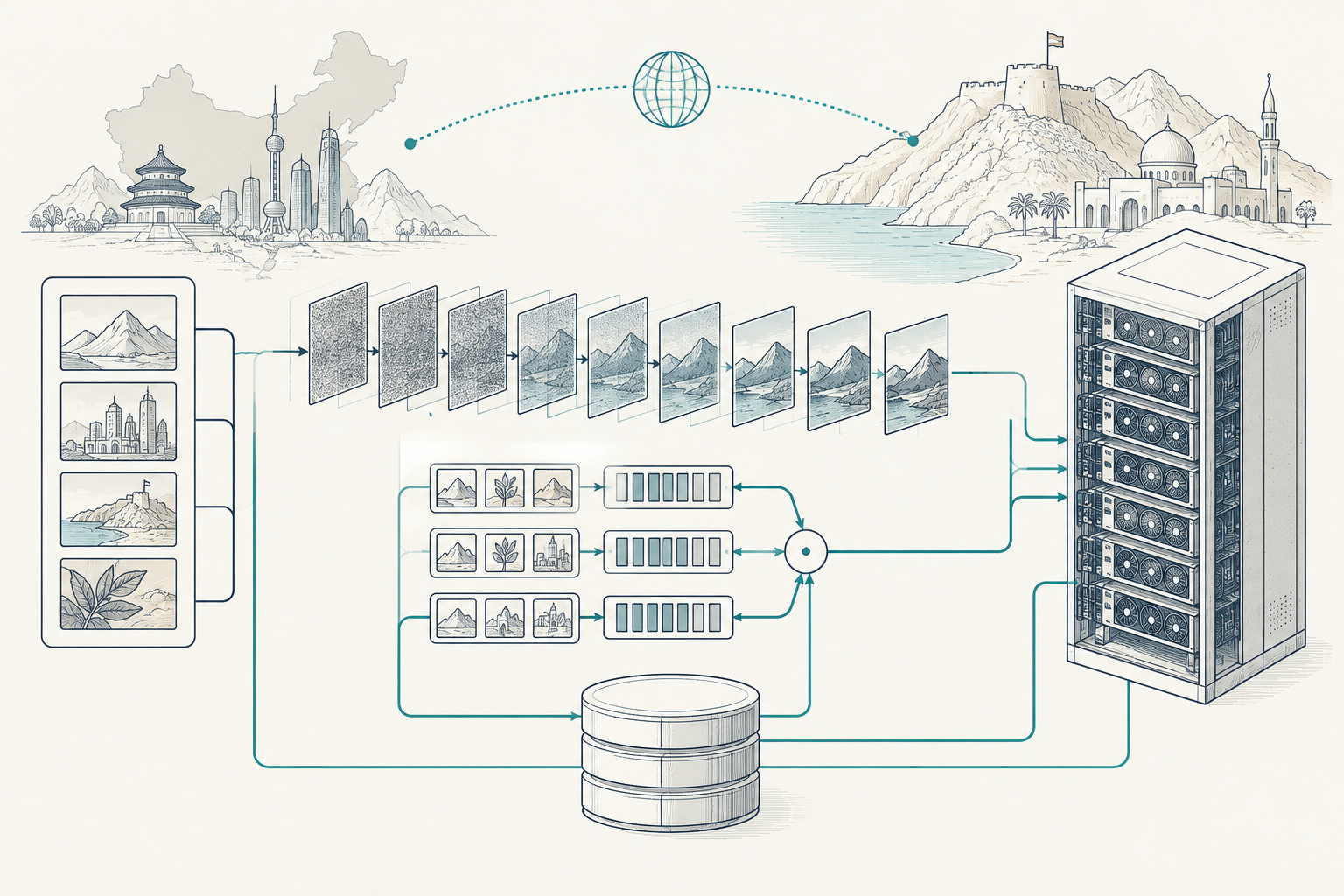
October 9 moves the experiment beyond denoising
Qwen’s official repository dates the Qwen-Image-2.1-Turbo checkpoint release to October 9, 2026, and documents image generation and editing in eight steps. For operators evaluating the China-developed model, the change is specific: fewer denoising iterations create a new throughput hypothesis, not a guaranteed service-level improvement.
The repository describes a 7-billion-parameter visual generator, but that generator is only part of the deployment. A text encoder and variational autoencoder, or VAE, also consume resources. The repository identifies a Qwen Research License, rather than Apache or MIT licensing. Capacity planning and commercial approval therefore need separate checks before a locally hosted endpoint becomes a tenant service.
The useful experiment is whether eight-step execution produces more acceptable images per GPU-hour without pushing memory pressure, queue latency or retry rates beyond operating limits. That requires measuring the entire request path, including input processing, model movement, generation, decoding and output storage.
For a quarter-rack installation, one additional resident worker can displace another tenant. Across a few racks, short jobs can expose inefficient dispatch and storage behaviour previously hidden behind longer generation times. The release changes where operators should look for waste.
A shorter GPU phase can expose a longer queue
An image request is not simply eight equal blocks of GPU work. It can include prompt encoding, reference-image loading, preprocessing, accelerator transfers, denoising, VAE decoding, safety checks and persistence. Some stages use the accelerator; others wait on CPU, memory or storage.
Reducing denoising work can shift the bottleneck toward those surrounding stages. Component offload may make a request fit while introducing transfer delays. Increasing concurrency may hide CPU preparation time but trigger allocation failures during decoding. Loading reference images from a busy shared storage pool may leave an otherwise available GPU idle.
The operator’s question is therefore not “How fast is eight steps?” It is “Which admission and placement policy delivers acceptable images within the promised deadline?” Benchmark both warm workers and cold starts. A successful warm inference says little about the wait experienced when a scaled-down tenant must reload components.
Keep queue wait separate from execution time. A median execution improvement can coexist with worse tail latency when oversized jobs block smaller ones. Record arrival, admission, execution start, completion and output availability as distinct timestamps.
Benchmark the complete deployment envelope
Freeze the checkpoint revision, inference implementation, dependency versions and component configuration before comparing results. Record precision, attention implementation, VAE settings, offload policy and any compilation or caching. Otherwise, an apparent scheduling gain may actually be a software change.
Use a small matrix that represents intended customer work. For GCC agencies, that could include campaign illustrations and approved edits to supplied assets. For retailers, include product images where object identity, label integrity and composition matter. These are proposed evaluation workloads, not reported Cognition-AI customer deployments.
| Dimension | Initial comparison | Operational question |
|---|---|---|
| Resolution | Two supported output sizes | Where does peak memory rise sharply? |
| Reference images | None, one, several where supported | How much input preparation and memory are added? |
| Component placement | Resident versus supported offload | Does saved VRAM justify transfer delay? |
| Concurrent jobs | One, two, then higher if safe | When do latency and failures deteriorate? |
| Worker state | Warm and cold | What does tenant activation cost? |
Use only combinations supported by the selected implementation. Reference-image count is an editing workload dimension, not a promise that every pipeline accepts arbitrary counts. Preserve the eight-step configuration when testing scheduling, then run separate quality comparisons against a suitable baseline.
Change one dimension at a time before testing combinations. Repeat runs after warm-up and retain failures. Discarding out-of-memory attempts or slow requests produces a capacity figure that the scheduler cannot safely deliver.
Measure accepted output, not just completed files
Peak VRAM must cover the full worker lifecycle. Sample device memory and collect framework-level allocation statistics where available; brief peaks can escape coarse monitoring. Note whether a measurement includes every pipeline component, a single process or the whole device. These scopes are not interchangeable.
Report accepted images per allocated GPU-hour alongside attempted images and completed images. Define acceptance before testing: prompt adherence, preservation of referenced products, legible required text and absence of disqualifying artefacts. Use a consistent review process, with reviewers blinded to configuration where practical.
For GCC deployments, include Arabic and bilingual material in that review rather than assuming an English-language evaluation transfers. Where campaign requirements depend on exact typography or regulated wording, assess whether generated content needs a deterministic layout stage instead of relying on image generation alone.
Track p50 and p95 queue wait, execution time and end-to-end latency. Add failure rate, retry count and accepted-output rate. Measure host RAM, CPU saturation, storage throughput and power where instrumentation permits. A configuration that saves GPU time but doubles rejection may be commercially worse, even if its demo looks faster.
Make the benchmark reproducible
A lightweight benchmark record should connect each request to its configuration and outcome. Use tenant-safe identifiers, not raw prompts, in general operational logs. Keep sensitive evaluation assets in access-controlled storage with explicit retention.
The following shell example illustrates a local benchmark harness interface; it is not an upstream Qwen command or a Clastiq Orchestrator CLI:
# Illustrative harness: implement against your deployed endpoint.
python bench_image_service.py \
  --manifest approved-evaluation.jsonl \
  --steps 8 \
  --concurrency 2 \
  --repetitions 3 \
  --output results/resident-c2.jsonl
The manifest should identify output size, reference inputs, seed where supported and acceptance criteria. Store the endpoint’s resolved checkpoint and runtime configuration with the results. Repeat the same workload under offload, then compare the full latency distribution rather than only the average.
Use a controlled arrival pattern for throughput tests and a separate burst pattern for queue tests. Record whether concurrency means requests admitted into workers or requests merely waiting at the gateway. Confusing those counts can make a memory-safe endpoint appear to support more simultaneous execution than it does.
Worked example: throughput is not utilisation
Consider an illustrative four-GPU service with an eight-hour operating window. It allocates 32 GPU-hours. Assume an internal cost of $2.40 per allocated GPU-hour, including the operator’s chosen share of hardware, electricity, hosting and support. The window therefore costs $76.80. These figures are hypothetical, not product benchmarks.
Configuration A attempts 1,600 images, of which 80% pass review. That yields 1,280 accepted images, or 40 accepted images per allocated GPU-hour. Its infrastructure cost per accepted image is $76.80 divided by 1,280: $0.06.
Configuration B uses a different placement and concurrency policy. It attempts 2,000 images, with a 72% acceptance rate. It delivers 1,440 accepted images, or 45 per allocated GPU-hour. Its corresponding cost is approximately $0.0533 per accepted image. Despite lower acceptance, B delivers 12.5% more accepted output from the same allocation.
Now apply the latency condition. If B’s p95 queue wait exceeds the interactive service target, it cannot simply replace A. It might instead become the batch policy while interactive requests retain reserved capacity. Also account separately for review labour and retry-related costs; the calculation above covers infrastructure only.
Suppose device-active time totals 24 hours within the 32 allocated GPU-hours. That is 75% device-active utilisation under this defined metric. Do not divide costs by 24 while billing against 32 without explaining the difference. Reserved idle time still costs money, and high activity alone does not establish useful throughput.
Turn memory findings into admission policy
Translate benchmark results into workload classes: for example, small generation, large generation and reference-heavy editing. Each class needs tested memory headroom, a concurrency ceiling, a deadline and a retry policy. Admission should consider available accelerator memory and host resources, not merely a free worker slot.
A system such as Clastiq Orchestrator provides the infrastructure layer for this policy through bare-metal provisioning, Kubernetes and VM tenancy, GPU partitioning, and quota engineering. The application gateway and worker scheduler still need to enforce request-level limits. Infrastructure allocation alone cannot prevent an endpoint from accepting an unsafe combination of requests.
Treat partitioning as conditional on hardware support and measured fit. A partition that holds weights may still be too small for reference processing or decoding peaks. Time-sharing also does not provide the same memory or fault isolation as a hardware-backed partition. Match the isolation mechanism to the tenant agreement.
For small estates, start with conservative placement and explicit queue separation. Reserve an interactive pool or a bounded share, and let batch work consume remaining capacity where policy permits. Introduce backfilling only after measuring interference. One saturated worker should not turn every tenant’s deadline into an estimate.
Meter the reservation and the work separately
Per-tenant metering should distinguish reserved GPU time, execution time, storage consumption and output counts. An agency buying exclusive capacity is purchasing availability as well as computation. A retailer submitting overnight batches may instead accept a queue in exchange for shared infrastructure pricing.
Clastiq Orchestrator’s metering and chargeback capabilities can support that distinction, but the image service must supply request-level usage records. Correlate tenant identity, workload class and resource allocation with execution events. Avoid charging retries caused by platform faults as though they were deliberate tenant consumption.
Set quotas for active jobs, queued jobs, input bytes, reference-image counts and retained output storage. A GPU-hour limit alone cannot protect the service from a large upload burst or an unbounded queue. Publish cancellation and timeout behaviour, including whether interrupted work is billable.
Use the worked example’s accepted-output metric for internal optimisation, not automatically for invoicing. Acceptance can be subjective and delayed. If billing depends on accepted images, define who reviews them, when decisions become final and how disputes are handled. Otherwise, bill a clearly measurable resource unit and report quality separately.
Local hosting requires a controlled supply chain
For GCC agencies and retailers, local hosting can keep prompts, product references and generated assets within an operator-controlled environment. It does not by itself establish legal compliance, data residency across every dependency, or permission to use the checkpoint commercially.
Review the Qwen Research License and the terms applicable to every required component before offering service. Do not interpret repository visibility or downloadable weights as Apache-style permission. Confirm permitted uses, restrictions and any approval obligations with the organisation responsible for legal review. Record the exact terms assessed alongside the checkpoint revision.
For an air-gapped deployment, stage weights, tokenizer assets, runtime packages and container images through a controlled import process. Verify hashes, retain provenance and test startup without external network access. Check for telemetry, remote asset fetching and package resolution that might otherwise occur at runtime.
Clastiq Orchestrator supports air-gap deployments and human-led local support. Those capabilities help operators maintain a local service boundary; they do not replace licence review or application hardening. Cognition-AI, based in Muscat, Oman, should be evaluated on the operational scope it provides, without assuming unprovided certifications or customer results.
Storage and power become scheduling inputs
Ceph storage can provide shared capacity for approved inputs, model artefacts and generated outputs, but those workloads have different access patterns. Large model reads during simultaneous worker startup can contend with tenant asset traffic. Separate policies or pools where justified, and test recovery and degraded conditions rather than only an idle cluster.
Where local caching is used, account for cache capacity, eviction and integrity checks. Tenant separation must apply to cached reference assets as well as shared storage. Define output expiry and deletion behaviour, including backup retention, before accumulating a production image library.
Measure wall power or the closest reliable infrastructure metric during comparative tests. Lower step counts do not guarantee proportionally lower energy per accepted image because memory, CPU preparation, idle reservations and cooling remain. Compare energy over the same workload and acceptance boundary.
Finally, test bursts against the estate’s power and cooling envelope. Faster dispatch can raise simultaneous device activity even when individual requests are shorter. Coordinate admission ceilings with facility limits, and verify that thermal throttling does not invalidate the benchmark. Scheduling policy should reflect sustained operation, not a brief run from a cool rack.
What to do this week
- Pin and review the release. Record checkpoint revisions, required components and the Qwen Research License review before exposing an endpoint to tenants.
- Build a representative evaluation set. Include generation and supported editing workloads, Arabic and bilingual requirements, two resolutions and documented acceptance rules.
- Run the scheduling matrix. Compare resident and offloaded components, warm and cold workers, and increasing concurrency; capture peak VRAM, failures and queue tails.
- Set enforceable service classes. Establish interactive and batch queues, memory headroom, per-tenant admission limits, storage quotas and retry rules.
- Reconcile output with cost. Calculate accepted images per allocated GPU-hour and cost per accepted image, then check sustained power and storage behaviour before expanding capacity.
Clastiq Orchestrator runs this infrastructure on the operator’s own hardware: request a demo.