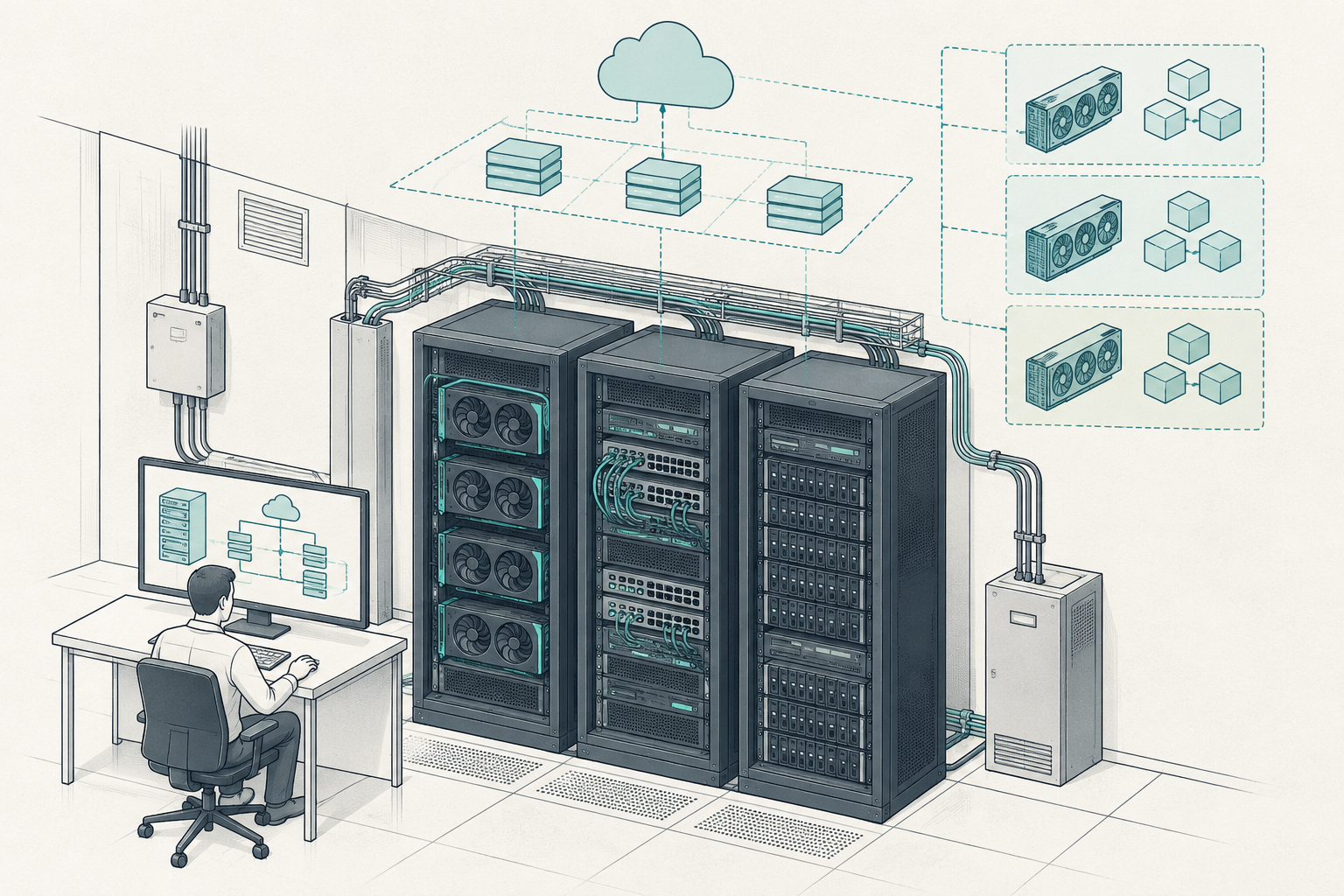
Hibiscus makes the control-plane question concrete
OpenStack 2026.2 Hibiscus arrives on September 30, 2026, according to the OpenStack community and OpenInfra Foundation announcements referenced below. The release messaging emphasises security, confidential computing and accelerated workloads. For operators considering GPU-backed services, those priorities put trusted tenant execution alongside resource scheduling in the platform evaluation.
The announcements establish the release context, not compatibility with your particular servers. A security improvement is not proof of confidential GPU execution; accelerated-workload support is not proof that every partitioning mode can be scheduled, isolated and billed. Those claims need component-level documentation and hardware-specific tests before they become service commitments.
For a quarter-rack to few-rack estate, the decision is therefore narrower than whether OpenStack is capable. Does a full cloud control plane remove enough tenant-management work to justify the services, integrations and recovery procedures it adds? The bottleneck is usually multi-tenancy under limited staffing, not raw GPU performance.
Start with the service boundary, not the platform
A small estate can have a complicated commercial boundary. One tenant needs Kubernetes namespaces, another expects virtual machines, and a third wants a dedicated accelerator server. Each expects separate credentials, networks, storage limits and a bill that matches the allocation. Ownership of the hardware does not make those boundaries automatic.
Without orchestration, the operator becomes the integration layer: updating inventory, reserving devices in spreadsheets, creating networks, expanding volumes and reconciling usage. That works until two administrators allocate the same capacity or a tenant deletion leaves a billable volume behind. Adding GPUs does not correct either failure.
Write down the actual product before selecting the control plane. Specify whether tenants buy dedicated hosts, whole GPUs, supported GPU partitions or workload execution time. Define whether VM and Kubernetes consumption share one quota. Decide whether storage survives compute deletion and whether idle reservations remain chargeable. These are scheduling and accounting inputs, not downstream billing details.
Compare two operable designs
OpenStack earns consideration when tenants genuinely need cloud-style self-service, VM lifecycle management, network services, volumes and stable APIs. Relevant components can provide those abstractions, but the operator must select, integrate and maintain the required services. Not every deployment needs every project, and optional accelerator or confidential-computing paths deserve separate qualification.
Compare that design with a simpler deployment serving the same contracts. A system like Clastiq Orchestrator covers bare-metal provisioning, Kubernetes and VM tenancy, GPU partitioning, Ceph storage, per-tenant metering and chargeback, quota and policy engineering, and air-gap deployments. The comparison should measure administrative work and failure recovery, not count dashboard features.
Clastiq's role is to coordinate those functions on operator-owned hardware rather than leave their boundaries to scripts and memory. Hardware-agnostic does not mean that hardware differences disappear: supported partition modes, isolation guarantees and maintenance procedures still depend on the installed devices and software stack. Human-led local support can help operators maintain these boundaries, but acceptance tests must establish what the deployed system actually does.
Run one tenant lifecycle through both
Build an isolated evaluation environment and give both designs the same tenant request: one project, two users, a VM, a Kubernetes workload, one accelerator allocation, a private network and a capped storage allocation. Record elapsed time, manual interventions and privileges required. Include approval and deletion, not just creation.
Then introduce contention. Have a second tenant request the last available accelerator while the first tenant expands a workload. A correct system rejects or queues requests according to policy; it does not silently borrow another tenant's reservation. Repeat through both API and interface paths so that a convenient dashboard cannot hide an unenforced backend limit.
Finally, delete the tenant and recreate it. Check for stale device assignments, networks, credentials, volumes, snapshots and accounting identities. Preserve the records needed to explain the previous bill without granting the new tenant access to old data. This lifecycle exposes integration gaps faster than an idle demonstration cluster.
Qualify the accelerator path explicitly
Inventory exact server models, accelerator models, firmware, drivers, hypervisors and orchestration integrations. Record which combinations support whole-device passthrough, hardware partitioning, mediated devices or time-sharing. These mechanisms offer different isolation and scheduling properties. Treating them as interchangeable creates promises the hardware cannot keep.
For every advertised allocation type, verify discovery, scheduling, attachment, workload execution, release and reuse by another tenant. Test host reboot and failed workload cleanup. Check locality where it matters: a device assigned across an unsuitable CPU or network topology can meet a quota while delivering an unacceptable service.
Confidential computing requires an additional chain of evidence. Identify what is protected, against which adversary, and where attestation is checked. CPU memory protection alone does not establish protection for accelerator memory, device transfers or storage. Make the whole trusted path explicit, including firmware and key release, before selling a confidential GPU tier.
| Acceptance gate | Evidence required | No-go condition |
|---|---|---|
| Accelerator allocation | Supported device and partition survive lifecycle tests | Stranded or double-allocated capacity |
| Tenant isolation | Cross-tenant network and access tests fail safely | Reachable tenant data or management endpoints |
| Quotas and metering | Enforced limits reconcile with allocation records | Unexplained billable usage |
| Recovery | Documented restore meets the agreed target | Recovery depends on an unavailable specialist |
Test isolation beyond the compute instance
Network isolation must survive mistakes, not merely normal traffic. Attempt cross-tenant access between VMs and Kubernetes workloads, including services exposed through load balancers or ingress. Verify that tenant credentials cannot alter provider networks or reach management interfaces. Include storage, orchestration APIs and device-management endpoints in the protected inventory.
Separate control-plane, tenant and storage traffic logically, and physically where risk and capacity warrant it. On a small estate, shared switches may be reasonable, but shared failure domains must be documented. A network policy is not an independent network path; a switch reboot can still interrupt every tenant.
Check identity boundaries across interfaces. A user removed from the portal must lose relevant API access, and automation credentials need scoped privileges and rotation procedures. Keep an emergency access path outside routine tenant identity flows. Audit its use and test it before the identity service becomes the incident.
Storage quotas must reflect physical consequences
Ceph can support shared storage services, but advertised tenant capacity and usable estate capacity are different quantities. Replication or erasure coding, recovery headroom, snapshots and failure-domain design all affect what can safely be sold. A few racks do not automatically provide independent power, networking or maintenance domains.
Set quotas for bytes, volumes and snapshots where the service exposes them. Test concurrent allocation near the limit and confirm that alternate interfaces cannot bypass enforcement. Determine whether snapshots and retained volumes remain chargeable after compute termination. Otherwise, a tenant can appear inactive while consuming the capacity needed for recovery.
Exercise storage degradation during the evaluation. Remove a failure domain in a controlled test, measure workload behaviour and observe recovery traffic. The acceptance criterion is not simply that data remains available. Operators also need sufficient headroom and a clear rule for pausing new allocations while redundancy is reduced.
Meter allocations before pricing utilisation
Consider an illustrative estate with eight identical GPUs over a 30-day month. It has 8 × 24 × 30 = 5,760 physical GPU-hours before maintenance. Suppose Tenant A reserves two GPUs continuously, Tenant B receives four for 12 hours daily, and Tenant C receives two for eight hours daily.
Their allocations are 1,440, 1,440 and 480 GPU-hours respectively, totalling 3,360. Allocated utilisation is 3,360 ÷ 5,760 = 58.3%. These allocations can fit without oversubscription if B and C run together alongside A. The figure describes reserved device time, not measured GPU execution activity.
Assume a declared monthly service-cost pool of $6,720 covering depreciation, energy, cooling, support, staff time and shared infrastructure. Dividing by allocated hours gives a recovery rate of $2.00 per allocated GPU-hour. At that rate, A and B are charged $2,880 each and C $960. The total recovers $6,720 without margin.
Dividing the same costs by all 5,760 available hours would produce $1.17 per available GPU-hour, rounded. That lower denominator-based rate would not recover costs if only 3,360 hours were sold. Partitioned devices need separately defined allocation units; do not assume a fraction of device memory equals the same fraction of performance or cost.
Make the accounting trail replayable
Choose billable boundaries explicitly: reservation start, successful device attachment, workload start or another agreed event. Define rounding, cancellations and failed provisioning. Capture tenant, resource, allocation type, timestamps and tariff version. Activity telemetry can explain efficiency, but it should not silently replace the contractual billing clock.
Reconcile independent records daily. Allocated devices should match scheduler state; billable intervals should match lifecycle events; stored bytes should match the defined storage measurement. Test collector outages and replay. Missing telemetry must raise an exception rather than become either free service or an estimated charge presented as measured usage.
For an OpenStack evaluation, begin with a small inventory check using credentials scoped for the task:
# Inspect limits and resources visible to the evaluation project.
openstack quota show "$PROJECT_ID"
openstack server list --project "$PROJECT_ID"
openstack volume list --project "$PROJECT_ID"
openstack network list --project "$PROJECT_ID"
These commands are inventory checks, not billing validation. Their output must be joined with the deployed accelerator, Kubernetes and metering records. Confirm client versions and permissions in the test environment rather than assuming one command set covers every integration.
Sovereignty includes dependencies and power
Sovereignty is an operational property, not just a server address. Identify where credentials, encryption keys, images, usage records and backups reside. Document who can administer the system and whether support access is local, temporary and auditable. Trace dependencies on external registries, licensing services, identity providers and telemetry endpoints.
For air-gapped deployments, demonstrate installation, image import, patch delivery and recovery without an Internet connection. Keep verified package repositories and installation artefacts under operator control. Security updates still require a distribution and validation process; disconnection does not remove that obligation.
Power belongs in admission planning as well. An accelerator quota does not guarantee electrical headroom when tenants become busy simultaneously. Establish measured rack limits, cooling constraints and a maintenance reserve. Decide whether policy rejects new workloads, moves them or applies supported power limits. Clastiq's quota and policy engineering should be evaluated against those operational constraints, not assumed to replace facility controls.
Upgrade recovery is the staffing test
A full control plane brings dependencies that need coordinated upgrades: databases, messaging, identity, networking, compute agents, storage integrations and API services. The exact set depends on architecture. Count the components your team owns and the maintenance steps requiring elevated access or specialist knowledge.
Rehearse an upgrade with active tenants and deliberately stop at a documented failure point. Measure API unavailability, workload disruption and time to restore administrative control. Include versioned configuration, database backups, secrets and network state in the recovery plan. A backup file is useful only if the team can restore a consistent service.
Do not assume rollback is possible after every schema or state transition. Establish when recovery means rollback, restore or forward repair. Have the second available operator execute the runbook without its author directing every command. If only one person can recover the platform, the deployment carries a staffing dependency that the service contract must acknowledge.
Make the go/no-go decision defensible
Choose OpenStack when its tested cloud interfaces and tenant controls satisfy requirements that the simpler design cannot meet economically. A go decision needs verified hardware support, enforceable cross-service quotas, reconciled metering, acceptable failure behaviour and a recoverable upgrade path. It also needs funded operator time after deployment.
Choose the simpler design when it meets the same tenant contract with fewer failure paths and less recurring administration. This is not a judgment about project size or technical ambition. A small sovereign cloud benefits more from a narrow service that staff can restore than from a broad catalogue whose integrations remain untested.
Mark unsupported confidential-computing paths, ambiguous partition accounting and unrehearsed recovery as no-go items for those service tiers. They need not block every workload. Limit the initial catalogue to validated combinations and expand only when another test produces evidence, not when another feature appears in release messaging.
What to do this week
- Freeze a hardware matrix. List installed devices, firmware, drivers and intended partition modes; mark every unverified combination as unavailable for sale.
- Write one tenant contract. Define compute units, network boundaries, storage retention, quotas and billable start and stop events.
- Run the same lifecycle twice. Compare Hibiscus and the simpler deployment using identical provisioning, contention, deletion and isolation tests.
- Reconcile a sample bill. Match allocation events to tenant charges, then interrupt collection and prove that replay does not duplicate usage.
- Rehearse degraded operation and recovery. Test storage failure and a stopped upgrade; record recovery time, manual steps and the staffing required.
Clastiq Orchestrator runs these infrastructure workflows on the operator's own hardware — request a demo.