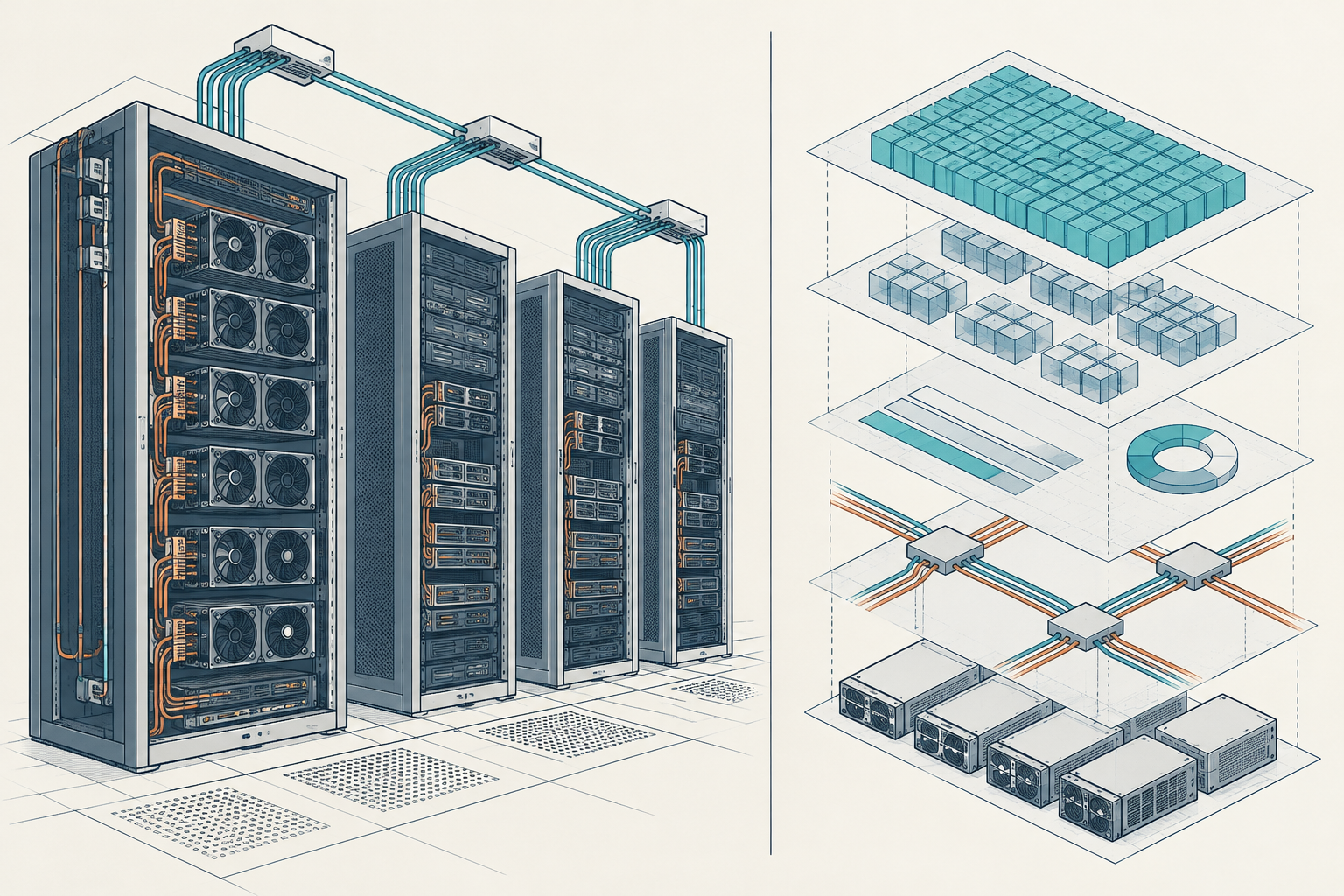
A 309B release changes the capacity question
NaiveAI’s September 27, 2026 release of Naive-N0.5-Flash, as described in the supplied release information, puts an MIT-licensed, open-weight mixture-of-experts model into the deployment discussion: 309 billion total parameters, 15.5 billion active parameters and a claimed native context window of one million tokens. For operators evaluating China-origin models, the significant distinction is between the parameters used for computation and the parameters that must remain available for serving.
The supplied model-card detail adds an important constraint: sparse attention retains the full KV cache. Sparse attention therefore must not be interpreted as a proportional reduction in resident context memory. A million-token window is a capability claim, not evidence that several million-token sessions will fit alongside the weights or meet an interactive latency target.
This analysis uses those release details as inputs, not as independently verified benchmark results. Operators should confirm the current model card, configuration, license and supported serving implementations before procurement. The practical question is whether one coding deployment deserves a substantial fraction of a quarter-rack-to-few-rack estate, rather than whether its active parameter count sounds economical.
Separate four budgets before selecting hardware
A feasibility plan needs four independent ledgers: total weight memory, KV-cache memory, runtime overhead and inter-GPU communication. Combining them into a single minimum-memory figure hides the failure modes that appear under production load.
Start with weights. At two bytes per parameter, 309 billion parameters require approximately 618 GB, or 576 GiB, before quantization metadata, alignment or runtime allocations. At one byte per parameter, the arithmetic becomes 309 GB, approximately 288 GiB. At an idealized four bits, it becomes 154.5 GB, approximately 144 GiB. These are payload estimates, not measured footprints or promises of supported formats.
| Budget component | First estimate | What must be measured |
|---|---|---|
| Weights | Total parameters × stored bytes | Loaded footprint and sharding balance |
| KV cache | Cached tokens × bytes per token | Architecture, cache precision and concurrency |
| Runtime | Backend-specific reserve | Peak prefill, graphs and workspaces |
| Communication | Parallelism-dependent traffic | Fabric throughput and tail latency |
The 15.5B active figure can indicate reduced computation relative to activating every parameter. It does not mean the deployment only needs space for 15.5B parameters. Experts must remain accessible, and offloading them creates a different system with host-memory, transfer-bandwidth and latency constraints. Treat offloading as a separate benchmark configuration, not free capacity.
Weight fit is only the first admission test
Consider an illustrative group of eight accelerators, each advertising 80 GB of device memory. Aggregate capacity is 640 GB. Against a 618 GB two-byte weight payload, that leaves only 22 GB across the group before anything else. This is not a credible production plan: shard imbalance, framework allocations, cache and temporary buffers can exceed the remaining space.
An independently validated one-byte representation would reduce the payload to 309 GB, leaving 331 GB before other allocations. That changes feasibility, but it does not establish performance or coding quality. Quantization format support, expert placement, kernel availability and numerical behavior all require testing on the selected hardware and backend.
Aggregate memory is also a misleading admission criterion when one rank exhausts memory first. Record the maximum per-device allocation, not merely its average. Embeddings, output layers, replicated components and expert placement can produce uneven footprints. A deployment should pass both the group-level capacity test and the most-constrained-device test.
For a small estate, this distinction affects purchasing and scheduling. Eight devices distributed across slow inter-node links are not interchangeable with eight devices connected through a suitable local fabric. Hardware-agnostic orchestration should preserve topology information rather than flatten every accelerator into an identical schedulable unit.
A million-token window needs a concurrency budget
KV-cache size depends on the actual architecture: attention layers, key/value dimensions, precision, replication and backend layout. Do not infer it from parameter count. For conventional KV layouts, a starting estimate is twice the layer count multiplied by KV heads, head dimension, bytes per element and cached tokens. Architecture-specific compression or alternative layouts require a different formula.
Because the supplied model-card detail says the full cache is retained, budget retained tokens independently of sparse attention’s compute savings. Confirm whether the runtime replicates any cache across parallel workers, how it allocates blocks and whether prefix sharing actually applies to the workload. Count generated tokens as well as prompt tokens.
A sensitivity example makes the risk visible. Suppose measurement establishes an aggregate cache cost of 128 KiB per retained token for a particular configuration. This is an illustrative assumption, not a Naive-N0.5-Flash specification. One million tokens would then occupy about 122 GiB. Two unrelated sessions would consume about 244 GiB before fragmentation or runtime workspaces.
Under that assumption, four 128,000-token sessions consume 62.5 GiB, while four million-token sessions consume roughly 488 GiB. The advertised context ceiling therefore says little about viable concurrency. Set separate limits for request length, aggregate retained tokens and simultaneous prefills. A request-count quota alone cannot distinguish four short conversations from four repository-sized prompts.
Runtime and fabric determine usable capacity
Measure runtime overhead after loading, during peak prefill and during sustained decoding. Temporary activations, attention workspaces, communication buffers, graph capture and allocator behavior can raise the peak above steady-state usage. A reserve chosen from an idle snapshot is not a reserve for production.
Mixture-of-experts execution also moves data. Depending on tensor, pipeline and expert parallelism, the serving stack may exchange activations between devices and nodes. Routing patterns, expert imbalance and collective performance affect utilization. Sparse computation does not eliminate this communication, and an accelerator waiting on a transfer is still reserved capacity.
Compare at least two placements where available: a topology-local group and a deployment spanning nodes. Keep model revision, precision, prompts and concurrency fixed. Measure time to first token, inter-token latency, completed tasks and fabric utilization together. High device utilization accompanied by unacceptable tail latency is not a successful deployment.
Loading is another operational bottleneck. Large artifacts require sustained storage throughput, local staging space and repeatable distribution. A Ceph-backed artifact store can provide a shared source, while local caches can reduce repeated startup transfers. Test cold starts during other storage activity; a maintenance restart should not unexpectedly saturate the same network used for model communication.
Benchmark the inference claim independently
Do not build the purchasing case around a vendor’s inference-speed comparison without its measurement conditions. The supplied brief does not include a complete throughput claim or benchmark protocol, so there is no defensible speedup number to repeat here. Retrieve the published conditions, then reproduce only comparisons that match useful operator workloads.
Pin the model revision, tokenizer, serving image, kernel versions, precision and parallelism configuration. Record whether results include tokenization, queueing and network time. Separate input-token processing from output-token generation: long-context prefill and interactive decoding stress different resources and should not disappear into a single tokens-per-second headline.
Use coding tasks with executable checks and representative repositories, including Chinese-language instructions where relevant to the intended users. Compare against smaller candidates under equal hardware budgets, not simply one instance of each model. Count accepted solutions, retries and operator intervention. Faster generation that produces more failed patches can be the more expensive service.
Run a matrix across prompt length, output allowance and concurrency, including realistic bursts. Include one long request arriving while short sessions are active. Report median and high-percentile time to first token, decode latency, failure rate and successful tasks per reserved GPU-hour. Million-token support earns production status only after the target workload passes those tests.
Put orchestration around the measured envelope
A system such as Clastiq Orchestrator addresses the estate-management problem around inference: bare-metal provisioning, Kubernetes and VM tenancy, GPU partitioning, Ceph storage, tenant metering, quotas and policy. It does not make unsupported kernels work or remove the model’s memory requirement. Its role is to turn tested deployment constraints into controlled resource allocation on the operator’s hardware.
Reserve the large model’s device group as a topology-aware allocation, with explicit placement and maintenance policies implemented through the selected scheduler and backend. Avoid partial starts that occupy some devices while waiting indefinitely for the rest. If a failed device cannot be replaced within the required topology, define whether the service queues, degrades to another model or becomes unavailable.
Use GPU partitioning where supported and validated for smaller workloads; do not assume this multi-device model benefits from slicing its accelerators. A partitioning decision should follow memory, isolation and bandwidth requirements. Large-model reservations and smaller tenant allocations need separate capacity pools when mixing them would make service guarantees unpredictable.
Expose request limits at the serving gateway as well as infrastructure quotas in the tenancy layer. The following is an illustrative policy record, not a Clastiq CLI or a supported serving configuration:
# Illustrative admission policy; map into your gateway and scheduler.
service: coding-large
placement: validated-topology-group
max_prompt_tokens: 128000
max_total_tokens_per_request: 136000
max_concurrent_prefills: 1
max_inflight_requests: 4
max_aggregate_cached_tokens: 544000
Those token limits are starting points for testing, not validated model settings. At the illustrative 128 KiB cache rate, 544,000 retained tokens require about 66.4 GiB in aggregate. Enforce output budgets so generation cannot exceed that envelope. Infrastructure tenancy provides allocation boundaries; the serving layer must enforce token-aware admission and release cache promptly after cancellation.
Charge for reservations, then compare useful work
Suppose an operator reserves eight GPUs for ten hours daily over 22 working days. The reservation consumes 1,760 GPU-hours: eight multiplied by ten multiplied by 22. At an illustrative internal rate of $2 per GPU-hour, the allocation costs $3,520. This is a planning rate, not a regional market quotation or a Cognition-AI price.
If the allocation is busy for 55% of that window, it delivers 968 busy GPU-hours. The effective reservation cost becomes about $3.64 per busy GPU-hour. Billing only those busy hours at $2 recovers $1,936 and leaves $1,584 of the reservation unrecovered. Either charge for reserved capacity, pool demand or explicitly fund the idle headroom.
Now compare useful tasks. If the large deployment completes 4,400 accepted coding tasks during the reservation, its allocation cost is $0.80 per accepted task. If smaller models sharing the same eight-GPU budget complete 7,040 accepted tasks, their cost is $0.50 each. These hypothetical outcomes illustrate the decision metric; they are not benchmark results.
The larger model may still win on tasks the smaller models cannot solve reliably. Route difficult work to it only when quality evidence justifies the premium. Meter reservation time, active service time, input and output tokens, retained-token duration where measurable, and accepted-task outcomes separately. Chargeback should explain whether a tenant paid for exclusive availability, consumption or a premium service guarantee.
China-origin weights do not determine sovereignty
For operators assessing a China-origin model, sovereignty is an operational property, not a conclusion drawn from the publisher’s location or an open-weight label. Verify the actual license files and dependencies. Review model loading code, container provenance, outbound connections, telemetry defaults and any tool-execution components before bringing proprietary code into the service.
For a disconnected deployment, mirror approved artifacts and dependencies into a controlled repository, retain checksums and test installation without external access. Define who can approve a new model revision and how to roll it back. Air-gap capability needs a working update procedure, not merely a firewall rule.
Clastiq Orchestrator’s air-gap deployments and human-led local support are relevant to that operating model, alongside tenant boundaries for Kubernetes and VMs. Cognition-AI is based in Muscat, Oman; that does not itself establish a particular regulatory outcome. Operators must decide where weights, prompts, repository data, caches and audit records reside, and who can administer each layer.
Power and availability complete the budget
Memory feasibility can still produce an unusable rack plan. Measure wall power for the whole serving group during load, prefill and decoding, including host and network overhead where possible. Confirm circuit and cooling headroom before scheduling coincident long-context prefills. Average accelerator power is not the same as worst-case rack demand.
Availability also consumes capacity. A replica of a multi-GPU deployment may be unaffordable in a quarter-rack estate. Document the resulting outage exposure and offer a smaller fallback service if appropriate. Store reproducible configurations and test restoration from local artifacts. The correct deployment might be a scheduled premium service rather than an always-on shared endpoint.
What to do this week
- Verify the release artifacts, license, architecture configuration and sparse-attention cache behavior; pin the exact model revision and serving image used for evaluation.
- Build separate weight, cache, runtime and fabric budgets. Measure the most-loaded device and reject placements that only fit in aggregate.
- Test long-context concurrency and cancellation under mixed coding traffic. Establish enforceable prompt, output, retained-token and prefill limits before onboarding tenants.
- Compare the large deployment with smaller-model pools using accepted coding tasks per reserved GPU-hour, including retries, idle headroom and latency failures.
- Rehearse cold start, node loss, disconnected installation and rollback. Confirm storage throughput, rack power and the smaller-model fallback before promising availability.
Clastiq Orchestrator runs this infrastructure on the operator’s own hardware: request a demo.