September’s disclosure changes the investor picture
The September 28, 2026 disclosure of Shorooq and Presight’s participation in Maven Robotics’ $100 million Series A adds a UAE investment connection to an industrial robotics financing already reported on September 10. It should not be presented as a newly announced $100 million round. Wamda’s later report concerns investor participation; TechCrunch’s September 10 coverage and Maven’s same-day announcement establish the earlier financing context.
That distinction matters for infrastructure planning. Investor participation is a company-level signal, not evidence of a GCC deployment, a local compute contract or a particular hardware requirement. TechCrunch provides earlier corroborating company coverage, but falls outside the later disclosure window. None of these references establishes how much GPU capacity Maven needs in the region.
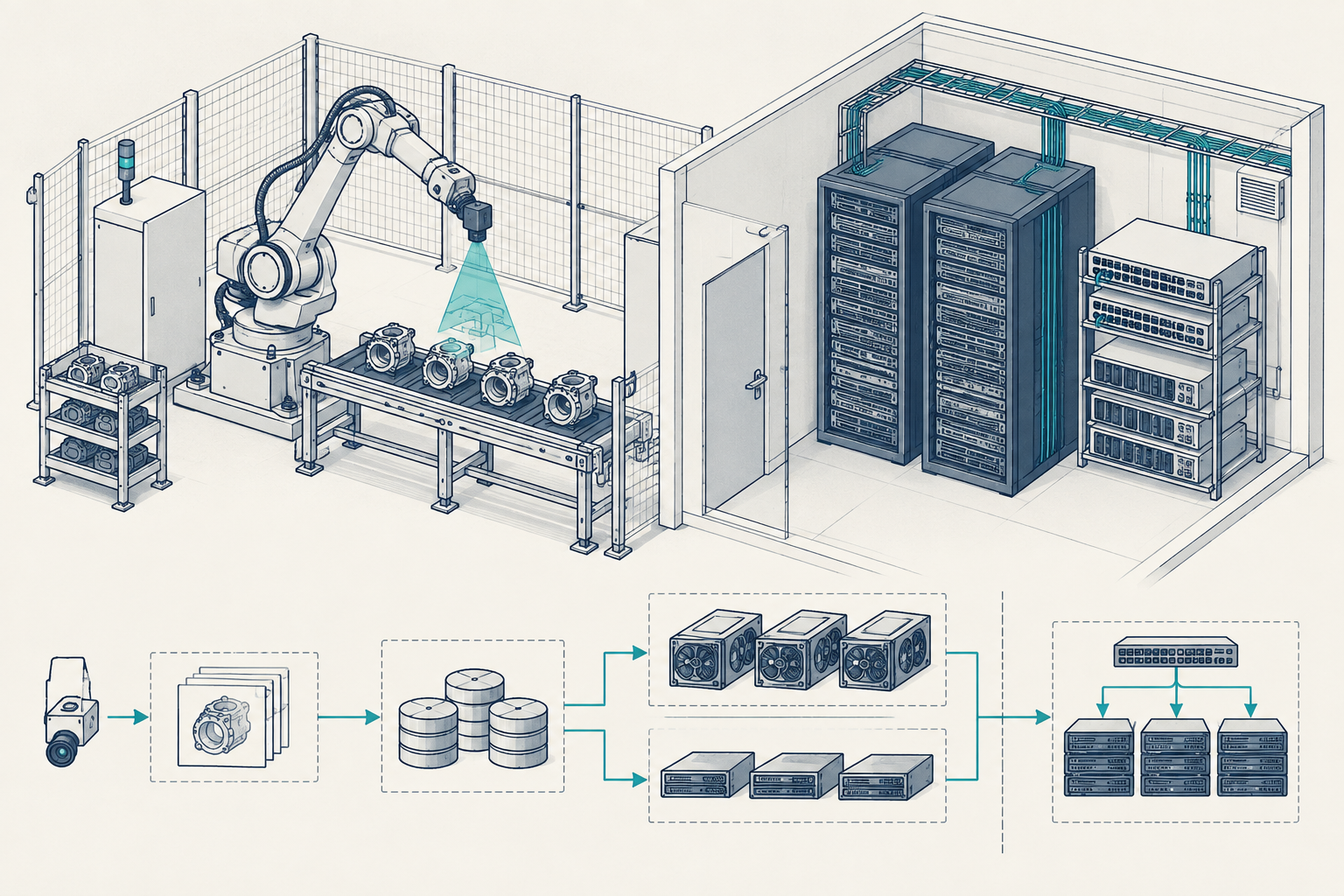
The useful operator question is narrower: what could an estate ranging from a quarter rack to a few racks provide to an industrial robotics development team? The answer is video ingestion, controlled dataset retention, simulation capacity, scheduled training and retraining, and development inference. Production robot control requires a separate latency and safety assessment; a regional GPU cluster is not automatically its execution environment.
The first bottleneck may be the data path
Robotics development creates several workloads with incompatible operating patterns. Cameras and sensors produce continuous writes. Dataset curation produces scans and metadata operations. Training repeatedly reads selected samples. Simulation generates bursts of compute and intermediate output. Inference needs predictable response times, often while everything else is active.
On a small estate, these jobs commonly converge on the same storage nodes, network links and GPU hosts. A training run can appear compute-bound while accelerators wait for decoded frames. An ingestion service can fall behind when checkpoint writes saturate its storage path. An inference service can miss its latency target even when average GPU utilisation looks acceptable.
The capacity plan therefore starts with data movement, not accelerator count. Record sustained ingestion bandwidth, peak training reads, checkpoint sizes, object counts, preprocessing CPU demand and the working set that must remain close to compute. Measure those together under contention. Separate benchmark results will not reveal whether a checkpoint flush interrupts ingestion or pushes inference beyond its service objective.
A platform such as Clastiq Orchestrator provides the management layer for this estate: bare-metal provisioning, Kubernetes and VM tenancy, GPU partitioning, Ceph storage, metering, quotas and policy engineering. These capabilities help operators impose boundaries. They do not remove physical bandwidth limits or turn shared hardware into guaranteed isolation without appropriate placement and testing.
Size retention before reserving accelerators
Consider an illustrative pilot with 24 cameras, each producing a compressed stream averaging 8 megabits per second. The aggregate input is 192 megabits per second, or 24 megabytes per second using decimal units. Continuous recording produces 2.0736 TB per day. Thirty days of retention requires 62.208 TB of logical capacity before derived datasets, indexes, checkpoints or backups.
With three-way replication, those raw recordings alone consume approximately 186.624 TB of physical storage. If the operator plans to keep 25% of installed capacity free, the corresponding installed-capacity requirement is about 248.832 TB: 186.624 divided by 0.75. This is an illustrative capacity calculation, not a recommended Ceph layout. Actual provisioning must also account for metadata, recovery space and other workloads.
The ingestion rate looks modest beside modern network capacity. The retention requirement does not. Nor does 24 MB/s describe training demand: multiple readers, repeated epochs and sample selection can drive much higher read traffic. Decompression and augmentation may exhaust CPU resources before the network reaches its limit.
| Data class | Example policy | Operational priority |
|---|---|---|
| Raw camera recordings | Thirty-day rolling window | Sustained writes and deletion discipline |
| Curated training sets | Versioned retention by project | Reproducible, parallel reads |
| Simulation output | Short retention unless promoted | Burst absorption and cleanup |
| Checkpoints and models | Retain approved recovery points | Reliable writes and traceability |
Make retention explicit per tenant and data class. A raw recording should not become permanent merely because somebody copied it into a training directory. Promotion into a retained dataset needs an owner, a version and an expiry or review date.
Engineer storage for concurrency and recovery
Ceph can provide shared storage for an estate with Kubernetes and VM tenants, but the design must reflect the workload. Large sequential objects behave differently from millions of individual frames. If a pipeline can read packed samples or indexed clips, it may reduce small-object overhead. Confirm the improvement with the actual loader rather than assuming that repackaging always helps.
Separate raw ingestion, curated data and model artifacts through appropriate pools, namespaces or buckets, with access controls and capacity accounting. Logical separation alone does not guarantee performance isolation when the same disks and links serve every pool. Placement, device classes and host-side caching may be necessary where contention is material.
Test the degraded state as well as the healthy state. Recovery after a storage-device failure competes for bandwidth and I/O. An estate that meets its ingestion target only when no recovery is running has not established a dependable service envelope. Include storage recovery in the acceptance test and reserve capacity for it.
Checkpoint behaviour deserves particular attention. Coordinate checkpoint intervals where possible, avoid synchronising every training job, and measure write completion rather than application-side buffering. Local scratch can absorb temporary output, but a checkpoint is not durable merely because it exists on a training host. Declare when it becomes a recoverable artifact.
Separate training from latency-sensitive inference
Divide the GPU estate into service classes before admitting tenants. One class can host interruptible simulation or experiments. Another can run scheduled training with checkpoint-aware interruption rules. A third can provide inference with a defined response-time target and reserved resources. These are operating commitments, not just namespace names.
For latency-sensitive workloads, use dedicated devices or supported hardware partitions where their isolation properties satisfy the application. GPU partitioning depends on the accelerator and driver stack; not every device supports equivalent partition sizes or memory isolation. Time-sharing can improve utilisation for tolerant jobs, but it should not be treated as a substitute for reserved capacity.
Device isolation is only part of the boundary. Reserve sufficient CPU, memory and network capacity for inference, and avoid uncontrolled preprocessing on its hosts. Where shared resources still cause unacceptable interference, use separate nodes. Test latency during training startup, dataset loading and checkpoint writes, not only during steady-state inference.
Kubernetes tenancy can support containerised development services, while VM tenancy can accommodate teams needing distinct operating environments or legacy tooling. Neither boundary automatically establishes the complete security or timing properties of a robotics deployment. Keep safety-critical control loops at an execution location approved by the robotics and safety teams; use the GPU estate for tasks whose latency and failure modes it can support.
Make quotas enforce the operating model
For each tenant, define an entitlement covering accelerator access, storage capacity, ingestion rate, job concurrency and retention. A monthly GPU-hour budget is useful for finance, but it does not prevent six teams from requesting the same devices at 09:00. Combine accumulated consumption limits with instantaneous resource limits and an admission policy.
For a Kubernetes deployment whose device plugin exposes nvidia.com/gpu, this standard quota illustrates a whole-device request ceiling:
apiVersion: v1
kind: ResourceQuota
metadata:
  name: robotics-training-limit
  namespace: robotics-dev
spec:
  hard:
    requests.nvidia.com/gpu: "4"
The resource name is vendor-specific; use the resources actually advertised by the installed device plugin for other hardware or partition types. This is Kubernetes configuration, not a Clastiq-specific API. It limits requested resources within one namespace. It does not establish scheduling windows, protect inference on its own, or enforce a monthly financial budget.
Use node placement rules and workload admission controls alongside quotas. Training jobs should declare resource requirements, expected duration, checkpoint behaviour and dataset identity. Operators need an explicit response when capacity is unavailable: queue, reject, offer another window or approve additional allocation. Silent overcommitment creates unpredictable service and disputed bills.
Clastiq Orchestrator’s quota and policy engineering should be used to implement this operating model across the supported estate. Verify the exact enforcement mechanism during deployment rather than assuming that every accounting limit is also a scheduler control.
Work the GPU-hour economics honestly
Take an illustrative estate with eight GPUs and a 30-day billing month. Its theoretical inventory is 8 × 24 × 30 = 5,760 GPU-hours. Reserve two devices for inference, leaving six for scheduled training and simulation. The batch pool therefore contains 4,320 GPU-hours before maintenance and other exclusions.
Suppose batch tenants receive 3,024 allocated GPU-hours during the month. Allocation utilisation is 3,024 ÷ 4,320 = 70%. At an illustrative chargeback rate of OMR 0.900 per allocated GPU-hour, batch charges total OMR 2,721.600. This is a billing example, not a market price or a forecast for Cognition-AI.
Assume the batch pool’s monthly attributable cost is OMR 2,400, including its assigned shares of equipment depreciation, electricity, cooling, support and common infrastructure. Its cost per billed GPU-hour is OMR 2,400 ÷ 3,024, approximately OMR 0.794. The difference between those charges and attributed cost is OMR 321.600. Storage or other costs excluded from that allocation must be charged separately or deducted before calling it a margin.
At 50% allocation utilisation, the same pool bills only 2,160 GPU-hours. Charges at the same rate fall to OMR 1,944, leaving a OMR 456 shortfall against the assumed cost. This is why storage stalls, failed jobs and admission decisions have financial consequences even when the devices were purchased outright.
Meter allocation separately from useful execution. A tenant can hold four devices while its input pipeline stalls. Record accelerator activity and job outcomes alongside allocated hours so operators can identify that waste. Define whether failures and retries are billable, and price inference reservations as availability commitments rather than pretending idle reserved devices are freely sellable capacity.
Power and maintenance constrain the timetable
A quarter-rack deployment can run out of its approved power envelope before it runs out of rack units. Calculate the estate’s servers, storage and networking together, then check the facility’s usable power allocation and cooling capability. Nameplate ratings, measured average draw and observed peak draw answer different questions; retain all three where available.
For illustration, an estate averaging 12 kW of IT load consumes 8,640 kWh in a 30-day month. Applying an assumed facility overhead factor of 1.4 gives 12,096 kWh of facility energy. At an illustrative tariff of OMR 0.030 per kWh, that is OMR 362.880. Replace both assumptions with site figures; neither is a claim about GCC tariffs or facility efficiency.
Schedule retraining around the actual site envelope, maintenance windows and staffing. Bare-metal provisioning helps operators rebuild and reassign hosts consistently, but firmware, drivers and storage changes still require controlled rollout. Keep inference capacity available while validating replacement images on another node. A shared cluster does not justify changing every host simultaneously.
GCC sovereignty is an operational boundary
For GCC industrial operators, recordings can expose production methods, facility layouts, personnel and commercially sensitive activity. Hosting in-country may be required by a contract or internal policy, but geography alone does not settle sovereignty. Dataset copies, model artifacts, support logs, telemetry and backup destinations all need a documented boundary.
Specify who can access each class of data, where encryption keys are controlled, how privileged access is approved and how deletion is evidenced. A development tenant should not gain unrestricted access to every factory camera stream simply because it shares the same cluster. Dataset permissions must follow the underlying contractual and privacy obligations.
Air-gapped operation adds another set of requirements: local image and package repositories, approved artifact transfer, offline dependency availability and a workable update process. Test provisioning, job startup and recovery without external connectivity. Document which support diagnostics may leave the environment and require approval before export.
Cognition-AI is based in Muscat, Oman, and Clastiq Orchestrator includes air-gap deployments and human-led local support in its scope. Those capabilities are relevant to the region, but they are not evidence of a particular certification or legal compliance outcome. Operators must still establish jurisdiction, contractual controls and escalation responsibilities for their own deployment.
What to do this week
- Measure one complete data path. Capture camera bitrate, daily retained volume, preprocessing demand, training read throughput and checkpoint completion time. Repeat with simultaneous ingestion and storage recovery.
- Write three service classes. Define inference reservations, scheduled training windows and interruptible experiments. Assign devices or supported partitions, host resources and placement rules to each.
- Publish a retention budget. Calculate logical and physical capacity separately. Name an owner for every dataset and set promotion, expiry and deletion rules before expanding recording coverage.
- Run a contention acceptance test. Start training and checkpoint writes while measuring inference tail latency. Set pass/fail thresholds with the application team and preserve the results with the configuration.
- Reconcile a trial chargeback ledger. Compare allocated GPU-hours, useful activity, storage consumption and attributable costs. Confirm the data boundary and support-access procedure before admitting external tenants.
Clastiq Orchestrator runs this operating model on the operator’s own hardware; request a demo.