A funding announcement, not a GPU purchase order
Wamda reported on October 14, 2026, that UAE startup JustAd had attracted $5 million to expand into new markets. The report falls within the October 9–18 monitoring window. What changed is the startup’s reported access to expansion capital; the announcement does not establish a corresponding increase in GPU consumption.
For GCC infrastructure operators, this is a low-weight demand signal: weight 1 in the scan. JustAd’s actual hosting architecture and GPU requirements were not disclosed. There is no basis for assigning it a cluster size, assuming it trains models, or treating the funding amount as an infrastructure budget.
The useful response is an applied design exercise. If a regional marketing platform needed shared campaign-analysis capacity, what could an operator deliver from a quarter rack without sacrificing isolation, responsiveness or margin? The answer starts with workload evidence and a capacity worksheet, not an accelerator order.
The bottleneck is conflicting service expectations
Campaign analysis can mix very different jobs. A scheduled process might aggregate campaign results, generate embeddings or classify creative assets. An interactive request might ask for a summary while a customer reviews performance. These are hypothetical workload classes, not claims about JustAd’s product implementation.
Some tasks need only CPUs, memory and efficient database queries. Others may use an external model API. Local GPUs become relevant only when measured latency, volume, data-control requirements or model economics justify them. Establish that distinction before pricing a GPU service.
Where GPUs are justified, the first bottleneck in a small estate is often contention rather than aggregate compute. A long batch job occupies accelerator memory just as interactive demand arrives. Storage scans saturate the network. A tenant retries failed requests aggressively and consumes the headroom another customer expected.
Adding hardware can postpone this conflict without resolving it. The operator needs separate service classes, explicit admission rules and tenant-level accounting. A platform such as Clastiq Orchestrator provides the infrastructure foundation through bare-metal provisioning, Kubernetes and VM tenancy, GPU partitioning, storage, metering and quota engineering. The application still needs its own queue discipline and latency instrumentation.
Define two service lanes before choosing hardware
Start with an interactive lane that has reserved capacity and bounded concurrency. Its service objective should describe a measurable response-time percentile, the permitted request size and the conditions under which requests are rejected or queued. Average latency hides the noisy-neighbour incidents customers remember.
Put scheduled analysis in a batch lane with submission deadlines, maximum runtime and retry limits. State whether a job can be interrupted and resumed. A process that cannot checkpoint should not borrow capacity that must be reclaimed instantly for interactive traffic.
| Service lane | Capacity rule | Tenant control | Commercial basis |
|---|---|---|---|
| Interactive | Protected allocation with tested headroom | Concurrency and request-size limits | Reservation plus measured usage |
| Scheduled batch | Admitted against deadline and available capacity | Runtime, queue and retry limits | Allocation time or committed window |
| Development | Best-effort access only | Small quota and automatic expiry | Explicit sandbox allowance |
Borrowing between lanes is optional, not a default promise. Measure model-loading time, memory reclamation and scheduler behaviour first. For a quarter-rack installation, predictability can be worth more than a higher headline utilisation figure.
Make tenant isolation a complete boundary
A tenant identifier must follow the workload from API authentication through queue submission, runtime allocation, storage access and billing. If the identifier disappears at any boundary, the operator can neither prove isolation nor reconcile charges reliably.
Kubernetes namespaces alone are not a complete security boundary. Combine them with role-based access, network policy, service-account restrictions and limits on privileged execution. Where the risk assessment requires stronger separation, use VM tenancy or dedicated hosts. Confirm how device access and isolation work on the selected hardware and software stack.
GPU partitioning can help fit small inference services onto shared equipment, but not every accelerator supports the same partition sizes or isolation properties. Software sharing is not interchangeable with hardware-enforced separation. Partition memory, compute entitlement and reset behaviour must match the service contract.
Clastiq Orchestrator’s hardware-agnostic role is to manage these tenancy and partitioning choices on the operator’s equipment. Hardware-agnostic does not mean capability-identical: unsupported isolation mechanisms cannot be created by orchestration. Record the supported configurations, then deny placements that do not satisfy a tenant’s policy.
Build the capacity worksheet from sellable hours
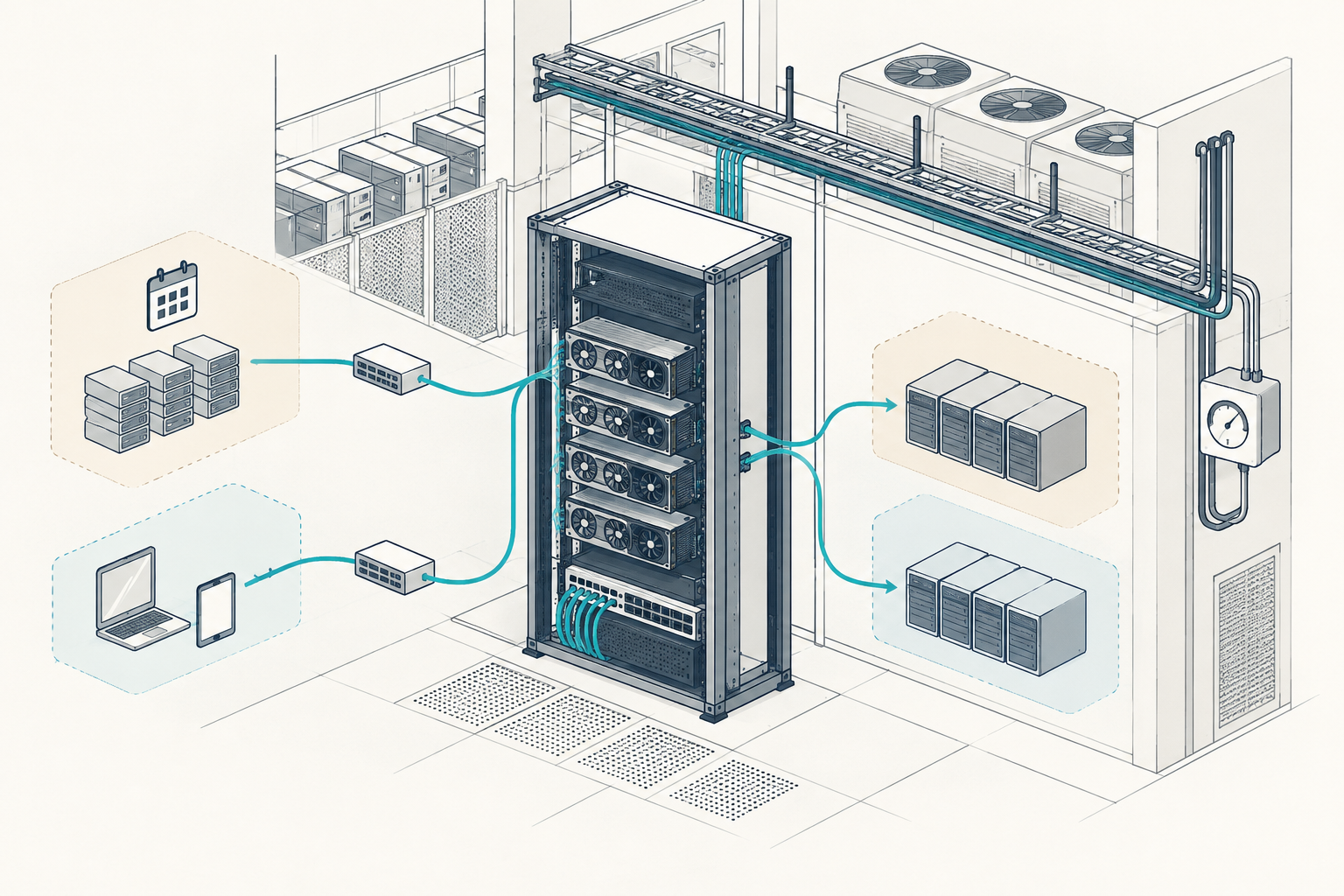
Consider an illustrative quarter-rack service with four physical GPUs across two compute hosts, alongside the required storage and networking. This is a planning model, not a reference bill of materials. Rack fit, cooling, power and failure tolerance must be validated separately.
Use a 30-day month: four GPUs multiplied by 720 hours gives 2,880 physical GPU-hours. Protect one GPU-equivalent continuously for interactive work, leaving three GPU-equivalents, or 2,160 hours, for batch scheduling. Here, an equivalent is an accounting unit for a full device-hour, not a performance guarantee across accelerator models.
Assume interactive tenants consume 432 allocated hours during the month. That is 60% of the protected lane’s 720 hours. Assume batch tenants consume 1,296 hours, also 60% of their lane’s allocation. Total allocated consumption is 1,728 GPU-hours, or 60% of installed capacity.
This does not mean accelerator execution units were busy 60% of the time. An allocated job may wait for data or leave memory underused. Track allocation occupancy separately from device activity, memory pressure and completed work. Otherwise, an inefficient pipeline can look like strong demand.
The unused 1,152 hours are not automatically saleable. Some protect latency, absorb maintenance or exist in fragments too short for queued jobs. Keep theoretical capacity, admitted capacity and billable consumption as separate worksheet columns.
Calculate break-even without borrowing optimism
Assume monthly costs of $2,400 for hardware amortisation, $900 for power and cooling, $500 for space and connectivity, $400 for storage and software, and $800 for operations and support. The total is $5,000. These are illustrative inputs, not Oman or UAE market quotations.
The power allowance assumes an average IT draw of 8 kW, a facility energy multiplier of 1.25 and an electricity rate of $0.125 per kWh. The arithmetic is 8 × 720 × 1.25 × $0.125 = $900. Replace all three assumptions with site measurements and tariff terms, including any demand charges.
At 1,728 billable GPU-hours, fully allocated cost is $5,000 ÷ 1,728 = approximately $2.89 per GPU-hour. At an illustrative realised selling price of $3.50, revenue is $6,048 and the monthly operating surplus is $1,048 before taxes, financing and costs excluded from the worksheet.
At that price and cost base, break-even requires 1,429 billable hours after rounding up: approximately 49.6% of installed monthly capacity. At only 40% occupancy, revenue would be 1,152 × $3.50 = $4,032, leaving a $968 shortfall under the same cost assumption.
This sensitivity matters more than the funding headline. Require evidence that customers will buy sufficient hours at the proposed price. A reservation fee can cover protected interactive capacity, but do not count both that fee and the same bundled hours as separate revenue. Keep the simple usage-only model until actual contracts justify changing it.
Meter entitlement, then reconcile useful work
For shared devices, billing needs a defined unit. Suppose a supported partition receives one-quarter of a physical GPU’s accounting entitlement for eight hours. It consumes two equivalent GPU-hours: 0.25 × 8. This is a chargeback convention, not proof that it delivers exactly one-quarter of every workload’s performance.
Different GPU classes should have separate rate cards unless tests establish a defensible normalisation. Partition profiles may also need different rates because compute, memory capacity and bandwidth do not necessarily divide in the same proportions.
Record tenant, job, device class, partition profile, allocation start, release time and termination reason. Specify whether model loading, retries and idle reservations are billable. Failed jobs need a policy distinguishing tenant errors from operator faults.
A small worksheet check can prevent unit mistakes:
physical_gpus = 4
hours = 30 * 24
billable_hours = 432 + 1296
monthly_cost = 5000
rate = 3.50
print(f"Occupancy: {billable_hours / (physical_gpus * hours):.1%}")
print(f"Cost/GPU-hour: ${monthly_cost / billable_hours:.2f}")
print(f"Revenue: ${billable_hours * rate:,.0f}")
Clastiq Orchestrator’s per-tenant metering and chargeback belong at the infrastructure layer. Reconcile those records with application request counts and batch completion logs. Neither layer alone explains why an invoice rose while customer-visible output stayed flat.
Quotas must control bursts as well as totals
A monthly GPU-hour allowance does not prevent a tenant from occupying every available device on Monday morning. Set concurrent allocation limits, queue-depth limits and per-lane admission rules alongside monthly budgets. Keep development quotas separate from production entitlements.
For interactive work, bound input size and generated output where applicable. For batch work, require an estimated resource request and a maximum execution window. Reject oversized jobs or route them to a separately priced service rather than allowing silent starvation of smaller jobs.
Use notifications before hard budget stops, but define what happens at exhaustion. Interactive requests might move to a lower service tier; batch submissions might pause. These are commercial decisions implemented through policy, not settings an administrator should invent during an incident.
Quota engineering also needs an exception trail. Record who authorised a temporary increase, its expiry and its billing treatment. Human-led local support is useful here, but human intervention must remain auditable rather than becoming an undocumented scheduler bypass.
Storage and power set the real rack boundary
Campaign-analysis pipelines may move more data than their GPU usage suggests. Raw assets, intermediate embeddings, model files and result exports compete for storage bandwidth. Put retention limits and storage quotas into the tenant definition rather than discovering uncontrolled growth on the shared pool.
Ceph can provide shared storage within the platform design, but resilience costs capacity and resources. With three-way replication, 30 TB of raw capacity yields roughly 10 TB before operational headroom and other overheads. Failure domains must be real: multiple storage processes on one host do not survive that host’s loss independently.
Test recovery traffic while inference and batch jobs run. A small cluster that performs adequately in steady state may miss latency objectives during backfill. Where feasible, separate traffic paths or reserve bandwidth for latency-sensitive services. Maintain tested backups; replication is not a backup policy.
Likewise, the worksheet’s average 8 kW draw does not establish the required electrical circuit capacity. Validate peak server consumption, cooling delivery, rack distribution and site derating rules. A quarter rack is a physical footprint, not a standard power envelope. Admission policy should respect the usable facility budget as well as available accelerator slots.
GCC sovereignty means tracing every data path
For a UAE marketing platform or an Oman-based operator serving GCC customers, local hosting may support procurement and data-control requirements. It does not, by itself, establish compliance. Campaign data can contain personal information, and applicable obligations depend on jurisdiction, sector, contracts and processing activity.
Map where source data, prompts, outputs, backups and operational logs reside. Check whether model downloads, telemetry, support access or external APIs move information across borders. A locally hosted inference endpoint can still depend on services outside the agreed boundary.
Air-gap deployment is a separate operating mode, not simply a firewall rule. It requires controlled imports of images, models and updates, plus vulnerability handling and a support procedure that works without unrestricted remote access. Plan the staff time and storage required to maintain those artefacts.
Clastiq Orchestrator includes air-gap deployment and human-led local support within its scope. Cognition-AI is based in Muscat, Oman. Those facts inform an operating discussion; they are not claims of regulatory certification or proof that a particular customer architecture satisfies legal requirements.
Validate demand before expanding the estate
Run a constrained pilot with representative datasets and explicit tenant consent. Measure end-to-end completion time, interactive tail latency, GPU memory demand, storage throughput and allocation occupancy. Include simultaneous tenants and a host failure rather than testing only an isolated successful request.
Expansion gates should combine commercial and technical evidence. Signed reservations or repeat paid usage establish demand more credibly than enquiries. Sustained queue delay, after fixing inefficient data movement and scheduling, establishes a capacity constraint more credibly than a busy dashboard.
A two-host compute design also cannot assume full service after losing either host. Document which tenants retain service, which jobs pause and whether the protected interactive allocation can restart elsewhere. Price the required spare capacity before promising availability.
What to do this week
- Classify the funding report as a weight-1 lead. Record the unknowns and seek workload evidence without assuming JustAd needs GPUs.
- Define interactive and batch contracts, including concurrency, deadlines, interruption rules, isolation and failure behaviour.
- Build the four-GPU worksheet with local costs; test 40%, 50% and 60% billable occupancy and reconcile reservation revenue separately.
- Pilot tenant metering against application logs. Check partition accounting, retries, release timestamps and invoice adjustments.
- Test storage recovery, host loss and peak power; document GCC data paths, retention and support access before accepting production data.
Clastiq Orchestrator runs this infrastructure on the operator’s own hardware: request a demo.