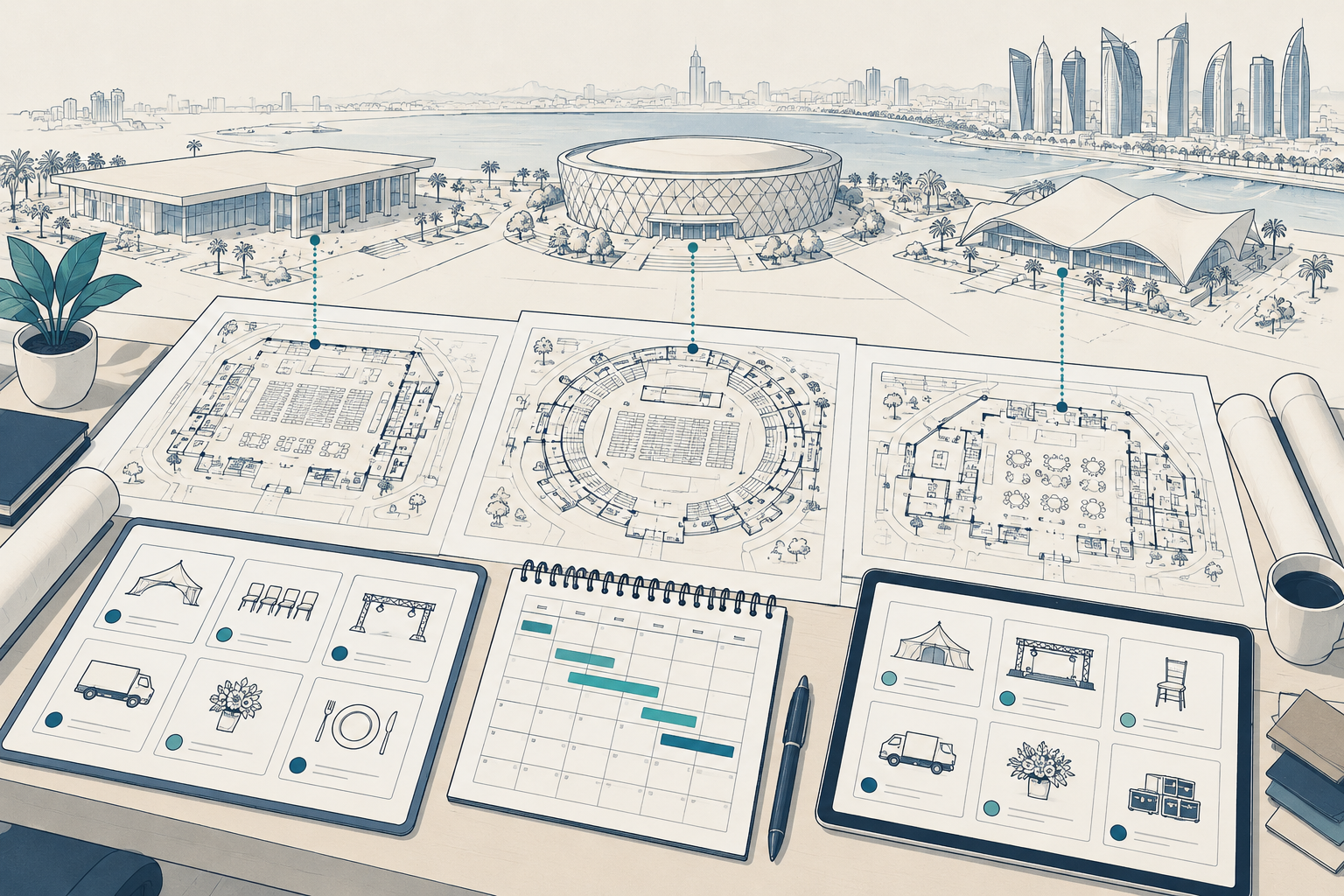
Funding expands the coordination problem
On October 22, 2026, Wamda reported that INVE raised $300,000 from Outliers VC to expand its eventtech platform across the GCC. The reported funding establishes a regional expansion agenda. It does not establish how INVE manages its internal operations, which tools it uses, or whether it faces any particular delivery problem.
For operators pursuing similar expansion, however, the operational question is concrete: how do several events, suppliers and internal teams remain coordinated when responsibilities cross company boundaries? A spreadsheet can describe each event adequately while leaving the portfolio poorly controlled. Local plans may look complete even when they depend on the same unavailable person or an unresolved supplier decision.
This is a practical application for DPO, the project and portfolio management product in Cognition-AI’s rFactorial group. Its verified capabilities include configurable flows, forms, tasks and a shared management view across companies and teams. The workflow below applies those capabilities to event operations; it does not imply that INVE uses DPO.
Control commitments, not every conversation
An expanding event portfolio needs a shared record of commitments: what must happen, who owns it, when it is due, what evidence establishes completion and which unresolved decision could prevent delivery. That record should connect local execution to portfolio decisions without requiring management to read every supplier exchange.
Consider a venue change. The event team may update its schedule while procurement continues against the original specification and the commercial team quotes the earlier capacity. The problem is not simply missing information. It is that one decision changes several commitments without a clear process for accepting those changes.
A shared operational model should therefore separate three objects: the event, its delivery tasks and decisions that alter scope, timing or resources. These are proposed management conventions, not claims about a particular DPO data structure. Operators should validate how to represent them during configuration rather than assume a ready-made event industry template.
The objective is bounded consistency. Everyone needs the same meaning for ownership and status, but not an identical production checklist. A conference, exhibition and private event can share reporting rules while retaining different delivery steps. Overstandardisation merely moves useful work into unofficial documents.
Start with a bounded portfolio
Begin with two or three events that share a management sponsor and at least one operational dependency. Include a cross-company handoff if that reflects normal delivery. Do not start by migrating years of archived plans or every document associated with the business.
Name a portfolio owner who can resolve priority conflicts. Each event also needs an accountable lead, while each task needs one internal owner. A supplier can perform the work, but an internal person should remain responsible for accepting the result and escalating problems. Shared responsibility without a named decision-maker is difficult to manage.
For GCC portfolios, explicitly record the delivery country, venue location, local deadline and responsible operating entity. Working weeks, public holidays, venue procedures and local requirements can vary. Validate these locally rather than encode a single regional assumption. Where teams span time zones, include the time zone in critical deadlines, even when most participants usually share one.
Build intake around decisions
Use a configurable intake form to establish whether a proposed event is sufficiently defined to enter planning. Minimum information should include an event identifier, accountable lead, operating entity, country, venue status, target dates, delivery scope, internal teams involved and known supplier dependencies. Add the requested decision and the person authorised to make it.
Distinguish confirmed information from assumptions. A requested venue date is not a reservation; an indicative supplier quote is not an approved commitment. If intake silently converts uncertainty into certainty, later status reporting becomes misleading. Require the event lead to identify the assumptions that could change cost, timing or feasibility.
Avoid turning intake into a comprehensive production manual. Require only information needed for the next decision, then collect detail as the event progresses. An incomplete submission can remain in intake with a named owner and a deadline for clarification. It should not appear alongside approved work as if delivery had already been authorised.
Use forms to capture material change requests too. Record the old commitment, proposed change, affected tasks, decision owner and decision date. This creates a reviewable account of changes without claiming that the software automatically identifies every downstream impact. The event lead still needs to assess what else must change.
Make task ownership testable
A task should describe an observable result, not an activity category. “Supplier coordination” is difficult to close consistently. “Obtain and review the revised staging specification” identifies a deliverable. Pair it with an owner, due date, reviewer where necessary, and acceptance evidence appropriate to the work.
During the pilot, use a compact task convention such as this illustrative YAML record. It is a planning example, not a DPO API schema or import command:
portfolio: gcc-events-pilot
event_id: EVT-014
task: Review revised staging specification
owner: production_lead
reviewer: event_lead
due: "2026-11-12T15:00:00+04:00"
status: ready
acceptance: Specification checked against approved scope
blocked_by: none
The value is the discipline behind the fields. One owner maintains the commitment; one reviewer decides whether the result meets the agreed standard. If several people contribute, split the work where handoffs matter rather than assign an indistinct group responsibility. For a blocked task, name the person who can remove the obstacle, not merely the person waiting.
Configure the selected DPO flows, forms and tasks around that convention where supported. Test the actual setup with users before rollout. Do not assume automatic reminders, dependency scheduling, supplier portals or connections to other systems; those capabilities are not established by the supplied product context.
Agree on status before building reports
Status definitions should describe evidence, not confidence. Teams often use “in progress” to mean anything from accepted work to a task that has been untouched for weeks. A portfolio view cannot correct that ambiguity. Agree on entry and exit rules before managers start comparing events.
| Status | Meaning | Required next step |
|---|---|---|
| Intake | Request is not yet authorised | Resolve missing information or decide |
| Ready | Owner and scope are accepted | Start by the agreed date |
| Active | Work has started | Maintain the next commitment |
| Blocked | An obstacle prevents progress | Name resolver and decision deadline |
| Review | Deliverable awaits acceptance | Reviewer accepts or returns it |
| Complete | Acceptance criteria are met | Record completion evidence |
Allow rejection, cancellation or deferral as explicit outcomes in the agreed process rather than disguising them as completion. The exact configuration needs validation, but the reporting principle is straightforward: abandoned work must not inflate delivery throughput.
Separate task status from event health. An event can have many completed tasks and still be at risk because one venue decision remains unresolved. Event health should reflect critical commitments, remaining time and unresolved dependencies. If a team uses red, amber and green labels, write down what each means and who can change it.
Review exceptions across the portfolio
Use DPO’s shared management view across companies and teams to support a weekly portfolio review. The meeting should resolve exceptions, not reproduce every event’s task list. Each event lead should arrive with current commitments and a short list of decisions that require authority beyond the delivery team.
Review four questions: which near-term milestones are threatened; which blocked tasks have exceeded their decision deadlines; where multiple events need the same people or supplier capacity; and which scope changes need approval. Maintain a decision record with an owner and due date, then reflect approved changes in the affected work.
Cross-company visibility needs governance. Before exposing operational records, decide which participants need which information and validate the product configuration against those requirements. Supplier pricing, commercial negotiations and personal information should not become broadly visible merely because a portfolio is shared. If the required separation cannot be demonstrated, narrow the pilot and exclude sensitive content.
Set review cadence according to delivery risk. A weekly portfolio meeting may be sufficient early in planning, while imminent events may need brief daily exception checks. Avoid making every team attend every discussion. Escalation should bring the right decision-makers together, not convert portfolio control into another reporting burden.
An illustrative coordination workload
Consider a hypothetical operator managing six events through four weekly review cycles. Each event has 40 active tasks, creating a portfolio of 240 tasks. These figures are illustrative planning assumptions, not DPO benchmarks or claims about INVE. The calculation measures recurring coordination work, not production productivity.
In the baseline process, each event coordinator spends 90 minutes per week collecting updates and reconciling separate files. Across six events, that is nine hours. A portfolio manager spends another three hours assembling the management summary. Total weekly preparation is therefore 12 hours, or 48 hours across four cycles.
Suppose the pilot reduces each coordinator’s preparation to 45 minutes and management consolidation to 90 minutes. Weekly preparation becomes 4.5 plus 1.5 hours: six hours. That is a gross reduction of six hours per week, or 24 hours across four cycles.
Now account for maintaining the shared record. If 60 tasks change status each week and each update takes one additional minute, the new process adds one hour weekly. Net recurring time saved is five hours per week, or 20 hours across four cycles. Assuming 16 hours of initial configuration and training, the first four cycles yield four hours of net time benefit after setup.
That modest result is useful because it exposes the assumptions. If record maintenance takes three minutes per changed task, recurring savings fall to three hours weekly, and setup is not recovered within four cycles. Measure actual effort before expanding. Reduced coordination time also does not prove fewer late deliveries; that requires a separate outcome measure.
Measure reliability alongside reporting effort
Track median blocked-task age, overdue critical commitments, review turnaround and accepted deliverables by their agreed dates. Establish a baseline using the same definitions that will apply during the pilot. Otherwise, a change in labels can look like a change in performance.
Define on-time acceptance as deliverables accepted by the agreed due date divided by deliverables due in the period. Preserve visibility of changed deadlines in the management process: repeatedly moving a due date should not create apparent reliability. Report approved rescheduling separately so management can distinguish planned changes from missed commitments.
Balance speed with quality. A lower review backlog is not a benefit if reviewers accept incomplete work. Sample completed tasks for evidence and check whether they later reopen. Also measure participation: if updates only happen immediately before the meeting, the shared view may be a presentation layer rather than a working operational record.
Roll out without creating another shadow system
Run the pilot for four weekly cycles. In the first cycle, concentrate on intake completeness and ownership. In the second, test status definitions against real exceptions. In the third, examine cross-event resource conflicts. In the fourth, compare coordination effort and delivery indicators with the baseline, then decide whether to expand or revise the model.
The principal trade-off is between local flexibility and portfolio comparability. Let teams maintain specialised working material, but agree which system holds the authoritative owner, deadline, status and acceptance decision. If those fields remain editable in several places without a reconciliation rule, the organisation has added another source of disagreement.
A second trade-off concerns administrative load. Start with fewer mandatory fields and add a field only when it supports a recurring decision or control. Managers should retire reports made redundant by the shared view. Otherwise, operational staff pay for both the old process and the new one.
Cognition-AI, based in Muscat, Oman, owns the rFactorial product group. DPO is the relevant product here because the problem is portfolio coordination, not infrastructure capacity or voice automation. Its verified scope provides a basis for testing the proposed operating model; the pilot must establish whether the configured workflow meets the operator’s needs.
What to do this week
- Select two or three GCC events for a DPO pilot, name the portfolio sponsor and event leads, and identify one shared operational dependency.
- Draft an intake form covering operating entity, country, dates, assumptions and the next approval decision. Test it against one incomplete request.
- Write ownership, acceptance and status rules. Apply them to 20 existing tasks and resolve disagreements before configuring the wider portfolio.
- Validate shared-view requirements with participating teams, including what must remain restricted. Keep sensitive information outside the pilot until the proposed setup is checked.
- Establish a four-cycle baseline and review plan covering coordination time, blocked-task age and on-time acceptance. Schedule the first exception-focused portfolio meeting and retire one duplicate report where feasible.
Review DPO’s product destination when planning the configuration discussion. For questions about the rFactorial group, contact info@cognitionai.cloud.