A translation release becomes a deployment decision
Bilibili’s Index-Translate release sequence adds more than another model download to the local inference queue. The supplied release chronology dates the model launch to September 30, 2026, official GGUF and FP8 builds to October 3, and NVFP4 builds to October 4. The primary repository lists 2B, 9B and 35B-A3B preview text models. For operators, those choices create a checkpoint, precision and runtime selection problem before any translation endpoint reaches production.
The release guidance also distinguishes Blackwell NVFP4 serving from deployment recommendations for Hopper and Ampere. That distinction matters: a downloadable weight format is not proof that an installed GPU, driver and serving engine can execute it efficiently. Treat these release details as the starting inventory, then verify the repository’s current model cards, artifact revisions, licensing and runtime instructions before scheduling capacity. The operational recommendations below are a proposed evaluation plan, not reported Index-Translate benchmark results.
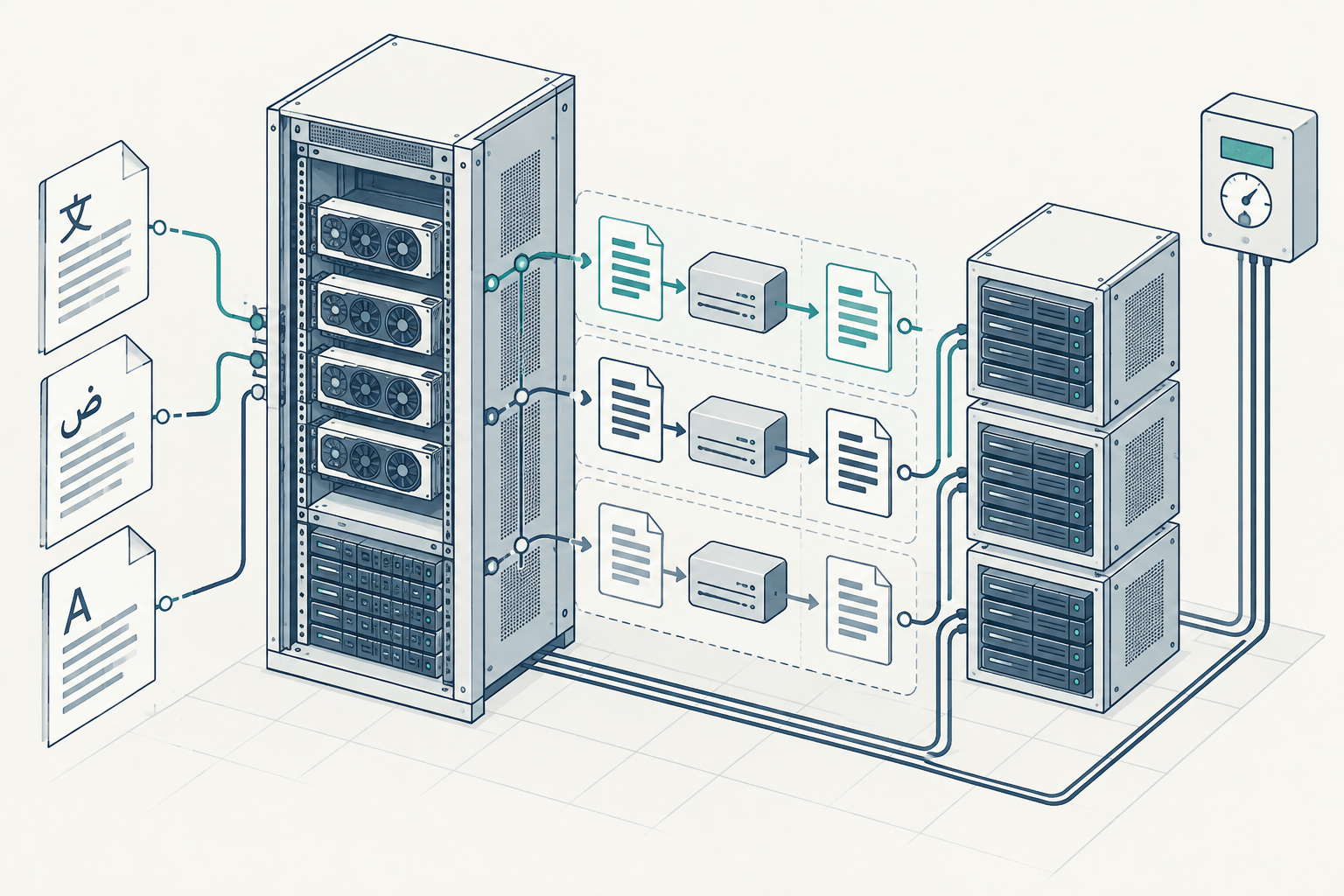
For a Chinese model release, the practical question extends beyond Chinese–English translation. An enterprise service might handle Chinese supplier documents, Arabic correspondence and English technical manuals. Operators in Oman and the wider GCC should explicitly evaluate Arabic–English alongside Chinese–Arabic, Chinese–English and relevant regional pairs. Urdu, Hindi, Persian or other languages belong in that evaluation only where demand exists and the checkpoint’s documented scope supports testing them.
The bottleneck is predictable document capacity
A quarter rack to a few racks rarely has a spare GPU pool for every model variant. Translation must compete with other inference, development jobs and sometimes virtual machines. A larger checkpoint can improve selected translations while reducing concurrent capacity, leaving less memory for long documents or making an interactive queue wait behind a bulk upload. Aggregate GPU utilisation can look healthy while the service misses every useful latency target.
Document translation also includes work outside the accelerator. Files need ingestion, parsing, segmentation, glossary lookup, reconstruction and validation. Scanned material requires a separate OCR path; describing Index-Translate as a text model does not establish native PDF layout processing or image translation. CPU workers, storage and application queues can therefore become limiting resources even when the GPU has headroom.
Build the service around accepted documents rather than generated tokens alone. Define an accepted document as one that passes the applicable language, terminology and structure checks. Report latency by document class, queue age, rejection rate and retries. Those measurements reveal whether buying more accelerator time would help, or whether the actual constraint is parsing, review or a poor segmentation policy.
Select quality before selecting precision
Construct a small, controlled evaluation corpus from material the organisation is authorised to process. Include short messages, tables, numbered procedures, contracts and technical passages. Separate source language, destination language, length and document complexity. Keep a held-out set so prompt tuning and glossary adjustments do not quietly become the benchmark itself.
Arabic deserves specific checks for right-to-left reconstruction, punctuation, mixed-script identifiers, dates and numbers. Chinese supplier documentation needs checks for units, part numbers and product names. Regional language testing should use reviewers who understand the relevant business vocabulary, not merely conversational fluency. English back-translation can expose problems, but it is not a substitute for direct review of the destination text.
Compare the available checkpoints under the same conditions before deciding which quantization to operate. Then repeat the checks for the actual deployment artifact. Quantization can change output behaviour; quality demonstrated by one precision does not automatically transfer to another. Preserve a baseline and record the model revision, prompt template, glossary version, runtime and decoding settings for every run.
Use a compact acceptance matrix that links linguistic quality to infrastructure consequences:
| Test slice | Acceptance check | Operational signal |
|---|---|---|
| Arabic–English procedures | Correct negation, units and terminology | Review minutes per accepted document |
| Chinese–English parts lists | Exact identifiers and table associations | Reconstruction failures and retries |
| Chinese–Arabic correspondence | Meaning, register and mixed-script handling | End-to-end latency by length |
| Long technical documents | Section completeness and glossary consistency | Peak memory and queue occupancy |
Do not select a checkpoint from an average quality score alone. A smaller model that passes routine correspondence may be suitable for one queue, while technical or contractual material needs another model and human review. Routing should be based on validated document classes, with an explicit rejection path when none of the tested configurations is adequate.
Match artifacts to the installed estate
Inventory accelerator architecture, usable memory, interconnects, driver versions and supported runtime builds. Treat GGUF, FP8 and NVFP4 as distinct deployment candidates, not interchangeable compression labels. Backend support, kernels, memory layout and execution paths determine whether an artifact works and whether it improves throughput. Unsupported or fallback execution can erase an apparent memory advantage.
Follow the release’s distinction between Blackwell NVFP4 and Hopper/Ampere deployment guidance without turning it into a procurement mandate. Existing hardware should first be tested with the documented compatible options. GGUF may offer a useful path through a compatible backend, but neither good performance nor a particular accelerator feature should be inferred from the file extension. Check exact artifact and runtime combinations.
The 35B-A3B name should not be read as a three-billion-parameter memory footprint. Active computation and resident weights are different considerations. Establish required weight residency from the model configuration, then budget runtime workspaces, attention cache and operational reserve. Where a deployment needs multiple GPUs, include communication overhead and the loss of scheduling flexibility in the comparison.
Increase concurrency gradually with representative input and output lengths. Record peak device memory, accepted documents per hour, tail latency and failures at each step. Leave measured headroom for the permitted workload envelope rather than filling memory to a nominal percentage. If long documents destabilise an otherwise efficient endpoint, separate their queue or tighten admission limits before raising concurrency further.
Turn GPU resources into tenant service limits
Clastiq Orchestrator is Cognition-AI’s first official product: a hardware-agnostic platform covering bare-metal provisioning, Kubernetes and VM tenancy, GPU partitioning, Ceph storage, metering and chargeback, quota and policy engineering, and air-gap deployments. For translation, those capabilities provide the infrastructure control plane. The translation application still needs its own validated parsing, routing, quality checks and supported model-serving runtime.
Use bare-metal provisioning to establish reproducible worker images. Record supported runtime profiles and expose their requirements through scheduling policy, so an endpoint cannot land on an incompatible worker merely because a generic GPU resource is free. Kubernetes can host application workers and serving replicas; VM tenancy can address workloads requiring a separate guest environment. Neither choice removes the need to validate the isolation boundary.
Partition accelerators only where the hardware and software stack support the required mechanism. Hardware partitions, virtual GPU arrangements and time-sharing do not provide identical memory, performance or fault isolation. Benchmark the chosen mode under contention. A small checkpoint might fit a partition cleanly, while another needs a whole device to meet latency or memory requirements.
Set tenant limits at two levels. Infrastructure quotas constrain GPU allocations, CPU, memory and storage. Application admission controls constrain document size, queued work, concurrent translations, output limits and retry budgets. A tenant with a valid GPU quota should still be unable to submit an unbounded collection of thousand-page documents that blocks everybody else.
Operate interactive and bulk queues separately, with documented priorities and borrowing rules. Reserve capacity for the interactive service only if its availability requirement justifies the idle time. Otherwise, let bulk work consume spare capacity through a mechanism that actually supports safe interruption or draining. Avoid treating queue priority as a guarantee that a running model request can be pre-empted cheaply.
A worked document-cost example
Consider an illustrative estate assigning four existing GPUs to translation for a 30-day month. Its available capacity is 4 × 24 × 30 = 2,880 GPU-hours. Suppose metering shows 1,728 busy GPU-hours: utilisation is 1,728 ÷ 2,880 = 60%. These are planning assumptions, not measurements of Index-Translate or Clastiq Orchestrator.
Assume the estate’s fully allocated accelerator cost is $1.20 per available GPU-hour, including its chosen depreciation, maintenance and accelerator energy allowances. Monthly accelerator cost is therefore 2,880 × $1.20 = $3,456. At 60% utilisation, that becomes $3,456 ÷ 1,728 = $2.00 per busy GPU-hour. Charging $1.20 only for busy time would leave reserved but idle capacity unrecovered.
Suppose the service produces 172,800 accepted documents during those busy hours, averaging 100 accepted documents per busy GPU-hour across its measured workload mix. Accelerator cost per accepted document is $3,456 ÷ 172,800 = $0.020. Add $864 for CPU processing, storage and service operations, without duplicating costs already included above. Total monthly cost is $4,320, or $0.025 per accepted document. Human review is excluded and must be priced separately where required.
If tenant A consumes 432 busy GPU-hours, it accounts for 25% of measured busy time. Under a disclosed proportional allocation policy, its chargeback is 25% × $4,320 = $1,080. That policy spreads idle capacity and shared costs proportionally; it is not the only defensible policy. Dedicated reservations should normally carry their own idle-capacity responsibility rather than silently subsidising another tenant’s availability target.
Normalise the document mix before comparing checkpoints. Ten short emails are not equivalent to ten technical manuals. Retain document-level charges for business reporting, but also measure characters, tokens, pages, retries and review effort. A cheaper inference configuration can still cost more per accepted document if it increases correction work or reconstruction failures.
Make measurements reproducible
Collect application telemetry alongside infrastructure metering. Associate each job with a tenant, document class, artifact revision, processing stages, queue duration, accelerator attribution and acceptance outcome. Do not place source text in ordinary metric labels or logs. High-cardinality document identifiers belong in controlled job records, not in every monitoring time series.
Before testing an NVIDIA worker, a simple inventory capture can establish part of the hardware baseline:
nvidia-smi \
  --query-gpu=uuid,name,memory.total,driver_version \
  --format=csv > gpu-inventory.csv
This command is an inventory example, not a Clastiq-specific interface or a complete compatibility test. Use the equivalent vendor tooling elsewhere. Store the result with runtime image digests, model checksums and benchmark configuration. Sample device memory and power during the run using supported telemetry, and retain end-to-end application results rather than relying on a device activity chart.
Compare configurations at the same service objective. Throughput measured with a long queue is not interchangeable with throughput that meets an interactive response target. Run both steady-state and burst tests, including one large tenant alongside several small tenants. Verify failure recovery after a worker restart and confirm that retries do not generate duplicate deliverables or duplicate billable records.
Keep documents, artifacts and power inside the plan
Ceph can provide the storage foundation for model artifacts, inputs, outputs and operational records, using the access mode appropriate to each component. Keep these categories separate. Use tenant-scoped identities and access policy, encryption, retention rules and tested deletion procedures. Object naming conventions are useful organisation, but they are not an access-control boundary.
Plan model staging so simultaneous worker restarts do not saturate the storage or management network. Immutable artifact versions and controlled local caching reduce avoidable transfers. Measure actual storage amplification from source files, extracted text, intermediate structures and translated outputs. Backups and replication add capacity requirements beyond the visible size of the uploaded document.
Local hosting supports a sovereignty requirement only when the surrounding workflow stays within the approved boundary. Review OCR, telemetry, glossary services, authentication, backups and support access for external dependencies. In Oman or other GCC jurisdictions, apply the organisation’s legal and contractual requirements rather than assuming that an on-premises GPU automatically establishes compliance. Cognition-AI is based in Muscat, Oman; that fact is not a certification claim.
For air-gapped operation, import approved weights, runtime images and dependencies through a controlled process with checksums and provenance records. Test updates without live package downloads. Document how human-led local support receives diagnostic information without receiving customer documents by default. Keep rollback artifacts available, because a runtime update can affect both translation quality and memory behaviour.
Power is also a scheduling constraint in a small estate. Measure whole-node energy, not just accelerator power, and account for cooling through the site’s chosen costing method. Track kilowatt-hours per accepted workload unit alongside throughput. Stagger bulk processing or model loading where required by measured circuit and cooling limits; a free GPU slot does not establish electrical headroom.
What to do this week
- Pin the repository revision, checkpoint artifacts, license terms and documented runtime combinations. Record which existing workers can support each candidate.
- Assemble an authorised evaluation set covering Arabic–English, Chinese-related workflows and justified regional pairs, with explicit terminology and formatting acceptance criteria.
- Benchmark two or three viable configurations under identical document mixes, capturing concurrency, memory headroom, tail latency, energy and accepted-document throughput.
- Establish tenant quotas, separate bulk and interactive queues, and test contention, retry accounting and worker failure before allowing shared production access.
- Calculate a fully allocated document cost, then validate storage retention, offline update procedures and the complete data-residency boundary.
Clastiq Orchestrator runs this infrastructure on the operator’s own hardware: request a demo.