The scheduling unit is changing from sessions to ready work
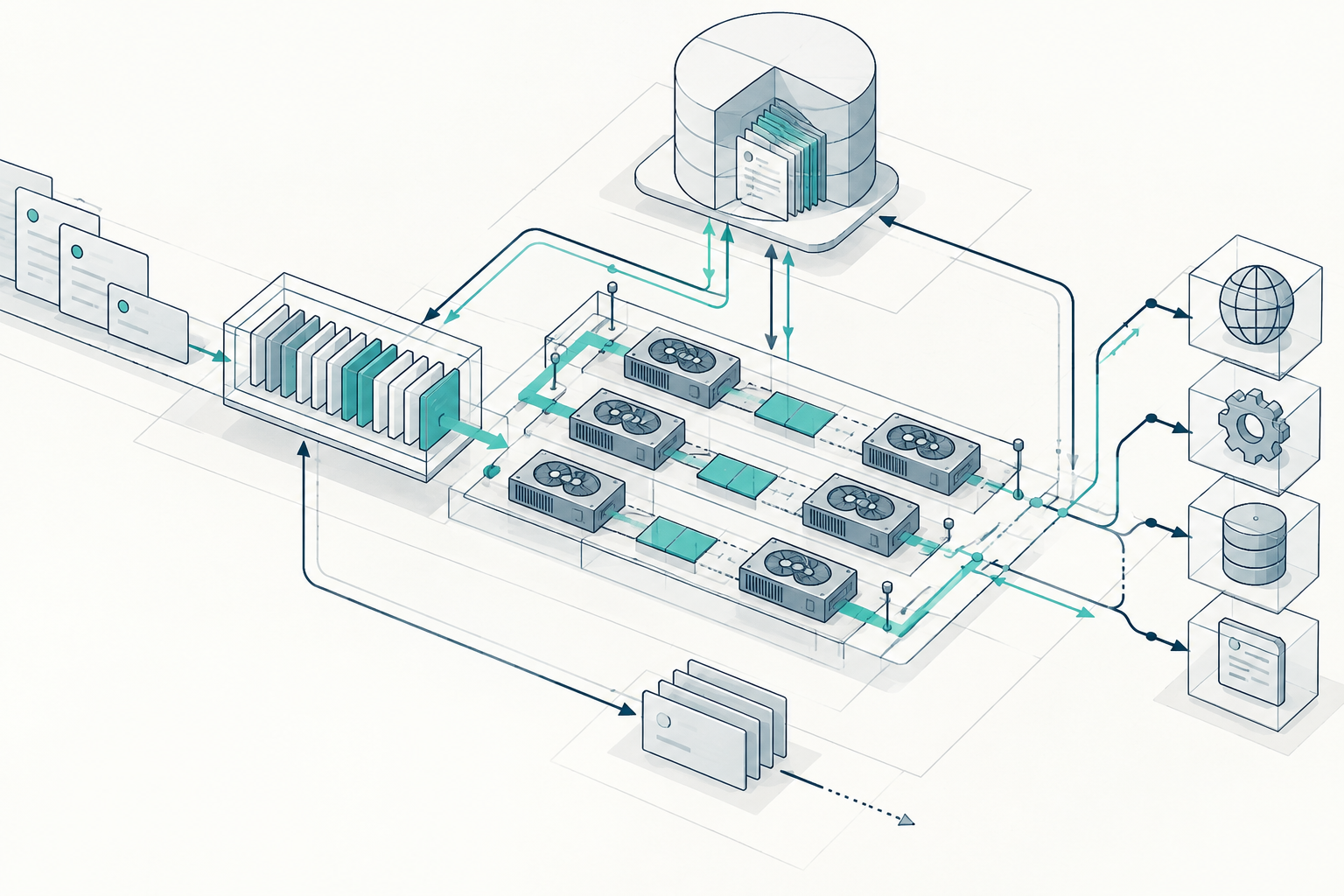
The October 27, 2026 TAO research paper, as described in the supplied research brief, proposes joint admission and GPU placement that considers tool-return readiness, cached context and memory footprint. The operational change is specific: an agent session should not automatically reserve inference execution capacity while an external tool is running. A session can remain active without continuously needing GPU computation.
That distinction matters when agents alternate between generating tokens and querying enterprise systems. A database request, approval step or document retrieval can leave inference execution idle for seconds or longer. Yet retaining the session's context can still consume GPU memory. Releasing execution capacity and releasing memory are different scheduling decisions, with different consequences for response time.
TAO should be treated as research, not an established production capability or a feature attributed to any product here. Its detailed methods and results require examination of the paper. The evaluation below translates the stated proposal into an operator test plan; it does not reproduce or validate TAO's implementation.
For Cognition-AI, the Muscat, Oman-based company that owns rFactorial, the infrastructure connection is Clastiq Orchestrator: private-cloud orchestration across compute, GPU, storage and networks. Radon supplies visual workflows, chatbots and AI-agent services connected to enterprise systems and deployed on approved infrastructure. Neither description establishes readiness-aware inference scheduling as a shipped capability.
Separate session state from GPU demand
An agent request has several resource phases. Prompt processing consumes GPU compute and creates context state. Token generation consumes execution time and memory bandwidth. A tool invocation shifts work to another system. When that tool returns, the agent becomes eligible for another inference step, potentially with a larger context.
Count those phases separately. A dashboard showing 100 active sessions cannot establish how many inference requests are runnable. Conversely, low GPU utilisation does not prove spare usable capacity: context caches, model weights or fragmented allocations may prevent another request from fitting.
A useful operating model distinguishes admitted sessions, runnable inference steps, tool-waiting sessions and retained contexts. Track each independently, including contexts retained for sessions that are not runnable. Treat cancelled, expired and disconnected sessions explicitly so abandoned state does not become a hidden capacity reservation.
Avoid interpreting this as a recommendation to unload models or restart GPU pods between tool calls. Model residency, server allocation and request scheduling operate at different timescales. The opportunity is usually to reuse execution capacity inside an available inference service, subject to its actual scheduling and isolation capabilities.
Coordinate admission and placement without confusing their roles
Admission decides whether the system can accept more work while meeting its objectives. Placement decides where that work should run. Handling these independently can create avoidable delays: admission may accept a returning request whose cache is on a full worker, while another worker has compute headroom but lacks its context.
A readiness-aware design needs current information about runnable work, expected tool returns, context location and memory headroom. Tool-return estimates will be uncertain. An enterprise API can respond quickly under normal conditions and stall during a downstream incident, then release many responses together.
Start with observable state rather than elaborate predictions. Record whether a tool call is outstanding, its elapsed time and its deadline. Measure return-time distributions by tool and workflow. Compare prediction-assisted scheduling against a simpler policy that uses only actual returns; prediction complexity must earn its operational cost.
Placement should weigh cache reuse against queueing and reconstruction costs. Sending a request to its cached worker is not necessarily faster if that worker has a long queue. Moving it is not necessarily cheaper if rebuilding context consumes substantial prefill work. Measure both paths rather than assuming locality always wins.
Choose sharing mechanisms for the isolation required
Kubernetes GPU sharing is not synonymous with memory isolation or latency guarantees. GPU time slicing, MIG and MPS address different parts of the problem. None, by itself, understands whether an agent is waiting for a purchase-order lookup or is ready to generate its next token.
| Mechanism | Useful role | Constraint to verify |
|---|---|---|
| GPU time slicing | Multiplex access to a GPU across workloads | A scheduler-visible share is not a hard per-workload memory or performance limit |
| MIG | Partition supported GPUs into hardware-isolated instances | Supported profiles constrain memory and compute allocation |
| MPS | Enable concurrent CUDA execution across compatible processes | Resource controls do not make it equivalent to MIG isolation |
| Inference-server scheduling | Batch and queue individual inference steps | Fairness and cache behaviour depend on the server implementation |
If operators need Kubernetes GPU sharing with hard limits, specify the limit first: memory capacity, compute allocation, execution time or tenant interference. A request for one shared resource unit does not automatically deliver all four. Verify enforcement with competing workloads, not just resource manifests.
Use the Clastiq agent-capacity planning guide as the starting point for deeper capacity analysis rather than repeating an infrastructure guide here. The agent-specific question is what happens between inference steps, after an infrastructure sharing mechanism has been selected.
An illustrative capacity calculation
Consider an illustrative workload, not a product benchmark. Each session completes three inference stages, each consuming two GPU-seconds of execution, separated by two external tool calls lasting eight seconds each. Assume one execution lane, no batching, no queueing, fixed tool delays and negligible dispatch overhead.
An uncontended session takes 22 seconds: six seconds of GPU execution plus 16 seconds of tool waiting. If the operator reserves an entire execution lane for that session throughout, only 6/22, or approximately 27.3%, of the reserved interval performs inference. Sequential completion capacity is 3,600/22, approximately 164 sessions per hour.
If waiting sessions release that lane, the compute-only ceiling becomes 3,600/6, or 600 sessions per hour. This is a theoretical ceiling, not an achievable throughput claim. Tool-return collisions, scheduling overhead, memory limits and latency requirements will reduce it. Reusing the lane does not shorten an isolated session's 22-second critical path.
Memory can become the limiting resource before execution does. Suppose a separate illustrative memory budget allows 24 GiB for session contexts after weights, runtime allocations and safety headroom. At a fixed 3 GiB per retained context, eight contexts fit. Real contexts vary in size, so eight is not a safe universal admission setting.
At a target 360 completed sessions per hour, or 0.1 per second, average compute demand is 0.6 GPU-seconds per second: 60% of this simplified lane. With a 22-second average lifecycle, average concurrency would be 2.2 sessions under Little's Law. Neither average protects against a burst of eight simultaneous tool returns. Tail tests determine the usable limit.
Build a test that isolates the scheduling effect
Use a representative workflow with at least two tool boundaries. Keep model version, prompt distribution, generation limits, hardware and tool results fixed between policy comparisons. Replay recorded tool delays where permitted, or inject controlled delays into test tools. Do not send synthetic writes into production enterprise systems.
Compare three policies: a reservation-heavy baseline, release of execution capacity while retaining context, and release with bounded cache retention. If the existing server already schedules other requests during tool waits, document that baseline honestly. There may be no session-level execution reservation to remove; the remaining problem could be admission or retained memory.
Define the test matrix in a versioned experiment file. The following is illustrative test configuration, not a Clastiq or Radon API:
experiment: agent-tool-waits
policies: [baseline, retain_context, bounded_retention]
tool_delay_seconds: [0, 2, 8, 30]
cache_retention_seconds: [0, 10, 60]
admitted_session_caps: [4, 8, 16]
return_patterns: [independent, synchronized]
context_profiles: [short, long]
Run steady arrivals and controlled bursts. Test slow tools, failed tools and timeouts, then a recovery event that releases outstanding responses together. Include long tool outputs because return readiness alone says nothing about the size of the next prefill. Repeat runs and report variability rather than selecting a single favourable trace.
Make cache retention an explicit budget
Retaining context saves reconstruction work but consumes memory that could admit another request. Evicting context frees space but can add prefill latency when a tool returns. A retention policy should therefore expose its memory budget, expiry rules and behaviour under pressure.
Evaluate short and long contexts separately. Record retained context bytes, cache-hit rate on return, reconstruction GPU time, evictions and allocation failures. Include metadata needed to identify the model and context version; accidentally reusing incompatible state is a correctness failure, not a performance trade-off.
If a serving implementation supports moving context to host memory or another tier, measure transfer and restoration costs explicitly. Do not assume that orchestrating storage provides inference-cache offload automatically. Offload capabilities belong to the serving stack and require their own validation.
Set a safety reserve for context growth after tool responses. Admission based only on current allocations can fail when several sessions append large results together. Bound tool output size, handle truncation deliberately and test the fallback when a returning request cannot fit. Silent failure or indefinite waiting is not a capacity policy.
Govern admission before queues become incidents
Use separate limits for admitted sessions, runnable inference requests and outstanding tool calls. A single concurrency setting hides which subsystem is saturated. Put deadlines on queued work and propagate cancellation so an expired agent does not continue consuming enterprise API capacity or retaining context indefinitely.
Apply tenant and workflow quotas according to business priority and isolation needs. Interactive assistance and background document processing may share hardware, but they need not share the same queue budget. Check that long contexts or frequent tool returns cannot monopolise service at the expense of other tenants.
Governance also covers the tool boundary. Preserve authorization through workflow transitions, restrict which systems an agent can access and record the relationship between a request, its tool invocation and its resumed inference. Logs should avoid unnecessarily copying sensitive tool results. Cache deletion and retention must follow organizational requirements, not only utilisation targets.
Retries require special care when tools change enterprise records. An inference timeout must not automatically repeat an unconfirmed write. Use application-level confirmation and idempotency controls where available, and distinguish tool completion from the agent's successful interpretation of that completion. Infrastructure admission cannot guarantee transactional correctness.
Connect the workflow to rFactorial without overstating it
Radon's documented role is the enterprise-connected workflow layer: visual workflows, chatbots and AI-agent services deployed on approved infrastructure. That makes tool boundaries a relevant place to instrument the experiment. Whether a particular deployment exposes the required events or controls must be checked; do not assume a ready-made TAO integration.
Clastiq Orchestrator addresses the underlying private-cloud resources across compute, GPU, storage and networks. Clastiq Lite brings self-service AI and GPU sharing to teams. These capabilities establish the infrastructure context, not a claim that either product predicts tool returns, migrates caches or implements the research scheduler.
The practical deployment exercise is to map approved workflow services, inference workers, tool connectivity and storage requirements onto available infrastructure. Then identify which component owns each control: infrastructure placement, serving queues, cache policy, workflow deadlines and enterprise permissions. Avoid configuring the same admission decision independently in several layers without a clear authority.
Measure completed work, not utilisation alone
Report end-to-end completion latency at the median, p95 and p99, alongside completion throughput and error rate. Break latency into tool execution, inference queueing, prefill and token generation. Specifically measure the interval from tool return to resumed inference; it reveals scheduling delay that a token-throughput dashboard can hide.
Also track admission rejections, queue timeouts, context reconstruction work and GPU memory peaks. Higher utilisation accompanied by more failed sessions is not an improvement. Compare policies at the same offered load and again at the highest load that satisfies a predefined latency and failure objective.
For on-premises economics, distinguish allocated cost from avoidable cost. Reusing idle execution capacity does not erase hardware depreciation or fixed operating expenses. Calculate cost per successfully completed workflow using a consistent cost boundary. Claim savings only when the change reduces a measurable expense, defers required capacity or delivers more acceptable work within the same budget.
What to do this week
- Instrument one agent workflow to separate inference, tool waiting, return-to-resume delay and retained context memory.
- Verify whether the current serving stack actually reserves execution during tool waits; establish a reproducible baseline.
- Test retention windows and admission caps under independent and synchronized tool returns, including oversized results.
- Validate tenant isolation, cancellation, cache cleanup and write-tool retry behaviour before increasing concurrency.
- Select a policy against completion latency, failure rate and cost per successful workflow, with rollback thresholds agreed in advance.
Explore Clastiq Orchestrator for the private-cloud infrastructure layer and the rFactorial product family for its documented workflow and AI products. Keep research scheduling proposals separate from verified product capabilities throughout evaluation and procurement.