Oracle puts GPU host recovery inside the Kubernetes conversation
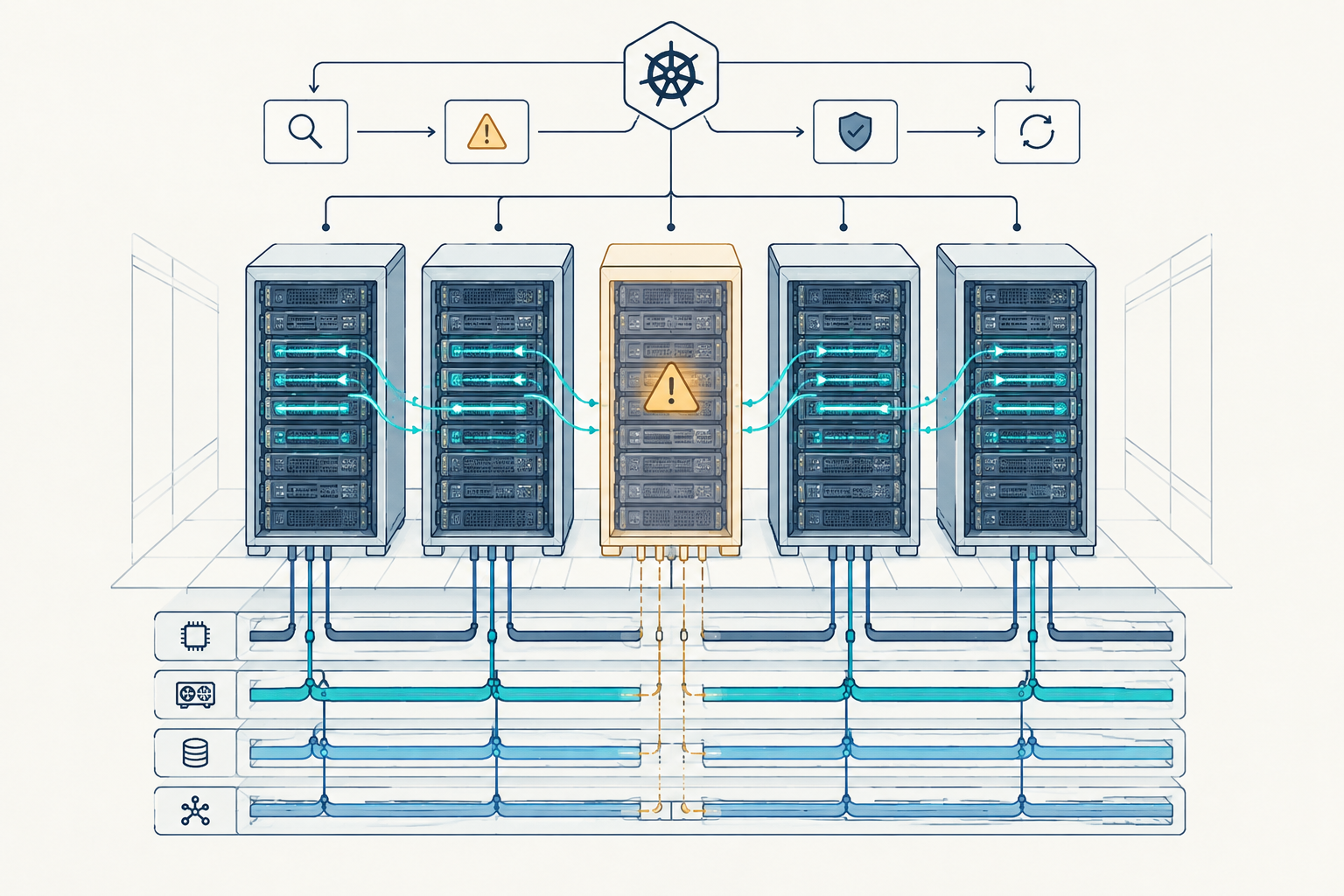
Oracle’s October 26, 2026 announcement of OKE GPU Host Repair describes coordinating GPU fault discovery and host recovery through Kubernetes. The operational change is the connection between a cluster’s view of failing hardware and the process used to recover the underlying host. A scheduler-visible server is not necessarily a usable GPU training or inference resource.
The announcement raises a question for private-cloud operators: how do you stop assigning work to infrastructure that appears available but cannot execute it reliably? Kubernetes Node Ready is useful evidence of node health, but it is not an end-to-end test of GPU execution, GPU memory, remote direct memory access (RDMA), storage access or distributed-job progress.
Oracle’s announcement is the news peg, not a specification for other platforms. The runbook below is an operator design for private clouds, not a claim that Oracle’s implementation follows every step. It connects to Cognition-AI’s rFactorial product group through Clastiq Orchestrator’s documented scope across compute, GPU, storage and networks—not through an asserted Oracle integration or automated host-repair capability.
Treat readiness as several independent decisions
A host can remain responsive while a GPU produces repeated errors, a device disappears from inventory, or an RDMA path becomes unreliable. Distributed training makes partial failures expensive: one impaired participant can stall an otherwise healthy group. Inference can fail differently, with intermittent request errors or rising latency despite apparently adequate capacity.
Separate three questions. Can the control plane communicate with this node? Are its required devices and infrastructure paths healthy? Is it eligible for this particular workload? A host might pass the first question and fail the second. It might also support a single-GPU development session while being unsuitable for a multi-host training job.
Maintain an explicit state model: eligible, suspect, quarantined, evacuating, awaiting approval, under repair, validating and restored. Record who or what changes each state, the supporting evidence and the permitted next transition. Do not make a successful reboot equivalent to restored service. Restoration requires workload-relevant validation and a deliberate return to scheduling.
Step 1: discover faults without confusing symptoms and causes
Collect evidence from several layers before choosing a repair action. GPU observations should include device visibility, hardware error reports and short execution tests. Network observations should include interface state, relevant error counters and connectivity between the peers a workload actually uses. Storage evidence should cover checkpoint reads and writes, not merely whether a volume is mounted.
Capture timestamps, node identity, device identity, driver and firmware versions, affected jobs and recent configuration changes. Preserve logs before restarting services or rebooting. Otherwise, the recovery action may erase the evidence needed to distinguish a hardware defect from a software regression or a bad network path.
Define severity by impact and confidence. A disappearing device or reproducible execution failure can justify immediate quarantine. An isolated warning may justify investigation and tighter observation instead. Set persistence thresholds and recovery conditions to avoid repeatedly removing and returning a marginal host. Correlate failures across nodes: several simultaneous RDMA symptoms may indicate a shared fabric problem rather than several independent GPU failures.
Step 2: quarantine before more work lands
Quarantine should block new assignments before evacuation begins. Kubernetes cordoning is a straightforward first action for an ordinary node-level incident:
# Replace gpu-worker-17 with the affected node.
kubectl cordon gpu-worker-17
kubectl get pods -A --field-selector spec.nodeName=gpu-worker-17 -o wide
kubectl describe node gpu-worker-17
Cordoning does not terminate existing pods, repair devices or prove that every placement mechanism respects the restriction. Review workloads with direct node binding and any privileged automation that can bypass normal scheduling. A maintenance taint can provide an additional policy boundary, but broad tolerations can weaken that boundary. Document exceptions rather than assuming the taint isolates everything.
Scope quarantine to the evidence. A device-specific issue may permit a narrower response if the installed device-management stack supports reliably excluding that device. A host-level fault or uncertain diagnosis usually warrants broader isolation. For RDMA incidents, check the communicating peer set and shared network dependencies. Moving a job to another host on the same impaired path may simply reproduce the failure.
Step 3: evacuate workloads according to recovery semantics
Before eviction, classify what is running. Stateless inference replicas, checkpointable training, interactive sessions and non-checkpointable batch jobs have different recovery costs. Identify the owner, restart mechanism, checkpoint location, expected recovery time and minimum replacement capacity. A generic drain command cannot supply those answers.
For inference, confirm healthy replacement replicas and traffic routing before removing serving capacity. For training, request a checkpoint through the workload’s supported mechanism and verify that it can be read from a replacement location. For distributed jobs, follow the job controller’s recovery model; moving one participant independently may leave the remaining group blocked or force a complete restart.
Use Kubernetes eviction controls and disruption budgets where applicable, but distinguish availability policy from application recoverability. A disruption budget can block voluntary eviction; it does not guarantee that model state is safely persisted. Do not casually override blocked eviction with forceful deletion or discard local data. Record who authorized the exception and what loss they accepted.
If replacement capacity is unavailable, pause lower-priority admissions before relocating critical work. Avoid draining several hosts into a cluster that cannot absorb their reservations. Quarantine still has value when evacuation must wait: it prevents the incident from accumulating additional workloads while operators arrange a safe destination.
Step 4: make repair approval a control boundary
Separate permission to isolate a host from permission to disrupt or modify it. A platform operator might be authorized to cordon immediately, while a hardware owner approves reboot, component replacement or firmware work. The workload owner should approve intentional loss of uncheckpointed progress unless an established emergency policy already covers that decision.
A repair request should carry the fault evidence, evacuation status, proposed action, affected dependencies, maintenance window and rollback or escalation plan. Include the expected capacity reduction. Approval without that capacity context can create a second incident when an otherwise reasonable maintenance action removes the cluster’s remaining operational reserve.
Keep the execution path restricted and auditable. Credentials that alter hosts or network devices should not be available to ordinary workload identities. Define an emergency route for severe failures, but require retrospective review. Repeated repairs on the same host should trigger investigation rather than an endless restart loop that hides declining reliability.
Step 5: restore capacity only after representative tests
Validation should reproduce the resource relationships the failed workload needs. Confirm GPU inventory and execution, then test relevant memory behavior and communication paths. For distributed workloads, include peer-to-peer and cross-host communication tests appropriate to the deployment. For checkpoint-dependent jobs, validate storage access from the intended recovery location.
A single successful test is weak evidence for an intermittent fault. Establish an observation window based on incident severity and historical behavior, then run a limited canary workload before reopening general placement. Keep the host quarantined while tests run through a controlled maintenance mechanism; do not expose it to normal scheduling merely to make validation convenient.
Return capacity in stages. Update the incident record with test results, versions, approvals and remaining restrictions. Remove scheduling blocks only after the restoration owner signs off. Track recurrence after restoration. A host that repeatedly passes a smoke test but fails production work needs a stronger acceptance test, not a shorter repair checklist.
GPU sharing changes the repair blast radius
Operators searching for Kubernetes GPU sharing with hard limits must distinguish scheduling entitlement from enforceable isolation. Sharing a GPU increases the number of tenants affected by a device fault, and the selected sharing mechanism changes how workloads contend during normal operation.
| Mechanism | Isolation consideration | Repair implication |
|---|---|---|
| Time-slicing | Shared access does not itself enforce per-workload GPU memory limits | Inventory every workload using the physical GPU |
| MIG | Hardware-partitioned resources on supported GPUs, with profile constraints | Map instances to their parent GPU and host |
| MPS | Concurrent CUDA process execution; controls depend on configuration | Account for shared service and device dependencies |
Time-slicing can suit workloads that tolerate contention, but advertising more logical allocations does not create physical capacity. MIG provides hardware partitioning on supported devices, yet partitions still depend on their parent hardware and host. MPS is not interchangeable with a hard multi-tenant security boundary. Select the mechanism against memory requirements, workload compatibility and trust boundaries—not just allocation count.
Keep the repair runbook separate from the full sharing configuration guide. Consult Clastiq’s in-depth infrastructure guides for further reading, and use its local-inference rack-test article as a companion when defining rack-level acceptance questions. Confirm each chosen configuration against the installed hardware and software documentation.
Worked example: capacity restoration is not just host uptime
Consider an illustrative private cloud with 32 hosts and eight GPUs per host: 256 physical GPUs. Its admitted workloads require 224 GPUs, leaving 32 GPUs of reserve. Two hosts are quarantined after independent GPU and network faults, removing 16 GPUs. Healthy capacity falls to 240 GPUs, leaving only 16 GPUs above admitted demand.
Assume workloads can be relocated without changing their total GPU requirement. The reservation ratio rises from 224/256, or 87.5%, to 224/240, or approximately 93.3%. This is not measured execution utilization. Placement can still fail if jobs require eight healthy GPUs on one host, a particular GPU type or network locality that the remaining free capacity cannot provide.
If both hosts remain unavailable for four hours, the incident removes 16 × 4 = 64 GPU-hours of capacity. At an illustrative internal ownership-cost allocation of $2 per GPU-hour, that represents $128 of unavailable capacity—not a new cloud invoice or necessarily a cash saving obtainable through faster repair.
The fixed ownership cost continues while on-premises GPUs are idle or quarantined. Measure useful work completed alongside cost allocation: safe repair can reduce unavailable hours, but productive utilization also depends on queued demand and placement constraints. These figures are planning examples, not Oracle, Cognition-AI or Clastiq benchmarks.
Apply the runbook across the private-cloud rack
Cognition-AI, based in Muscat, Oman, owns the rFactorial product family. Clastiq Orchestrator’s documented role is private-cloud orchestration across compute, GPU, storage and networks. That scope matters because GPU recovery crosses those boundaries: a healthy replacement GPU is insufficient if its host lacks suitable storage access or network connectivity.
The practical connection is to organize recovery requirements across those resource domains. Identify replacement compute, compatible GPU capacity, reachable checkpoints and suitable network paths before approving evacuation. Clastiq Lite brings self-service AI and GPU sharing to teams; operational policy should ensure that self-service admission does not treat quarantined resources as usable capacity. This is a deployment requirement to evaluate, not a claim of a supplied repair feature.
For GCC and MENA private-cloud operators, recovery planning should explicitly include local spare availability, maintenance staffing and the infrastructure locations approved for each workload. Do not assume external capacity is an acceptable fallback. Where organizational rules restrict data movement, checkpoint relocation and diagnostic-log handling need the same review as the original workload deployment.
Measure the control loop, not the reboot
Track time from first actionable fault evidence to quarantine, time to safe evacuation, approval wait, repair duration and validation duration separately. Also record jobs assigned after the first actionable signal, lost work since the last usable checkpoint, unavailable physical GPU-hours and recurrence after restoration. These measures reveal whether delay comes from detection, governance, capacity or hardware service.
Define denominators consistently. Logical time-slicing allocations should not inflate physical GPU availability. Distinguish reserved GPUs, active execution and useful completed work. A shorter repair interval is not an improvement if premature restoration increases failed jobs. Review false-positive quarantines too: unnecessarily removing healthy hosts consumes the same reserve needed for genuine incidents.
What to do this week
- Map GPU hosts to device identities, network dependencies, checkpoint storage and workload owners. Include sharing relationships beneath each physical GPU.
- Define quarantine triggers and restoration tests. Separate immediate containment authority from approval for disruptive repair.
- Rehearse one degraded-GPU incident and one RDMA-path incident in a controlled environment. Check that new placements stop before evacuation starts.
- Calculate replacement capacity using physical GPUs, job shape and locality. Identify which lower-priority admissions pause when reserve capacity falls.
- Build an incident scorecard covering detection-to-quarantine time, lost work, unavailable GPU-hours and post-restoration recurrence. Use it in the next maintenance review.
Explore Clastiq Orchestrator for its documented private-cloud orchestration scope and the rFactorial product family for the wider portfolio. Discuss deployment requirements with Cognition-AI at info@cognitionai.cloud, keeping requested recovery controls distinct from verified product capabilities.