A platform launch reframes the automation question
Wamda reported FinBursa’s launch of an AI-native platform for private-markets operations on October 24, 2026. The reported change is a platform offering aimed at streamlining those operations. That announcement provides a useful starting point for enterprise teams, but it does not establish deployment outcomes, implementation effort or measured reductions in manual work. Those require evidence beyond a launch report.
The broader operational question is whether repetitive information handoffs should become connected workflows rather than another standalone AI interface. Employees frequently move information between documents, messages, business applications and approval queues. Adding a conversational entry point can help them find or prepare information, yet still leave the actual transfer, verification and follow-up untouched.
For Cognition-AI’s Insights desk, the relevant rFactorial connection is Radon: visual workflows, chatbots and AI-agent services connected to enterprise systems and deployed on approved infrastructure. This article examines how an enterprise might use that documented capability envelope to design a bounded pilot. It does not assert a FinBursa partnership, product equivalence or investment recommendation.
Start with the handoff, not the assistant
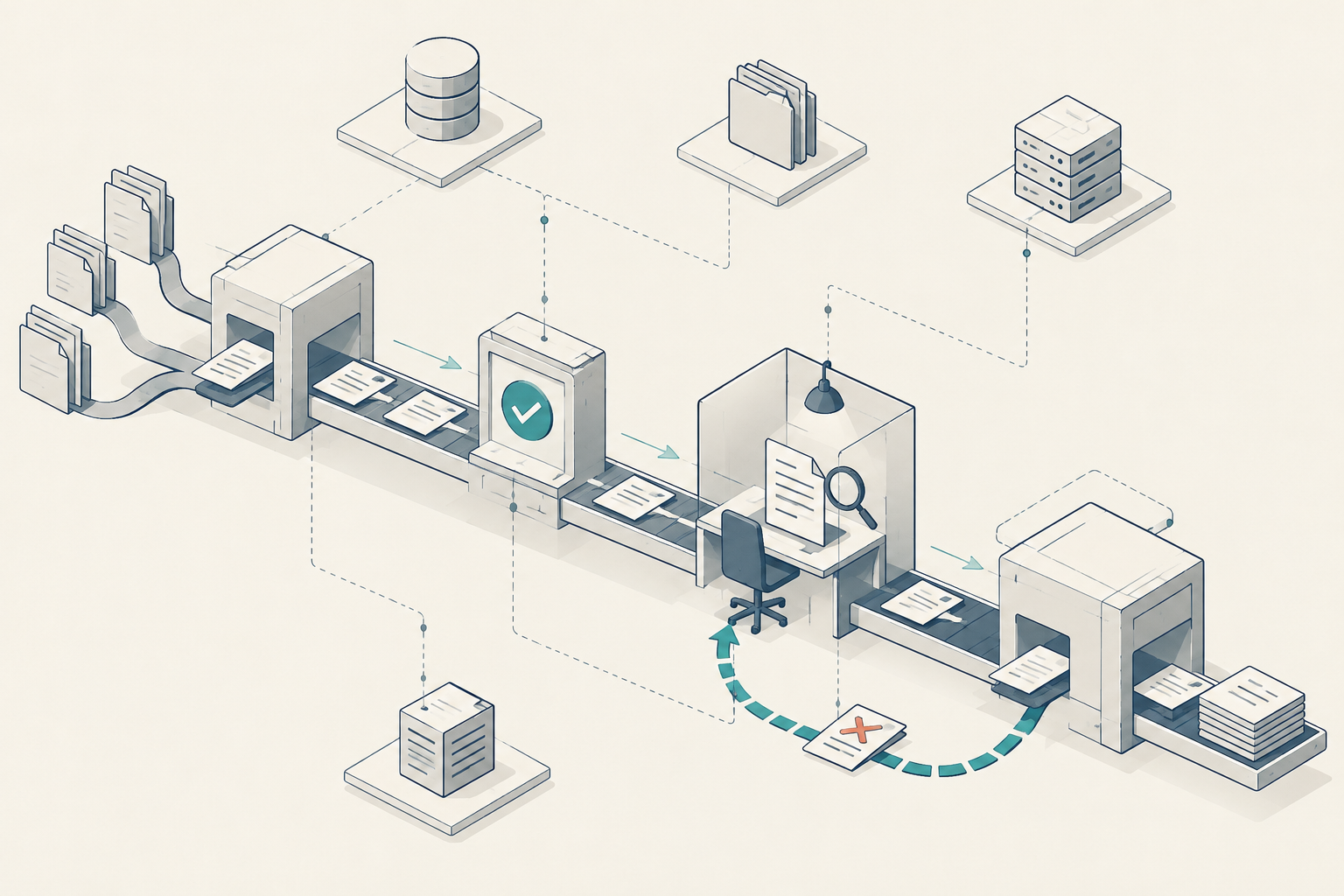
A handoff occurs whenever responsibility or information moves between people or systems. Consider an internal purchasing request. Someone receives a document, identifies the requesting department, checks whether required information exists, asks for clarification, prepares a record and sends it for approval. Each step can look trivial while the accumulated checking and copying consume substantial time.
The wrong starting question is whether an AI agent can handle purchasing. That scope combines interpretation, policy, authority and financial commitments. A better question is whether a workflow can prepare a complete request for a named reviewer, without submitting an order or changing an approved supplier record. The second question has a visible boundary and a testable outcome.
Map the current process before selecting an interface. For each step, record the input, responsible role, system of record, decision rule, output and common reason for rejection. Include the informal steps: spreadsheets maintained outside the main application, clarification messages and duplicate checks performed from memory. These often explain why an apparently straightforward automation produces downstream rework.
Measure elapsed time separately from handling time. A request may wait two days for an approver while requiring only twelve minutes of employee effort. Automating data preparation might reduce those twelve minutes without changing the approval queue. Reporting both measures prevents a useful but limited improvement from becoming an unsupported claim about end-to-end speed.
Preserve systems of record deliberately
Working across existing systems does not mean connecting everything immediately. It means assigning authority explicitly. One application may own supplier identity, another may hold a project budget, and a document repository may retain supporting evidence. The proposed workflow should use those authorities rather than quietly becoming a competing master record.
Radon’s documented enterprise-system connectivity makes this a relevant design discussion. It does not establish that any particular application, interface or connector is available for a given deployment. Before committing to a pilot, verify access methods, permissions, data formats and supported operations with the implementation team. A process diagram is not proof of an executable integration.
Separate read access, draft preparation and committed writes. A first release can retrieve permitted information and prepare a proposed update for review. Allowing the workflow to commit that update is a separate authorization decision. Where a safe write path is unavailable, an explicit manual completion step is preferable to disguising a fragile workaround as automation.
| Handoff | Pilot treatment | Required boundary |
|---|---|---|
| Document to draft request | Extract and organize proposed fields | Retain the source for checking |
| Draft to reviewer | Route complete packets for review | Name the accountable role |
| Missing information to clarification | Prepare a clarification request | Review sensitive communications |
| Approved draft to business system | Use a verified update path | Confirm authority and record outcome |
These are proposed workflow requirements, not claims that Radon supplies every control shown. Any unmet requirement belongs in the implementation plan or outside the initial scope.
Choose a pilot that can fail safely
A bounded pilot needs a defined population, predictable inputs, an accountable owner and a reversible output. For example, select one department’s non-urgent purchasing requests and stop at preparation of a review packet. Exclude payment execution, supplier changes, retrospective approvals and requests carrying restricted information until their handling has been separately assessed.
Choose work with enough repetition to measure, but not so much variation that every case needs a new policy decision. A low-volume process with highly consequential exceptions may be a poor first candidate. Conversely, a large queue is not automatically attractive if most handling time reflects missing upstream information that a workflow cannot obtain.
Write the completion condition before implementation begins. A successful case might mean that required fields are present, each material field can be checked against its source, the correct reviewer receives the packet and the final disposition is recorded. A generated summary alone is not completion if somebody must still reconstruct the request elsewhere.
Use Radon’s visual-workflow capability to frame the intended sequence, with chatbots or AI-agent services only where they have a defined purpose. A chatbot could provide an intake interaction; an agent service could assist an information-processing step. Neither should automatically receive authority over the full process. Confirm how each proposed step can actually be implemented before treating the design as deliverable.
Make exceptions part of the specification
Exceptions are ordinary operating conditions, not inconvenient outliers. A document can omit a department code. Two sources can disagree about a supplier name. A requester can submit a corrected version while the original remains in review. A destination system can be unavailable after a reviewer approves the draft.
For each exception, specify detection, ownership, permitted action and closure evidence. Distinguish business exceptions from technical failures. An ambiguous spending category requires business judgment; an unavailable destination requires controlled recovery. Sending both into an undifferentiated error queue makes it difficult to measure performance or assign responsibility.
A short policy artifact helps operations and implementation teams agree on boundaries. The following is illustrative pseudoconfiguration, not Radon syntax or a claim about built-in controls:
pilot:
  scope: one_department_purchase_requests
  output: review_packet
  autonomous_commit: false
exceptions:
  missing_required_field: return_for_clarification
  conflicting_sources: route_to_process_owner
  possible_duplicate: hold_for_review
  destination_unavailable: hold_for_controlled_retry
completion:
  require: [reviewer_decision, recorded_disposition]
Also define what happens when work resumes. A retry must not create a second business record because the first response was lost. Determine how an existing outcome will be checked, who can authorize another attempt and when a human must intervene. If those protections cannot be implemented reliably, retain manual submission during the pilot.
Govern information and authority separately
Deployment on approved infrastructure is part of Radon’s documented positioning. Approval of the infrastructure, however, is not approval of every dataset, model interaction or business action. The organization still needs to decide which records may be processed, which users may see results and what information may leave a given environment.
Create an access matrix for the pilot. The workflow should receive only the information needed for its assigned step. Reviewers should retain their existing business authority rather than inheriting broader permissions through an automation account. Verify how access restrictions carry through retrieval, generated drafts and any stored working material.
Treat incoming documents and messages as untrusted content. Instructions embedded in a supplier attachment must not redefine the workflow’s permissions or approval requirements. Keep document interpretation separate from action authorization, and test whether misleading content can cause an unintended routing choice or proposed update. These are implementation acceptance tests, not assumed product safeguards.
For GCC teams, cross-border information flows and multilingual working documents deserve explicit review. An Oman-based organization coordinating with regional offices may need to check applicable jurisdictional obligations, internal residency policy and Arabic-English terminology before expanding scope. Cognition-AI’s Muscat base does not itself establish compliance for a deployment; the relevant legal, security and operational owners must approve the actual arrangement.
Calculate savings after review and rework
Consider an illustrative pilot with 600 eligible requests per month. Before automation, staff spend an average of 12 minutes preparing and checking each request: 7,200 minutes, or 120 hours. Assume 15% also need a correction taking eight additional minutes. Those 90 corrections add 720 minutes, producing a baseline of 132 handling hours monthly.
Now suppose 480 requests follow the standard pilot path and require four minutes of review each. That is 1,920 minutes. The remaining 120 requests require twelve minutes each of total exception handling, including their review, adding 1,440 minutes. This distinction matters: counting a separate standard review for those same exceptions would double-count part of the workload.
Assume that, after those handling steps, 30 requests still need an eight-minute correction. That adds 240 minutes. Finally, allow eight hours, or 480 minutes, per month for workflow monitoring, queue reconciliation and routine rule maintenance. Total ongoing effort becomes 4,080 minutes, or 68 hours: 32 hours of standard review, 24 of exception handling, four of correction and eight of oversight.
The illustrative reduction is therefore 64 hours per month, approximately 48% of the 132-hour baseline. This is neither a Radon benchmark nor a forecast. It is a calculation whose assumptions can be tested. It excludes initial implementation, training and approval effort; those costs must be included when assessing payback.
The result is sensitive to exceptions. If 240 rather than 120 requests require twelve minutes, leaving 360 standard cases at four minutes, monthly effort rises to 84 hours with correction and oversight unchanged. Savings fall to 48 hours. That sensitivity shows why documenting exceptions is an economic requirement, not just a governance exercise.
Measure the work that remains
The main metric should be human handling minutes per completed eligible case, including preparation, review, exception resolution and correction. Track maintenance separately and include it in the aggregate business case. Count completed cases rather than generated drafts, because draft volume can rise while the downstream queue becomes harder to manage.
Pair that metric with first-pass acceptance, manual rekeying frequency, exception rate and post-completion correction rate. Record why reviewers reject or alter outputs. A change to punctuation is different from a wrong department assignment or a missing approval. Weighted severity helps prevent many harmless edits from obscuring a small number of consequential errors.
Maintain a denominator for every percentage. If difficult requests are excluded from the pilot, state how many were excluded and why. Otherwise, improvements may reflect easier work rather than a better process. Compare similar request types and disclose changes in staffing, workload or policy that could affect the result.
Use timestamps to locate waiting time, but avoid treating employee activity as an unrestricted monitoring resource. Collect enough information to evaluate the process, set retention rules and explain the measurement purpose to participants. A workflow pilot should not quietly become a separate workforce-surveillance project.
Roll out through explicit decision gates
Begin with historical or suitably controlled cases whose expected outcomes can be reviewed. Include missing fields, conflicting documents, duplicates and unavailable destinations. Confirm whether the proposed workflow produces a useful review packet and whether failures reach the intended owner. Testing only complete examples says little about operational readiness.
Next, run a shadow phase alongside the existing process without permitting duplicate business actions. Compare proposed outputs with actual decisions, and have the process owner resolve disagreements. This phase should reveal whether the workflow captures business rules correctly or merely reproduces the most common document pattern.
Then authorize a limited live phase with named reviewers, daily queue reconciliation and a documented way to pause new intake. Set acceptance thresholds before observing results. For example, a team might require no unauthorized committed changes, no unexplained lost cases and a sustained reduction in handling time without increased consequential corrections. These are suggested acceptance criteria, not reported performance.
Expand only one dimension at a time: another request type, another department or a broader permitted action. Changing all three makes failures harder to diagnose. Retain ownership of the workflow after launch, including responsibility for policy changes, access reviews and maintenance. Connected automation is an operating process, not a one-time interface delivery.
What to do this week
FinBursa’s reported launch is a prompt to examine operations, not a reason to replace functioning systems. The useful next step is a small, measurable workflow that removes an identified handoff while preserving accountability.
- Map one recurring handoff. Capture inputs, authoritative systems, responsible roles, waiting time and the last twenty reasons for correction or rejection.
- Write a Radon pilot boundary. Specify eligible cases, excluded actions, the proposed review packet and the human owner of each decision.
- Verify implementation feasibility. Check the required enterprise connections, permissions and approved infrastructure before committing to automated updates.
- Build an exception test set. Include conflicting sources, missing information, duplicate submissions and an interrupted completion step; assign an owner to every failure path.
- Baseline effort and set gates. Measure handling, rework and oversight, then agree on the evidence required to continue, pause or expand the pilot.
Explore Radon’s documented workflow and AI-agent offering as the starting point for that scoped assessment.