A reported 510 GB refresh changes the operating calculation
The supplied story brief identifies DeepSeek-V4.1-Flash-1017 as a checkpoint refresh of approximately 510 GB. That is the operational event under examination: a new artifact whose acquisition, verification and retention could consume substantial storage and maintenance time before it serves a single enterprise request. The immediate question is not whether to replace an existing model, but what evidence would justify that replacement.
There is an important verification boundary. The supplied references point to a DeepSeek Hugging Face repository, its file tree, a vLLM recipe and an October 2026 news archive. Their live contents have not been independently inspected for this article. Consequently, the release identity and 510 GB figure remain reported premises, not independently confirmed findings. Neither a publication date nor a release date should be inferred from the identifier “1017” or the archive URL.
For China's model ecosystem, the practical issue is how an enterprise absorbs an upstream checkpoint change without letting release cadence dictate production policy. For rFactorial, owned by Muscat-based Cognition-AI, that question spans Clastiq Orchestrator infrastructure, Radon enterprise workflows and Radon Mini employee workspaces. Nothing here establishes tested support for this checkpoint by those products.
Verify the release before estimating its value
The first deliverable should be an evidence record, not a deployment ticket. An operator should confirm that the repository belongs to the intended publisher, record the exact revision, inspect its model card and license, and reconcile the files against the reported size. Repository totals can include artifacts that a particular deployment does not need; conversely, associated runtime files can enlarge the eventual footprint.
A branch named main is not an immutable release reference. Record a commit identifier and inventory filenames, byte counts and available digests. Establish whether the checkpoint refresh changes weights, configuration, tokenizer assets or executable loading code. Those distinctions affect both security review and regression scope. An unchanged product-facing model label does not establish unchanged behavior.
The vLLM recipe is a separate evidence category. If accessible, check which model revision, software versions, hardware assumptions and launch settings it actually documents. A recipe for a model family is not proof that every later checkpoint works under the same conditions. The Dealroom archive is contextual material, not an authoritative source for checkpoint contents or runtime compatibility.
Until those checks are complete, procurement estimates and test plans should explicitly say “assuming a 510 GB artifact.” That phrasing preserves useful planning without converting an unverified premise into a technical specification.
Clastiq's role is resource coordination, not assumed compatibility
Clastiq Orchestrator provides private-cloud orchestration across compute, GPU, storage and networks. Its relevant role is the resource layer around an approved deployment: the infrastructure team must decide where artifacts land, which resources testing may consume and what capacity remains protected for existing workloads. These are planning requirements, not claims that Clastiq supplies a checkpoint-specific deployment or verification integration.
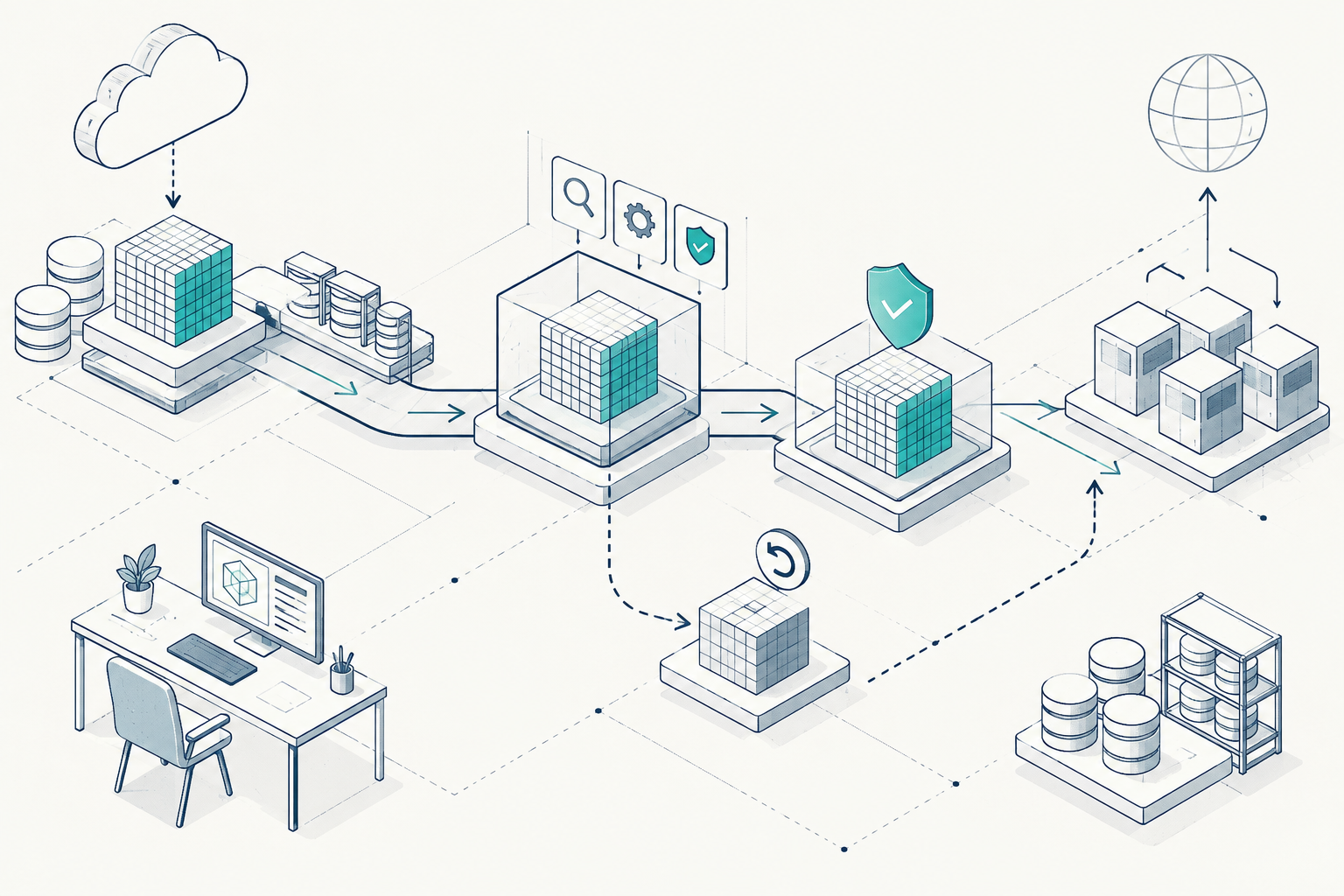
Keep artifact staging separate from production activation. Download to a designated volume, verify completeness, complete runtime and security checks, then admit the candidate to a controlled evaluation environment. Do not let an incomplete transfer become a discoverable production model merely because a directory exists. Readiness must be an explicit operational decision.
Storage also has competing users. A refresh can contend with datasets, employee file services, workflow logs or backups even when GPU capacity is idle. Schedule transfer and verification work against network and disk headroom, not just accelerator availability. The measurable outcomes are staging duration, peak storage consumption, impact on unrelated workloads and time to recover from failure.
Clastiq Lite brings self-service AI and GPU sharing to teams, but that capability does not remove release governance. A team evaluation should still have a bounded resource allocation and a defined route to production approval.
Budget for copies, not just the headline size
Consider an illustrative storage plan using decimal GB throughout. Assume the reported artifact really is 510 GB, the current approved checkpoint is also 510 GB, and the process keeps both the staged candidate and a separate serving copy. That produces three full copies before temporary files or runtime-specific artifacts are counted.
| Illustrative allocation | Capacity | Operational purpose |
|---|---|---|
| Candidate staging copy | 510 GB | Download and verification |
| Candidate serving copy | 510 GB | Controlled evaluation and activation |
| Previous approved checkpoint | 510 GB | Rollback |
| Planning allowance | 306 GB | 20% of the three-copy subtotal |
| Total reservation | 1,836 GB | Approximately 1.84 TB |
The allowance is a planning choice, not evidence that 306 GB will cover every runtime. Converted weights, caches, additional replicas or filesystem behavior could require more. A design that safely reuses immutable storage may need less, but that saving must be demonstrated rather than assumed.
Transfer time is similarly easy to understate. At an illustrative effective throughput of 100 MB/s, 510,000 MB takes 5,100 seconds: 85 minutes. An ideal 1 Gbit/s link would take 68 minutes before protocol overhead and contention. Verification, internal copying and startup then extend the window. Report effective throughput and wall-clock readiness separately; download completion is only one milestone.
Stage downloads and make verification reproducible
Use a resumable transfer process pinned to the approved revision, with controlled concurrency and sufficient staging space. Avoid repeated full downloads after transient failures. Where repository access is constrained by bandwidth, enterprise egress policy or location, establish an authorized acquisition route before reserving scarce evaluation resources. Do not turn an unavailable upstream path into an unreviewed mirror dependency.
Checksum verification needs a trusted reference. Computing a local hash proves little about provenance if nobody knows what the hash should be. Compare against publisher-provided digests where available and authenticated; otherwise document the assurance gap and how the approved artifact was acquired. A checksum can detect changed bytes without establishing that the original bytes were trustworthy.
The following generic shell example assumes an approved manifest and a completed staging directory. It is not a DeepSeek installation recipe or a Clastiq command:
set -euo pipefail
cd /srv/model-staging/candidate
# Manifest must come from the approved evidence process.
sha256sum --check /srv/model-manifests/candidate.sha256
# Record actual staged bytes for the capacity review.
du -sb .
Stop promotion when verification fails. Preserve the failure record, identify whether the cause is a partial transfer, wrong revision or altered file, and reacquire only through the approved process. Rehashing a suspect file and replacing the expected digest defeats the control.
A rollback copy is not a rollback plan
Retaining old weights is necessary in this example, but insufficient. Record the previous runtime version, configuration, tokenizer assets, prompt templates and workflow dependencies. If a candidate changes output structure, reverting only the weights may leave downstream processing incompatible. Recovery must restore an approved operating combination.
Define rollback triggers before evaluation: unacceptable failure rates, missed latency objectives, invalid structured outputs or increased reviewer intervention. Set thresholds using the enterprise's existing service requirements, not invented universal limits. Assign a decision owner and test the actual restoration procedure, including how traffic or queued work returns to the previous service.
Checkpoint bytes also do not establish GPU requirements. Accelerator memory depends on representation, runtime overhead, parallelism, context length and concurrency, among other factors. A 510 GB download is not a reliable estimate of serving memory or throughput. That uncertainty belongs in the capacity request until measurements replace assumptions.
A staged deployment can preserve the existing service while the candidate runs elsewhere, but it temporarily increases resource demand. A replacement-in-place approach may consume less concurrent capacity while increasing interruption and recovery risk. Clastiq's infrastructure scope makes this a resource-allocation discussion; it does not establish either deployment pattern as an automatic product feature.
Radon turns model changes into workflow changes
Radon provides visual workflows, chatbots and AI-agent services connected to enterprise systems and deployed on approved infrastructure. Its exposure to a checkpoint refresh therefore extends beyond conversational quality. A model that writes a more fluent answer may still choose an unsuitable next step, produce malformed fields or repeatedly retry a failed operation.
An appropriate evaluation uses representative workflow cases with expected outcomes. For example, test whether a candidate extracts required fields, handles missing information, follows approval boundaries and stops when evidence is insufficient. These are proposed enterprise tests, not descriptions of a supplied Radon template or a confirmed DeepSeek integration.
Keep consequential operations behind the existing authorization process. During initial evaluation, use synthetic or appropriately sanitized records and prevent real writes to enterprise systems. If a later pilot includes live actions, limit its scope and identify who can approve, interrupt and reconcile them. Model quality and action authority are separate controls.
Record outcomes per workflow, not just as a single model score. Useful measures include accepted completion rate, retries per accepted task, reviewer minutes and downstream correction work. A checkpoint can improve one workflow while degrading another. Promotion should therefore be scoped to the workflows that passed, rather than automatically extending to every Radon service.
Radon Mini needs a workspace-specific review
Radon Mini is an employee AI workspace with approved files, memory and tools under organizational control. A checkpoint change in that setting should be assessed against the employee's actual work: locating evidence, drafting from approved material, retaining relevant context and using permitted tools appropriately. It should not be treated as interchangeable with a public chatbot evaluation.
Build a test set that includes conflicting documents, superseded policies, ambiguous requests and absent evidence. Check whether the candidate distinguishes document content from instructions embedded in that content. Review how it uses workspace memory and whether unsupported answers increase the employee's verification burden. These are recommended checks, not claims about implemented Radon Mini evaluation features.
A limited pilot should specify which approved files and tools are in scope, which outputs require review and how feedback is recorded. Preserve the model revision associated with each evaluation result. Otherwise, employees may report inconsistent behavior without operators being able to distinguish a checkpoint change from changed documents or instructions.
The forthcoming Radon in the box edition should remain outside claims about current checkpoint availability. Its mention in the product roadmap does not establish packaging, hardware sizing or support for this release. Governance decisions should apply to the verified workspace capabilities available to the organization, not anticipated functionality.
Calculate accepted-task cost, including human review
An illustrative task-cost model shows why artifact management and application quality belong in the same decision. Assume 20,000 eligible tasks per month. Under the current deployment, each task consumes 18 accelerator-seconds. Under a candidate, assume 15 seconds. Use an internal allocated rate of $3 per accelerator-hour; this is not a market quote or product benchmark.
Current accelerator consumption is 100 hours, costing $300. Candidate consumption is approximately 83.33 hours, costing $250. The apparent monthly saving is $50. These hypothetical figures assume comparable allocation and no additional replica, idle-capacity or retry costs.
Now include review. Suppose 8% of current tasks require four minutes of human attention at $30 per hour. That is 1,600 reviews, approximately 106.67 hours and $3,200. If the candidate reduces review incidence to 6%, with the same review duration, the cost becomes $2,400. If all tasks are ultimately accepted, combined compute and review cost falls from $0.175 to $0.1325 per accepted task.
The resulting monthly saving is $850. Assume the refresh requires eight engineering hours at $60, plus $120 in incremental storage and transfer charges: $600 once. Payback would be approximately 0.71 months if the improvement persists. But if candidate review incidence rises to 10%, combined monthly cost becomes $4,250, worse than the current $3,500. Faster inference alone would conceal the loss.
Treat China-origin updates as governed supply changes
The China focus matters because this story concerns an upstream DeepSeek artifact and the operating consequences of incorporating it into enterprise services. It does not justify assumptions about data location, licensing rights or suitability. Repository hosting, checkpoint origin and the location where inference runs are different facts and should be recorded separately.
Before approval, establish permitted acquisition, deployment and retention arrangements. Evaluate any required executable loading code in a controlled environment, and do not expose credentials or sensitive business records during initial tests. For Cognition-AI's Oman context, deployment on approved infrastructure must reflect the organization's own data-handling requirements rather than assumptions derived from the publisher's geography.
The release decision should combine verified artifact evidence, infrastructure measurements and application outcomes. An infrastructure team can approve resource feasibility without approving employee use. A workflow owner can approve task quality without authorizing broader tool access. Keeping those decisions distinct makes both promotion and later investigation more defensible.
What to do this week
- Verify the repository, immutable revision, license, actual byte count and recipe scope. Keep the 510 GB figure labeled as reported until confirmed.
- Prepare a Clastiq infrastructure reservation covering staging, serving, rollback and temporary capacity; measure transfer and verification time separately.
- Run a rollback rehearsal using the previous approved weights, runtime and configuration. Record recovery time and unresolved dependencies.
- Select representative Radon workflows and Radon Mini workspace tasks. Evaluate structured outputs, authorization boundaries, review effort and accepted-task cost before expanding access.
- Assign separate infrastructure, security and application approval owners. Publish a limited-pilot decision with explicit stop conditions and an artifact-retention deadline.
Product context: Clastiq Orchestrator, Radon and Radon Mini.
Sources
The following references were supplied for this story; their live contents were not independently verified here.