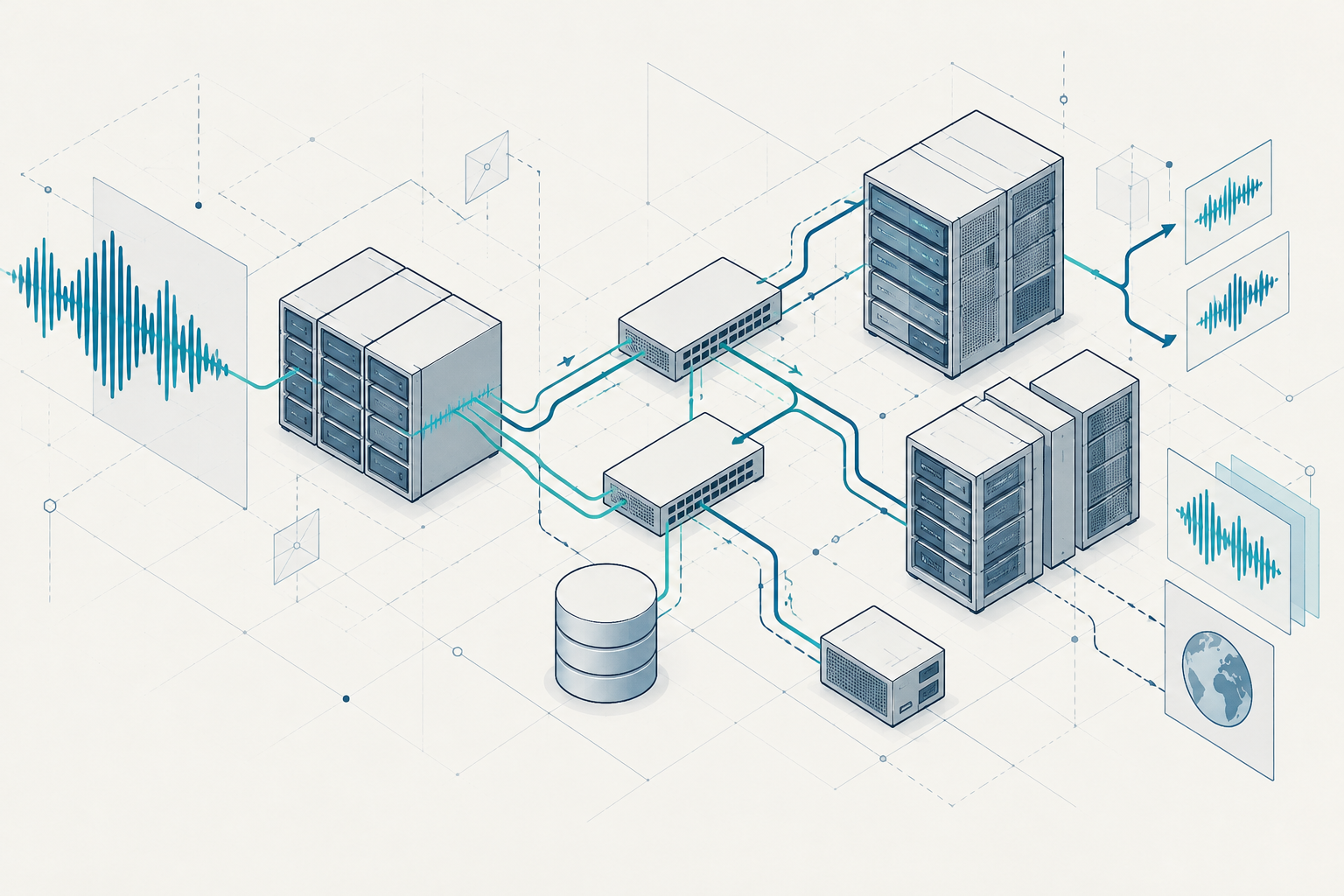
DeepL’s selection shifts attention to the data foundation
On October 20, 2026, DeepL announced its selection of VAST’s AI Operating System as a data foundation for AI research and development. The change described in the announcement is an infrastructure selection: a language AI company choosing the underlying environment on which research data and development workloads depend. It is not, by itself, evidence of a particular improvement in translation speed, service availability or infrastructure cost.
For enterprise operators, the useful question is broader than which platform DeepL selected. What happens when occasional speech experiments become repeatable workloads, with scheduled ingestion, concurrent processing, retained outputs and accountable service owners? At that point, compute availability is only one condition for success. Storage capacity, data access and network paths become part of the same operating decision.
That is the relevant connection to Clastiq Orchestrator, part of Cognition-AI’s rFactorial product group. Its documented scope is private-cloud orchestration across compute, GPU, storage and networks. Voice workloads provide a concrete planning example for that cross-resource scope, without implying a VAST integration, a DeepL relationship or equivalent architecture.
Separate the news from the operating lesson
The supplied announcement identifies VAST’s AI Operating System as DeepL’s chosen data foundation. It does not supply the deployment topology, workload mix, storage volumes or performance measurements needed to reproduce DeepL’s decision. Enterprise teams should therefore avoid treating the selection as a procurement template or as proof that one infrastructure design fits every language workload.
Instead, use the news to examine a recurring operational gap: compute gets requested explicitly, while the data services required to use it arrive through separate tickets. A pilot can survive that arrangement because engineers manually move files and resolve permissions. A recurring service cannot depend on those interventions without accumulating delay and operational risk.
The practical objective is a complete workload allocation. It should identify where inputs live, how processing reaches them, where intermediate and final data go, who approves capacity and how resources are released. The technology decision should follow those requirements rather than substitute for them.
Start with the voice workflow, not the server
Two verified rFactorial capabilities illustrate why workload definitions matter. Rovetta turns conversations into structured meeting minutes or clinical drafts for professional review. Risonour provides live voice translation, allowing each participant to speak their language and hear the language they choose. These are different operating patterns, even though both involve speech.
A planning exercise around conversation-to-draft work should examine input duration, processing deadlines, draft delivery and the professional review queue. Where an organization chooses to retain recordings or drafts, it must also define access and retention. These are deployment requirements to establish, not claims about additional Rovetta features.
Live translation requires a different measurement plan. Operators need to observe delays across capture, transport, processing and playback, as well as variation under concurrency. Persistent audio storage may be unnecessary or inappropriate for a particular deployment. Do not impose a recording-heavy architecture simply because a batch pilot used one.
Neither example establishes that these products are integrated with Clastiq. They demonstrate how application requirements can inform private-cloud resource planning.
Map data movement before allocating capacity
Draw the path from the approved input location to the processing environment and then to the authorized destination. Include intermediate files, temporary copies and any separate review environment. Every boundary can introduce transfer time, access checks, duplication or uncertainty over deletion.
For batch speech processing, distinguish ingestion from repeated reads. A recording uploaded once might be read several times during experimentation. A retained output might be small, but keeping multiple source copies across development environments can dominate capacity. Count the copies that actually exist rather than multiplying source volume by an unexplained safety factor.
For live workloads, examine the network path separately from the storage path. Acceptable storage throughput does not establish acceptable conversational delay. Routing changes, congestion and competing traffic can affect an interactive session even when the processing node appears healthy.
Document which transfers are unavoidable and which exist only because teams lack a shared approved location. Removing an unnecessary copy can reduce both elapsed time and governance exposure. It may be more useful than adding compute to a job that is waiting for its inputs.
Give each capacity decision an owner
Capacity ownership is not simply identifying the team that pays the invoice. Someone must decide whether a workload receives more space, whether a burst takes priority over another service and whether retained data still serves an approved purpose.
Use a compact ownership map before the pilot becomes a recurring service:
| Resource or decision | Accountable role | Pilot evidence |
|---|---|---|
| Input and output retention | Data owner | Bytes retained by age and purpose |
| Storage allocation | Storage operator | Peak occupancy and growth |
| Network path | Network operator | Transfer rate and contention |
| Compute allocation | Platform operator | Queue time and busy time |
| Draft acceptance | Professional review lead | Review time and correction rate |
Roles can sit in one team, but the decisions should remain explicit. In particular, platform operators should not decide on their own that sensitive recordings must be retained indefinitely to simplify troubleshooting.
Agree escalation thresholds as well. A capacity warning needs a named recipient and a defined response: delete expired data, expand an approved allocation, defer work or reject new submissions. An alert without a decision owner merely documents an approaching failure.
Treat provisioning as a dependency sequence
A workload is not ready because a compute instance has started. The approved data location must be reachable, the required storage must be available, and the network path must permit the intended traffic. Access must be limited to the appropriate identities. Output destinations must exist before processing begins.
Clastiq Orchestrator’s documented cross-resource orchestration is relevant to this coordination problem. Evaluation should focus on how an organization’s required compute, GPU, storage and network allocations can be managed together. The supplied product context does not establish particular policy engines, storage drivers or automated rollback behavior; those details require direct validation.
An operator-written readiness checklist can make dependencies testable. The following is an illustrative shell gate, not a Clastiq command or product interface. The paths represent locations prepared by the deployment team:
#!/bin/sh
set -eu
: "${INPUT_DIR:?Set approved input directory}"
: "${OUTPUT_DIR:?Set approved output directory}"
test -r "$INPUT_DIR/pilot-manifest.csv"
test -d "$OUTPUT_DIR"
test -w "$OUTPUT_DIR"
printf '%s\n' 'Basic filesystem checks passed'
This catches a narrow class of failures before work starts. It does not verify authorization policy, available capacity, throughput or network isolation. Those need separate tests and recorded results.
Worked example: size a repeatable batch workload
Consider an illustrative enterprise pilot processing 120 hours of recorded meetings each working day. All numbers in this example are hypothetical planning assumptions, not rFactorial or DeepL benchmarks. Assume uncompressed mono audio at 16,000 samples per second and two bytes per sample, with decimal storage units.
The input rate is 32,000 bytes per second. One recorded hour therefore occupies 115.2 MB, and 120 hours generate 13.824 GB per day. With 20 working days of retained input, the primary source volume is 276.48 GB. One additional full copy brings source storage to 552.96 GB.
Suppose temporary processing space peaks at three times one day’s input, or 41.472 GB. If retained drafts and associated metadata total another 5 GB, planned peak occupancy becomes 599.432 GB. To keep occupancy at or below 80 percent, provision at least 749.29 GB: peak occupancy divided by 0.8. This calculation excludes any further backup or snapshot requirements, which must be added explicitly.
Now assume one processing worker completes six audio hours per wall-clock hour. Processing 120 hours requires 20 worker-hours. Four workers finish in five hours under ideal scaling. That leaves one hour of a six-hour processing window for staging, startup, variation and recovery. The pilot must establish whether those assumptions hold.
Use the example to test the bottleneck
At an effective transfer rate of 100 MB per second, staging 13,824 MB takes approximately 138 seconds. At 10 MB per second, it takes approximately 1,382 seconds, or 23 minutes. These figures exclude setup overhead and assume a single complete input transfer.
If all input must be staged before processing, the slower path consumes almost two-fifths of the example’s one-hour contingency. If four workers each copy the entire daily input unnecessarily, the staging traffic becomes 55.296 GB. At a shared aggregate rate of 10 MB per second, that takes about 92 minutes, already exceeding the contingency before startup or recovery.
The response is not automatically a faster network. First determine why every worker needs a complete copy. Partitioning approved inputs or using an appropriate shared access pattern may remove duplication, subject to workload behavior and access requirements.
Conversely, eliminating copies does not guarantee sufficient read throughput when workers operate simultaneously. Test the actual concurrent pattern. The example shows why storage layout, network capacity and compute allocation must be considered together: independent resource estimates can each look reasonable while the complete workflow misses its deadline.
Measure service completion, not just busy hardware
A useful pilot records timestamps at submission, input readiness, processing start, processing completion and output availability. For a draft-producing workflow, add review start and acceptance. This separates infrastructure delays from processing time and professional review workload.
Report queue time, staging time and processing time separately, including medians and tail values where the sample supports them. Record failures and retries rather than excluding them from throughput calculations. Track storage growth and transfer volume alongside compute utilization so that a busy worker is not mistaken for an efficient workflow.
For the illustrative batch case, the primary technical outcome is whether all 120 audio hours reach the agreed output destination within six hours, repeatedly. A second outcome is whether professionals can review the resulting drafts within their own service window. Faster processing can simply move a backlog downstream.
For a live translation pilot, define where delay measurement begins and ends. Measure the participant experience under agreed concurrency and network conditions. Do not compare a batch processing ratio with interactive latency; they answer different operational questions.
Put governance into the resource plan
Speech can contain personal, commercial or clinical information. The operator’s plan should identify permitted processing locations, authorized users, retention periods and the procedure for removing data when its approved purpose ends. Applicable obligations depend on the organization and jurisdiction; infrastructure selection alone does not establish compliance.
Temporary storage deserves particular attention. Teams often govern the original recording and final document while overlooking staging directories, failed-job remnants and debug exports. Include these locations in the data map and test cleanup after both successful and interrupted runs.
For Rovetta’s documented clinical-draft use case, professional review remains part of the workflow. Capacity planning should not assume a generated draft is an accepted clinical record. Access to inputs and outputs also needs to follow the organization’s approved clinical processes.
Clastiq’s cross-resource scope can inform where resources are allocated, but it should not be presented as proof of any unspecified governance capability. Ask for demonstrations against the organization’s requirements, and distinguish platform functionality from procedures implemented by the operating team.
Evaluate orchestration against recovery and contention
The strongest pilot is not the one with the cleanest single run. It is the one that exposes what happens when a dependency arrives late or another team uses shared capacity. Test unavailable input storage, reduced network throughput, exhausted temporary space and worker interruption with non-sensitive test data.
For each test, record who detects the issue, who can act and what happens to partial outputs. Establish whether rerunning work creates duplicate drafts or extra retained copies. Recovery time and cleanup effort belong in the operating model alongside normal processing time.
When evaluating Clastiq Orchestrator, use these scenarios to investigate cross-resource provisioning and operational visibility without assuming undocumented behavior. Clastiq Lite’s verified focus on self-service AI and GPU sharing may be relevant to team experimentation, but it does not remove the need to plan storage and networking for recurring workloads.
The decision criterion is practical: can the team provision the required resource set, demonstrate predictable completion and recover within an agreed window? DeepL’s selection brings attention to the data foundation. Enterprise pilots should turn that attention into evidence about their own workload, not borrowed performance expectations.
What to do this week
- Map one voice workload end to end. Identify inputs, processing steps, intermediate copies, output destinations and any professional review stage. Distinguish batch deadlines from live-session latency requirements.
- Assign resource and data owners. Name approvers for storage growth, network access, compute allocation and retention changes, with escalation thresholds for each.
- Build a dependency checklist. Document everything that must be ready before processing starts, then validate the relevant cross-resource provisioning requirements with Clastiq Orchestrator.
- Run a measured capacity pilot. Capture staging time, queue time, processing duration, transfer volume and peak storage occupancy. Include retries and at least one contention test.
- Set an evidence-based expansion gate. Require repeatable completion, approved data handling and tested recovery before increasing workload volume or opening self-service access.
Review Clastiq Orchestrator against that checklist, keeping product evaluation separate from assumptions about DeepL’s deployment.