A cancelled power plan changes the capacity calculation
On September 25, 2026, TechCrunch reported that Crusoe had abandoned its planned $1.25 billion partnership to use Boom turbines at AI data centres. The change concerns a proposed route to supplying power, not evidence that an equivalent amount of operational GPU capacity disappeared. The distinction matters: an announced energy arrangement is not the same thing as electricity delivered to commissioned racks.
For an operator managing a quarter rack to a few racks, the useful lesson is not to predict turbine economics. It is to stop treating future electrical capacity as available compute. A server can be delivered, installed and depreciating while its intended power path remains unavailable. Network configuration and cluster automation cannot repair that dependency.
The cancellation does not establish that other projects, including power developments in the GCC, face identical risks. Technologies, contracts, utilities and permitting differ. It does provide a reason to review an expansion against evidence: what is contracted, what is energised, what has passed acceptance testing, and what can support tenant workloads without consuming the redundancy margin.
Define usable capacity before ordering hardware
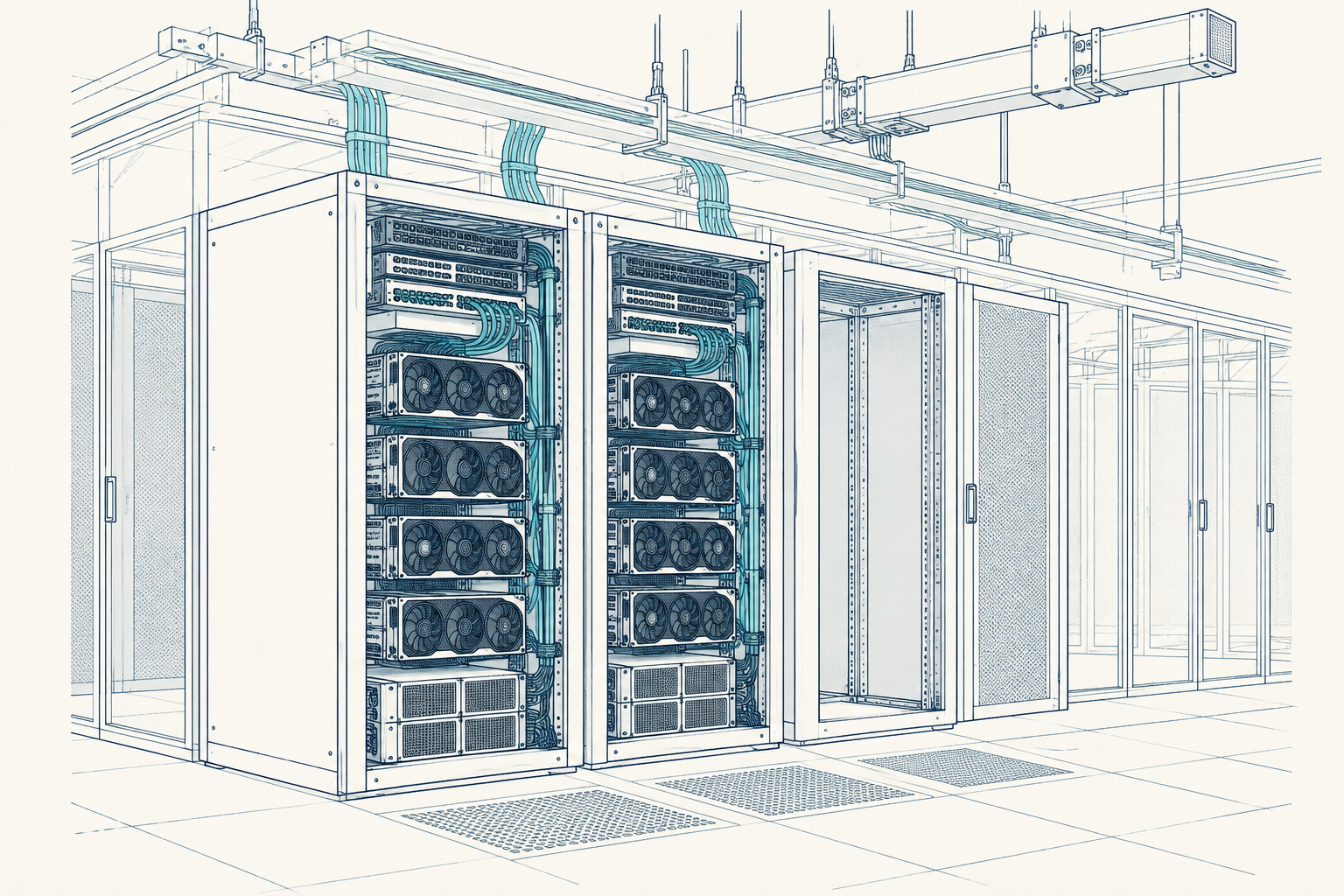
Small estates often encounter the bottleneck at the rack rather than the site. A facility may advertise spare megawatts while a particular allocation lacks sufficient branch capacity, cooling delivery or permission for higher rack density. Moving from one GPU server to three can require a different electrical and cooling arrangement even when there is physical rack space.
Track capacity as distinct states: proposed, contracted, energised, tested and released for production. Do not collapse them into a single dashboard value. Contracted capacity should identify the delivery point, date, permitted load and remedies for delay. Energised capacity means the electrical path is live; it does not prove that cooling, failover or sustained operation is acceptable.
Production release should require joint approval from facilities and platform operations. Facilities validates the electrical and thermal operating envelope. Platform operations validates node behaviour, storage, networking and tenant isolation within that envelope. Procurement should use this released capacity, plus explicitly accepted delivery risk, when deciding when another server can arrive.
Keep the constraint visible in both kilowatts and schedulable resources. GPU count alone omits CPUs, memory, storage devices, fans and networking. Nameplate values support conservative planning, while measured representative loads refine it. Neither should be confused with a guaranteed ceiling unless an enforceable, tested power limit provides one.
A power-readiness checklist with release gates
Use a short evidence register rather than a verbal assurance that power is coming. Every entry needs an owner, an acceptance criterion and a document or measurement. The following gates are suitable for an estate small enough that the infrastructure lead may also own procurement.
| Gate | Evidence required | Hold condition |
|---|---|---|
| Supply | Contract, delivery point and energisation date | Only a forecast exists |
| Rack distribution | Validated feed, PDU and branch limits | Failover overloads a surviving path |
| Cooling | Accepted test at the proposed operating envelope | Inlet limits or flow requirements are unmet |
| UPS and generation | Reviewed load margin, runtime and maintenance plan | Required resilience cannot be sustained |
| Production release | Recorded staged commissioning results | Faults or operating limits remain unresolved |
First, reconcile contracted and energised capacity. Ask who owns every dependency between the supply agreement and the rack: utility works, switchgear delivery, protection settings, inspections and landlord approval. Record dates as commitments or estimates, not an interchangeable schedule. Identify the last date on which a server order can be deferred without unacceptable commercial consequences.
Second, verify distribution under normal and failure conditions. Dual power supplies do not create resilience if the remaining feed cannot carry the transferred load. Have qualified electrical personnel check the applicable continuous-load limits, breaker coordination and PDU loading. Reserve explicit capacity for network switches, storage and management equipment instead of allocating the entire rack budget to GPU servers.
Third, make cooling acceptance a workload test. Agree the ambient design conditions, inlet limits and containment configuration with the facility. For liquid-cooled equipment, include coolant compatibility, supply temperature, flow, leak detection and the heat-rejection path. Test sustained operation and transitions between idle and load; a brief successful boot proves little about steady-state thermal behaviour.
Fourth, review UPS headroom using the complete protected load and the required resilience state. Available kilowatts and battery runtime are separate constraints. Check battery condition, expected ride-through time and the consequences of a maintenance bypass. A design that works only with every component healthy may not satisfy the service level sold to tenants.
Fifth, inspect generator readiness as an operating obligation, not an equipment inventory. Review maintenance dates, test records, starting batteries, fuel arrangements, transfer procedures and responsibilities during an extended outage. Any live failover test needs an approved method, qualified supervision and a recovery plan. Do not improvise electrical switching to satisfy a purchasing deadline.
Commission in stages, not with a full tenant queue
Commission the smallest useful increment first. Establish a baseline with switching, storage and management running, then add one compute node. Measure facility-side and server-side power where available, inlet temperatures, throttling, error rates and storage latency. Repeat with representative inference or training workloads rather than relying on an idle operating system.
Increase load in agreed steps, allowing temperatures and cooling controls to stabilise. Test simultaneous demand where it is plausible: several tenants can start jobs together after a maintenance window. Include storage rebuild or recovery activity in the operating assessment because Ceph and its network consume resources while GPU workloads continue.
Release each batch only after comparing measurements with acceptance limits. Keep unreleased nodes out of tenant scheduling, even if provisioning has finished. This creates an auditable boundary between hardware that exists and capacity the operator is prepared to sell. Automation should enforce that boundary, not erase it.
Put the readiness gate into orchestration
An infrastructure platform such as Clastiq Orchestrator can connect bare-metal provisioning with Kubernetes and VM tenancy, storage, policy and per-tenant accounting. The practical role is to make commissioned resources usable and govern their allocation. It cannot energise a rack or substitute for facilities acceptance; those remain external prerequisites recorded in the operational process.
For Kubernetes, a simple commissioning pattern is to mark a new node as unavailable to normal scheduling while tests proceed. For example:
# Hold a newly provisioned node outside normal tenant scheduling.
kubectl cordon gpu-node-03
kubectl label node gpu-node-03 power-readiness=pending --overwrite

# After documented facilities and platform acceptance:
kubectl label node gpu-node-03 power-readiness=accepted --overwrite
kubectl uncordon gpu-node-03
These are standard Kubernetes commands, not a claim about a product-specific interface. Cordoning does not stop workloads already running, and privileged or directly assigned workloads need separate controls. Restrict who can uncordon nodes, retain the acceptance record, and apply an equivalent placement hold to VM hosts. A label becomes a control only when policy actually uses it.
Once released, allocate capacity through explicit tenant quotas and supported GPU partitioning. Hardware-backed partitioning can provide separate GPU instances where available; other sharing methods have different isolation and performance properties. Do not present them as equivalent. Validate the selected method for each workload and meter the resource unit actually delivered.
Partitioning improves packing when workloads do not need a whole GPU. It does not multiply electrical capacity or guarantee proportional power savings. Similarly, a quota of eight GPUs is not an eight-GPU power reservation unless the operating model explicitly ties allocation to a tested envelope. Reconcile tenant admission with measured site constraints before increasing concurrent workload limits.
Clastiq Orchestrator’s combination of provisioning, tenancy, GPU partitioning, Ceph storage, metering and quota engineering supports this resource-management work on heterogeneous infrastructure. Implementation still requires an operator-defined readiness process. Describe any facility telemetry integration or automated power admission rule as something to validate in the deployment, not an assumed feature.
Worked example: installed GPUs with no usable power
Consider an illustrative expansion of two servers with eight GPUs each. The purchase and installation cost is $320,000. Assume straight-line depreciation over 36 months, no residual value, and $2,400 per month in incremental rack, support and connectivity commitments that begin on delivery. These are planning assumptions, not market prices or a Cognition-AI benchmark.
Monthly depreciation is $320,000 divided by 36, or $8,888.89. Combined with those commitments, the accounting carrying cost is $11,288.89 per month. A three-month energisation delay therefore incurs $33,866.67 while delivering zero GPU-hours. Depreciation is not a second cash purchase; distinguish it from the $7,200 of recurring cash commitments and any financing costs.
With a 30-day month, the 16 GPUs offer 16 × 24 × 30 = 11,520 calendar GPU-hours. At 60% billable utilisation, they deliver 6,912 billable GPU-hours. The fixed carrying cost is therefore $11,288.89 divided by 6,912, or approximately $1.63 per billable GPU-hour before electricity and other variable expenses.
Assume the complete incremental IT load averages 12 kW over the month, including its allocated storage and network load. At an illustrative power usage effectiveness of 1.4 and electricity price of $0.08 per kWh, facility electricity costs 12 × 720 × 1.4 × $0.08 = $967.68. Apply this calculation only if electricity is billed separately and the facility overhead is not already included elsewhere.
The resulting subtotal is $12,256.57 per month, or $1.77 per billable GPU-hour. It still excludes items such as staffing not covered by support, software fees, taxes and financing. Recovering the three-month idle carrying cost over the next 12 operating months adds $2,822.22 per month, or $0.41 per billable GPU-hour at the same utilisation. The subtotal becomes approximately $2.18.
This model shows why cheap acquisition is not enough. At zero delivered GPU-hours, cost per delivered hour is undefined, not merely high. For chargeback, keep idle expansion costs in a disclosed capacity-reserve account unless tenant contracts assign them elsewhere. Do not silently inflate active tenants’ consumption meters to recover a delayed infrastructure project.
Compare expansion in place with relocation
For GCC operators, including those in Oman, compare two executable plans rather than an existing rack against a promised future site. Expansion in place may reuse connectivity, storage, security approvals and operating procedures. It can still fail economically if raising rack density requires expensive distribution work or leaves no acceptable maintenance margin.
Relocation may offer an earlier production date or a better operating envelope, but include transport, insurance, installation, duplicate rack charges, network migration and data transfer. Add validation time for storage recovery and application performance. A facility with a favourable electricity tariff can be the more expensive option if the move extends the period before billable service begins.
Use local tariffs and contract terms rather than a generic regional electricity assumption. Ask for cooling acceptance appropriate to the site's outdoor design conditions and the proposed heat-rejection system. Where relevant, check dust-management procedures, water dependencies and the availability of maintenance personnel and spares. These are site-specific diligence questions, not evidence that GCC facilities share the cancelled project's circumstances.
Run three schedules for each option: committed delivery, a plausible delay and a severe delay. Calculate cash exposure, idle carrying cost and the earliest credible tenant start date. Separate lost revenue from lost contribution margin; revenue that would have required electricity and other variable spending is not all recoverable profit. Obtain a relocation quote before the decision becomes urgent.
Sovereignty and storage remain release conditions
A power-ready destination is not automatically an acceptable destination for enterprise data. Establish where tenant data, snapshots, backups, audit records and metering records reside. Check administrator access and support procedures against the operator's sovereignty obligations. Moving workloads to bridge a power delay can change those obligations even when the GPU application itself is unchanged.
For disconnected environments, plan an air-gap commissioning path covering installation media, dependencies, image registries, updates and licence requirements where applicable. Clastiq Orchestrator includes air-gap deployments and human-led local support in its operating scope. Neither removes the need to verify each workload's external dependencies before promising an offline service.
Treat Ceph as part of the availability and power model. Define storage quotas, replication or erasure-coding choices, failure domains and recovery headroom before onboarding tenants. Meter allocated capacity and consumed services consistently with contracts. A GPU may be electrically available but commercially unusable if storage latency, capacity or recovery behaviour prevents the tenant's workload from completing.
What to do this week
- Build a rack-level readiness register. Separate contracted, energised, tested and released capacity, assign an owner to each missing item, and attach evidence rather than meeting notes alone.
- Review the next GPU purchase against its complete operating envelope. Include non-GPU load, surviving-feed limits, UPS runtime, cooling acceptance and generator maintenance constraints.
- Hold unaccepted nodes outside normal tenant placement. Document who can release them, the required test results and how the same control applies to Kubernetes and VM tenancy.
- Recalculate expansion economics with a three-month delay. Show recurring cash exposure separately from depreciation, and compare expansion in place with a quoted relocation plan.
- Validate tenant policies on existing capacity. Check GPU sharing, quotas, storage headroom and chargeback units before selling additional concurrent workloads.
Clastiq Orchestrator runs this infrastructure on the operator's own hardware; request a demo from Cognition-AI in Muscat, Oman.