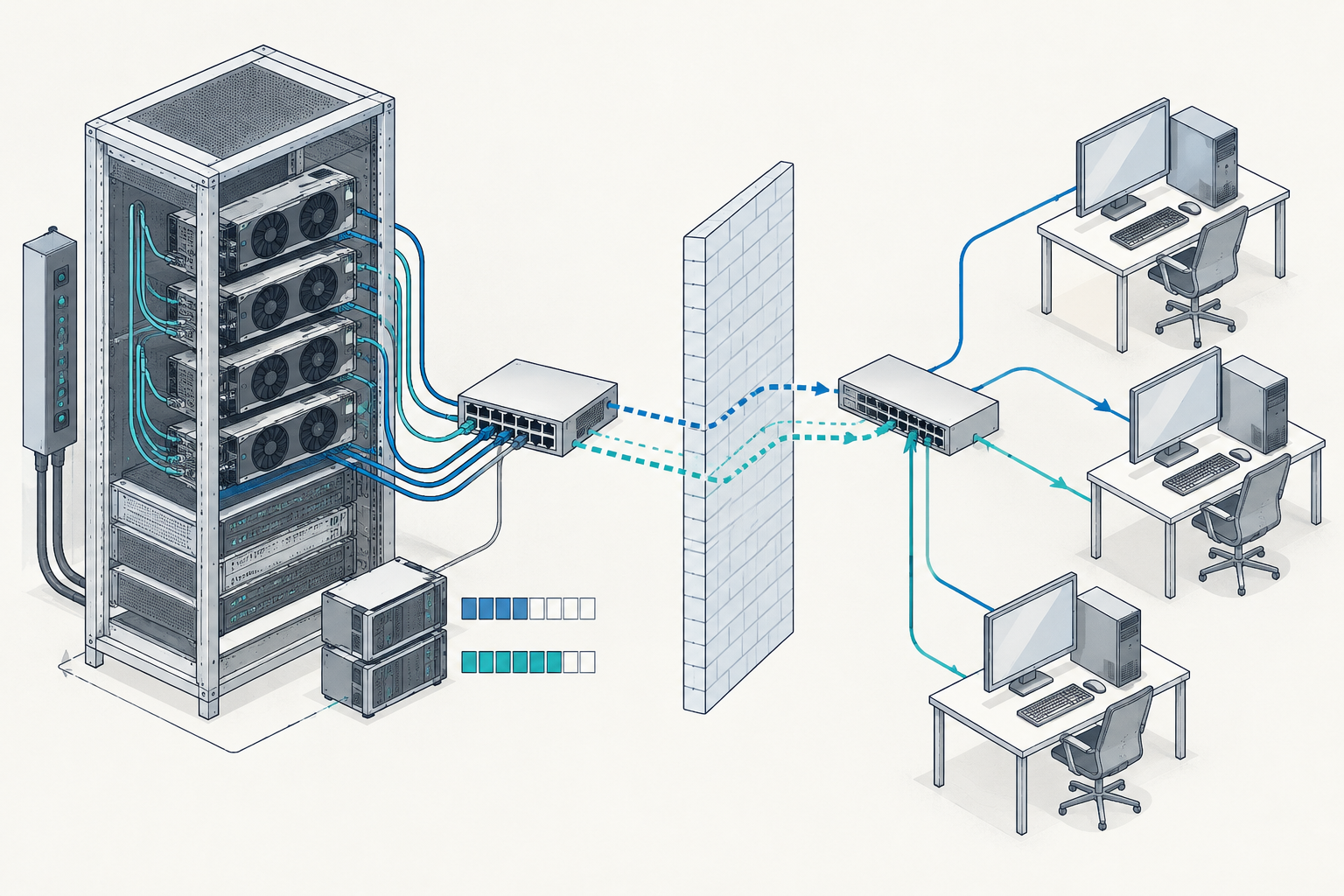
Research meets the rack queue
Apple’s Minions research, described in the supplied references as submitted on October 9, 2026, proposes distributed inference across idle Apple Silicon devices. The supplied news record also places it on Hacker News’s October 13 archive. That combination makes it worth an operator’s attention, but neither a paper nor a discussion thread establishes a production service. The dates and implementation details should be checked against the primary sources before procurement or deployment decisions.
The Hacker News appearance is a community-attention signal, not Y Combinator editorial endorsement. Its assigned source weight of two is a news-selection input, not a measure of technical readiness. The operational question is narrower than whether office computers can perform inference: can their spare capacity reduce a GPU rack’s backlog without creating a larger reliability, security or support burden?
For an estate spanning a quarter rack to a few racks, the useful hypothesis is an interruptible overflow tier for non-sensitive batch inference. The following design is an applied evaluation framework, not a claim that Minions already implements these controls or that its reported results transfer to another environment.
The bottleneck is service capacity, not installed silicon
Consider an operator running interactive inference, tenant development environments and overnight document processing on the same GPU estate. Interactive requests need predictable latency. Development reservations consume memory even when compute activity is low. Batch work fills whatever capacity remains, then misses its deadline when daytime demand extends into the evening.
Adding accelerators is not always immediately possible. Rack power, cooling, procurement lead times or an upstream electrical limit may bind before the equipment budget does. Idle office machines appear attractive because they already exist. Yet installed memory and theoretical compute are not the same as available service capacity: someone can reclaim a desktop, close a laptop or disconnect a network cable.
The first intervention should remain inside the rack. Check whether tenancy rules strand capacity, whether compatible workloads can share supported GPU partitions, and whether quotas reserve more than tenants use. Partitioning is device-dependent and does not automatically provide identical isolation across hardware. Only export work after distinguishing genuine compute shortage from poor scheduling, storage stalls or excessive reservation.
Define the boundary before distributing work
There are two different architectures to evaluate. Independent batch jobs can be dispatched to separate machines, with each machine holding a complete usable model. Alternatively, one inference execution can span multiple devices. The latter may require repeated exchange of intermediate state and closer coordination. An ordinary office network can make that traffic disproportionately expensive.
Do not infer from the research headline that both modes have equivalent performance or failure behaviour. Read the paper for model sizes, precision, device configuration, network assumptions and the exact distribution mechanism. Reproduce the relevant configuration before extrapolating. An overflow pilot should start with independent jobs where feasible because failures and accounting are easier to contain.
Choose tasks that tolerate delay and replay: public-document classification, synthetic-data generation or evaluation against approved public datasets. Exclude interactive requests and anything whose deadline assumes uninterrupted access to an endpoint. Non-sensitive inputs are only the beginning; model weights, prompts, outputs and intermediate state also need an explicit data classification.
Put tenancy and policy above the worker pool
A system like Clastiq Orchestrator provides the operator-controlled foundation: bare-metal provisioning, Kubernetes and VM tenancy, GPU partitioning where supported, Ceph storage, per-tenant metering and chargeback, and quota and policy engineering. Those controls address the rack-side problem before an experimental endpoint pool is introduced. Hardware choice should remain a scheduling constraint, not the definition of the service.
Office-device execution still requires a compatible worker runtime and an integration with the job dispatcher. Nothing in the supplied product description establishes a ready-made Minions connector or an endpoint fleet manager. Treat that adapter, its authentication and its support procedures as engineering work, not an implied product feature.
Keep tenant identity attached to every job. A tenant allowed to consume rack GPU-hours should not automatically be allowed to export work to desktops. Define separate eligibility, concurrency, data-handling and budget policies for overflow. Reserve rack headroom for production tenants, and cap returning jobs so a desktop outage cannot flood the production queue.
Make interruption an ordinary state transition
A worker should claim a time-limited lease rather than permanently own a job. The scheduler records the lease, attempt identifier and expiry; the worker renews it while making progress. If the endpoint disappears, the lease expires and another eligible worker can retry. Lease length must reflect task duration and observed network interruptions, not an arbitrary universal default.
A late worker can return after its lease has expired. Prevent it from overwriting a newer result by checking an attempt token or fencing value when committing output. Assume at-least-once execution unless the complete workflow proves otherwise. External side effects, including billing and notifications, need idempotency keys independent of worker retries.
Use bounded retries and a dead-letter queue. Repeated model-loading errors should quarantine a worker or artifact, not consume every endpoint in turn. Where checkpointing is supported, test restore compatibility across runtime versions. Otherwise, divide work into smaller independent units so interruption wastes minutes rather than an entire overnight run.
Express the experiment as policy
The following is an illustrative dispatcher policy, not Clastiq CLI syntax or a documented Minions configuration. It makes the intended contract reviewable before anyone writes the integration:
queue: public-batch-overflow
eligibility:
  data_class: public
  model_export_approved: true
  managed_endpoint: true
execution:
  lease_seconds: 300
  max_attempts: 3
  commit_requires_current_attempt: true
limits:
  tenant_concurrency: 2
  rack_fallback_concurrency: 1
A real implementation also needs deadline handling, worker renewal intervals, cancellation and a definition of which failures count toward the attempt limit. Keep policy enforcement server-side: an endpoint’s claim that it is idle or compliant is not sufficient authority to receive work.
| Decision | Rack tier | Office overflow tier |
|---|---|---|
| Workload | Latency-bound or restricted | Approved interruptible batch |
| Availability | Operator-managed service | Reclaimable capacity |
| Admission | Tenant quota and reservation | Quota plus endpoint eligibility |
| Accounting | Allocated resources and outcomes | Accepted outcomes and retry cost |
| Failure response | Service recovery policy | Expire lease, retry within budget |
This split prevents opportunistic capacity from silently inheriting the promises made for dedicated infrastructure.
Model distribution can consume the saving
Before measuring inference speed, measure cold-start behaviour. A 20 GB model copied to 20 endpoints represents 400 GB of distribution traffic before retries or updates. Over a single 1 Gbit/s bottleneck, that is roughly 53 minutes at the theoretical 125 MB/s maximum, using decimal units. Protocol overhead, shared traffic and disk writes make the actual interval longer.
Cache approved artifacts locally, verify checksums and stagger distribution. Record the model digest, runtime version, quantisation and tokenizer with each result. Otherwise, an apparently successful retry can produce a materially different output because it ran against another artifact. Model licences also need review before weights are replicated outside the rack.
Ceph can hold the authoritative input and result datasets within the operator’s infrastructure. That does not mean desktops should receive broad storage credentials or direct access to internal storage networks. Prefer a scoped transfer service with short-lived access to the specific objects required. Budget separately for staging, cache eviction and deletion verification when an endpoint leaves the pool.
Endpoint trust is a scheduling input
A managed office computer is not automatically a trusted inference worker. Require authenticated enrollment, short-lived worker credentials, encrypted transport and revocation. Keep tenant secrets out of endpoint configuration. An administrator on the endpoint may be able to inspect memory or alter execution, so encryption in transit cannot establish confidentiality from that endpoint.
Apply output validation suited to the workload. Schema checks catch malformed responses; known-answer samples and selective duplicate execution can expose some silent failures. Neither proves that every generative answer is correct. Include validation overhead in the experiment, and reject tasks whose correctness requirements cannot be met within the proposed trust model.
Sovereignty also concerns where copies and operational metadata travel. Owning the rack does not guarantee control if endpoints use external synchronization, remote support or telemetry services. Maintain an approved location and network boundary. In an air-gapped deployment, model import, worker enrollment, updates and logs must remain inside the controlled process; a public coordination dependency would break that design.
Work through the economics in rack-equivalent units
Consider a hypothetical eight-GPU rack tier operating across a ten-hour batch window. It offers 80 GPU-hours of capacity. Existing commitments consume 68 GPU-hours, or 85%, leaving 12. The incoming batch requires 24 GPU-hours on the measured rack configuration, so the window has a 12 GPU-hour deficit. These are planning assumptions, not Cognition-AI or Apple benchmarks.
Suppose a pilot sends that batch to 20 office devices for six hours: 120 endpoint-hours. After transfers, interruptions, retries and validation, accepted output equals what the rack completes in 15 GPU-hours. The batch has nine rack GPU-hours remaining. Those fit within the available 12, leaving three GPU-hours of headroom. The measured exchange rate is eight endpoint-hours per recovered rack GPU-hour.
Now price the experiment. Assume incremental endpoint power averages 35 W during those 120 hours: 4.2 kWh. At an illustrative $0.10/kWh, electricity costs $0.42. Add $3 for allocated network and storage costs and 30 minutes of incremental operator time at $40/hour, or $20. Total incremental cost is $23.42, approximately $1.56 per recovered rack GPU-hour.
If the alternative really costs $2 per GPU-hour, avoiding 15 hours is worth $30, leaving $6.58 before development, device wear and other omitted costs. At two hours of operator attention, total cost becomes $83.42 and the experiment loses on that comparison. Freed capacity creates revenue only if saleable demand exists; otherwise, the benefit is deadline relief, not automatically cash savings.
Meter outcomes without hiding waste
Raw endpoint-hours are unsuitable as a universal customer billing unit because devices have different throughput and interruption rates. Establish a workload-specific accepted-output unit, such as validated documents at a pinned model configuration. Keep the rack-equivalent conversion visible as a measurement, not a permanent promise across models, sequence lengths or precision settings.
Maintain separate ledgers for customer usage and operational waste. A tenant might be charged for accepted work while the operator records transfer time, rejected output and retries as service costs. Alternatively, an explicitly disclosed resource-based tariff can expose those costs. Do not bill the same completed task twice because two workers raced after a lease expiry.
Quota policy should limit input volume, concurrent attempts, artifact distribution and rack fallback, not only successful output. A tenant can exhaust storage bandwidth with jobs that never finish. Per-tenant metering and chargeback provide the accounting foundation; the overflow adapter must emit sufficiently complete, deduplicated events for that foundation to remain accurate.
Measure power and people alongside throughput
Recovered rack time does not necessarily reduce rack electricity proportionally. Accelerators and hosts have idle power, and freed slots may immediately serve another tenant. Meanwhile, office inference adds heat and can extend cooling demand outside normal occupancy hours. Measure whole-system incremental power where possible rather than treating chip power specifications as energy bills.
Run the pilot across actual office conditions: working hours, overnight sleep policies, operating-system updates and network congestion. Track accepted throughput, completion-time percentiles, interruption rate, retry amplification, cache-hit rate and operator minutes. Record desktop usability complaints too. A pool that relies on disabling staff power-management settings has changed the cost boundary.
Set stop conditions before launch. Pause admission when office responsiveness degrades, transfer traffic threatens production storage, validation fails or support time exceeds the value of recovered capacity. Human-led local support can help operate the boundary, but it does not eliminate its labour cost. Research becomes useful infrastructure only when those costs remain observable and bounded.
What to do this week
- Verify the research assumptions. Read the paper and Apple research page; confirm dates, topology, runtime requirements and whether the tested mechanism matches your proposed workload.
- Establish the rack baseline. Measure one batch workload’s accepted throughput, queue delay, allocated GPU-hours and power before changing scheduling or exporting work.
- Approve a narrow boundary. Select public or explicitly cleared inputs, review model distribution rights, and enroll a small managed endpoint pool with revocable credentials.
- Test failure deliberately. Interrupt a worker, expire a lease, submit a late result and exhaust retries. Confirm deduplicated commits and bounded rack fallback.
- Run a costed comparison. Include model staging, validation, incremental power and operator minutes; expand only if accepted throughput and deadline relief justify the full cost.
Clastiq Orchestrator runs the infrastructure foundation on the operator’s own hardware; request a demo to discuss the overflow integration boundary.