A funding signal, not a hardware order
Qatar’s Aligator raised $1.2 million in a seed round, according to the Wamda announcement dated September 30, 2026, identified for this story. The announcement falls inside the September 25–October 4 monitoring window. It provides a financing signal for autonomous public-relations agents, not evidence of a particular infrastructure purchase.
For GCC operators, the relevant question is what a service supporting workloads like media monitoring, drafting and outreach would require. Aligator’s actual hosting architecture, workload volumes and demand for on-premises GPUs are not established by the supplied reference. The design below is therefore a worked operating scenario, not a description of Aligator’s systems.
The infrastructure constraint is predictable multi-tenant utilisation. A quarter-rack operator cannot let a scheduled monitoring sweep consume every accelerator just as clients request urgent drafts. Nor can it reserve the entire estate for interactive work and expect idle capacity to pay its bills. The opportunity is to separate workload classes, meter their consumption and keep confidential material within an explicitly defined boundary.
Separate deadlines before choosing accelerators
A PR-agent pipeline combines several different resource profiles. Feed collection spends time on networks, parsers and external services. Embedding newly collected material can run in batches. Retrieval stresses memory and storage. Draft generation consumes accelerator capacity unevenly, while outreach introduces permissions, approval workflows and external delivery dependencies.
Putting all of these behind one unbounded queue creates avoidable contention. A long summarisation job can occupy inference slots that an interactive editor needs. Repeated agent retries can multiply traffic without increasing useful output. More GPUs may postpone the failure, but they do not establish fairness.
Define service classes around deadlines rather than model names:
| Workload class | Scheduling approach | Primary control |
|---|---|---|
| Scheduled monitoring and embeddings | Deferred, checkpointed batch windows | GPU-hour budget and queue age |
| Interactive drafting and revision | Reserved capacity with bounded concurrency | Waiting time and token limits |
| Retrieval and document ingestion | Tenant-scoped CPU, memory and storage pools | Access control and I/O quotas |
| Outreach and agent actions | Approval-aware application workers | Tool permissions and retry limits |
Start with separate worker pools even when they initially share physical hosts. That makes contention measurable before the operator decides whether dedicated hardware is necessary.
Size the quarter rack around the facility
A quarter rack is a physical envelope, not a capacity unit. Confirm usable rack units, circuit capacity, cooling capability, airflow and switch ports before selecting servers. Accelerators with similar memory capacities can have substantially different host power, cooling and interconnect requirements.
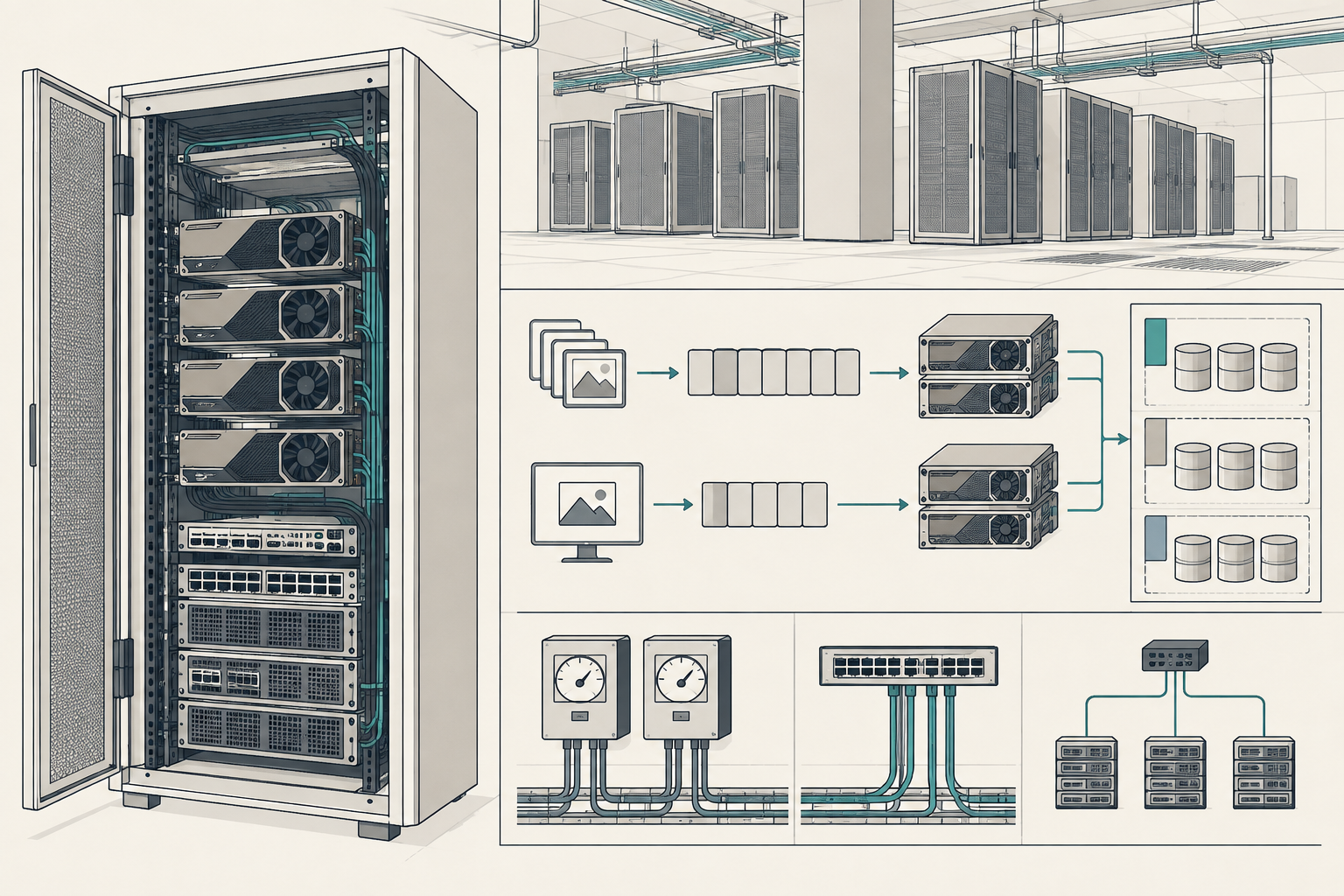
For an illustrative estate, assume two compute hosts with two allocatable GPUs each, plus the CPU, networking and storage resources required for the service. This is a sizing assumption, not a recommended bill of materials. Whether it fits depends on chassis density, storage placement and the facility’s operating limits.
Use an initial pool of two GPUs for interactive inference and two for batch work. Borrowing between pools should be conditional: batch jobs must be interruptible, interactive reserve must be recoverable within a tested interval, and queued requests must remain bounded. Loading model weights can make reclamation much slower than merely terminating a process.
N+1 service is not automatic. Losing one two-GPU host removes half the example’s accelerator capacity. Write a degraded-mode policy that suspends batch processing, limits interactive concurrency and identifies which tenant commitments still hold. Do not sell four GPUs of guaranteed capacity against four installed GPUs.
Make utilisation a scheduling contract
The scheduler needs more than a GPU count. Record model memory requirements, maximum context length, expected output length, permitted concurrency and whether a job can restart safely. Long contexts and growing inference caches can exhaust memory while aggregate device utilisation still looks acceptable.
Where hardware supports enforceable accelerator partitioning, partitions can provide more predictable resource boundaries. Where it does not, alternatives include whole-device assignment or carefully controlled time-sharing. These options do not provide identical isolation. Shared inference processes also require application-level separation regardless of the device allocation method.
For Kubernetes tenants, use namespaces, resource quotas, network policy and appropriately configured device resources. For workloads needing a different operating-system boundary, provide VM tenancy and validate passthrough or virtual-device support on the chosen platform. A namespace alone is not a complete security boundary.
A platform such as Clastiq Orchestrator supplies the provisioning and tenancy control plane across operator-owned hardware. Its GPU partitioning, quota and policy capabilities can express the allocation plan. Application queues, model-server settings and tenant-aware authorisation must still implement the service behaviour; infrastructure orchestration does not replace those controls.
Put admission control ahead of inference
Every client should have a finite allowance for concurrent requests, queued work, input size and generated output. Agent workflows need an additional budget across the whole task. Otherwise, a single approved request can trigger repeated retrieval, drafting and revision calls that evade per-request limits.
The following is an illustrative application policy, not a Clastiq configuration format:
tenant: client-a
interactive:
  max_in_flight: 2
  max_queued: 20
  max_input_tokens: 12000
  max_output_tokens: 2000
  queue_timeout_seconds: 30
batch:
  monthly_gpu_hour_limit: 60
  max_active_jobs: 1
agent_task:
  max_model_calls: 8
  require_approval_before_send: true
Reject or defer excess work explicitly. Return a retry interval rather than allowing clients to retry immediately. Cap retries at the task level, attach idempotency keys to submissions and prevent duplicate sends when outreach workers restart.
Watch queue age alongside queue length. Twenty short drafting requests and twenty document-wide analyses represent different commitments. Estimate admitted token volume where possible, but calibrate it against actual service times. Token counts alone cannot describe retrieval delays, model loading or external tool calls.
Keep retrieval isolated from ingestion onward
Tenant-isolated retrieval begins before the vector query. Assign ownership when documents enter the system, preserve that ownership through parsing and chunking, and enforce it when writing embeddings, fetching source passages and generating citations.
A separate index per tenant is straightforward to reason about, although operational overhead grows with tenant count. Shared indexes require mandatory server-side access filtering and tests that deliberately attempt cross-tenant retrieval. A filter supplied only by the client is insufficient. Public media can form a shared corpus, but private annotations and campaign strategy must remain tenant-scoped.
Ceph can provide storage for source documents, processed artefacts and persistent workloads. Its role is durable storage under an explicit design; it does not make a vector database tenant-aware. Apply scoped credentials, network restrictions, capacity quotas and an appropriate encryption and key-management design.
Do not treat two compute hosts as an adequate resilient storage design by default. Define storage failure domains, quorum, replication overhead and recovery capacity separately. A small installation may need additional storage nodes or an existing operator-managed cluster. Recovery traffic must be included in network sizing.
Meter tokens, capacity and outcomes separately
Per-client token metering belongs at the authenticated inference gateway and model-service boundary. Record tenant identity, request identity, model version, input tokens, output tokens, cached-token treatment and completion status. Establish whether failed, cancelled and retried requests are billable before issuing invoices.
Infrastructure meters answer a different question: how much capacity was allocated, for how long, and to which tenant or service pool? Clastiq Orchestrator’s per-tenant metering and chargeback capabilities provide the infrastructure side. Token accounting requires application instrumentation and reconciliation with those records; it should not be inferred from GPU allocation alone.
For shared model servers, individual request GPU time may be difficult to attribute precisely because batching combines tenants. Avoid presenting an allocation formula as direct measurement. Publish the chargeback method: reserved-capacity subscription, token-based consumption, batch GPU-hours, or a clearly defined combination.
Keep prompts and confidential drafts out of routine billing logs. Request identifiers, counters and status fields usually suffice for reconciliation. Separate access to financial records from access to application content, and define retention for both.
Work the capacity and chargeback numbers
Consider the four-GPU example over a 30-day month. Installed capacity is 4 × 24 × 30 = 2,880 GPU-hours. Assume the operator makes 90% available for planned service after maintenance and operational headroom: 2,592 GPU-hours. This is a planning allowance, not an availability guarantee or a throughput benchmark.
Split that usable budget evenly. Interactive service receives 1,296 GPU-hours and batch service receives 1,296. Suppose interactive work consumes 45% of its budget: 583.2 GPU-hours. Batch work consumes 80%: 1,036.8 GPU-hours. Total productive consumption is 1,620 GPU-hours, or 62.5% of the usable budget and 56.25% of installed capacity.
Assume monthly cost attributable to this service is $3,240, including hardware amortisation, support, power, cooling, networking and storage. That gives $3,240 ÷ 1,620 = $2.00 per productive GPU-hour. Spreading the same cost across installed capacity would show $1.125 per GPU-hour, but that figure conceals idle and unavailable capacity.
For internal chargeback, allocate half the cost to each pool. Interactive capacity then costs $1,620 ÷ 583.2, approximately $2.78 per productive GPU-hour. Batch capacity costs $1,620 ÷ 1,036.8, approximately $1.56. The difference is the cost of reserve, not proof that the interactive model is inefficient.
If measured consumption falls to 1,080 GPU-hours without changing monthly costs, unit cost rises to $3.00. This is why utilisation policy matters more than a peak tokens-per-second demonstration. A commercial price must additionally cover margin and risks excluded from the example; token tariffs require measured workload-specific conversion rather than a universal tokens-to-GPU-hours ratio.
Define what remains local in the GCC
For a Qatar-based client, “local” could mean a customer site, a Qatar data centre, or a permitted regional environment. These are different commitments. A Muscat-hosted service is not Qatar-resident merely because both locations are in the GCC. Contractual requirements and applicable rules need workload-specific review.
Map the complete data path: media ingestion, identity provider, retrieval database, model endpoint, telemetry, backups, support access and outbound email or messaging. Local inference does not preserve confidentiality if prompts are sent to an external observability service or sensitive attachments leave through an agent tool.
Confidential communications can remain within an operator-controlled boundary only if every relevant processing and storage path respects that boundary. Outreach to external recipients necessarily crosses it. Require an approval gate that shows the recipient, content and attachments, with policies for prohibited destinations and sensitive material.
Air-gapped operation introduces a separate constraint. Live monitoring and outbound outreach cannot use ordinary internet connectivity inside a strict air gap. A viable pattern is controlled import of collected material, local analysis and approved export of drafts. Clastiq supports air-gap deployments, but the operator must define transfer procedures, update handling and the resulting limits on agent autonomy.
Budget power and recovery together
Measure whole-service power rather than adding accelerator nameplate values. Hosts, storage, switches and fans consume power when inference is idle. Power caps may reduce facility risk but can also increase completion time and queue occupancy; test both effects under representative traffic.
For illustration, an average IT load of 4 kW over 720 hours consumes 2,880 kWh. With an assumed facility PUE of 1.5, attributable facility energy is 4,320 kWh. At an assumed $0.08 per kWh, that is $345.60 monthly. These are scenario inputs, not a Qatar tariff claim, and would be included within—not added again to—the earlier cost assumption.
Run failure drills while measuring latency and storage recovery. Restart a model server, remove a compute host and test a storage failure consistent with the design. Check that quotas remain enforced and that interrupted jobs cannot duplicate external actions.
Operate the service, not just the cluster
Clastiq Orchestrator connects bare-metal provisioning, Kubernetes and VM tenancy, GPU allocation, Ceph storage and per-tenant accounting on the operator’s equipment. That gives a small infrastructure team a control surface for enforcing the resource plan rather than maintaining disconnected allocation spreadsheets.
It does not establish application accuracy, authorise outreach or determine legal residency requirements. Those remain explicit application and governance responsibilities. Human-led local support should work from tested runbooks covering capacity reclamation, failed storage, tenant isolation incidents and offline updates. Cognition-AI is based in Muscat, Oman; agree the support scope and access boundary before onboarding sensitive clients.
What to do this week
- Capture a representative workload trace, including arrival times, token counts, retrieval latency and agent calls per task. Use synthetic or approved content.
- Establish separate interactive and batch pools, then test reclaiming borrowed capacity with model-loading time included.
- Run cross-tenant retrieval tests across indexes, document stores, caches, logs and backups; document every isolation boundary.
- Implement bounded queues, tenant concurrency limits and task-level retry budgets. Require approval before external communications leave the service.
- Reconcile one week of token records with infrastructure allocation meters, measured power and the declared chargeback formula.
- Draw the residency and failure-domain map, then rehearse host loss and controlled data import or export where air gaps apply.
Clastiq Orchestrator runs this infrastructure on the operator’s own hardware: request a demo.