Google puts agent execution on the infrastructure agenda
Google announced Agent Compute Engine on October 22, 2026, with customer preview expected in the coming months. That timing matters: this is an announcement to assess, not an immediately generally available service around which to schedule a production migration. The immediate change for enterprise operators is a planning question, not a purchasing deadline: what infrastructure does an agent need beyond the capacity that generates its next response?
The distinction is consequential. Model inference produces outputs; an agent execution environment must also run application logic, call tools, maintain state and handle interruptions. Those activities create demand for compute, persistent storage and networking even when the model itself runs elsewhere. Buying or reserving GPU capacity does not, by itself, provision an operational agent service.
For rFactorial, the product group owned by Muscat-based Cognition-AI, this connects directly to Clastiq Orchestrator’s private-cloud orchestration across compute, GPU, storage and networks. Clastiq Lite addresses a related but narrower need: team self-service AI and GPU sharing. Radon adds the application perspective through visual workflows, chatbots and AI-agent services connected to enterprise systems and deployed on approved infrastructure.
These are planning connections, not claims of integration with Google’s announced service. The useful response is to inventory workloads, assign provisioning responsibility and establish shared-capacity rules before selecting an execution platform.
Separate inference from execution
An enterprise agent request is rarely a single infrastructure event. Consider an internal service that receives a question, retrieves approved information, asks a model to interpret it, calls an enterprise tool and returns a proposed action. The inference step may be short, while waiting for a source system or completing a tool operation dominates elapsed time.
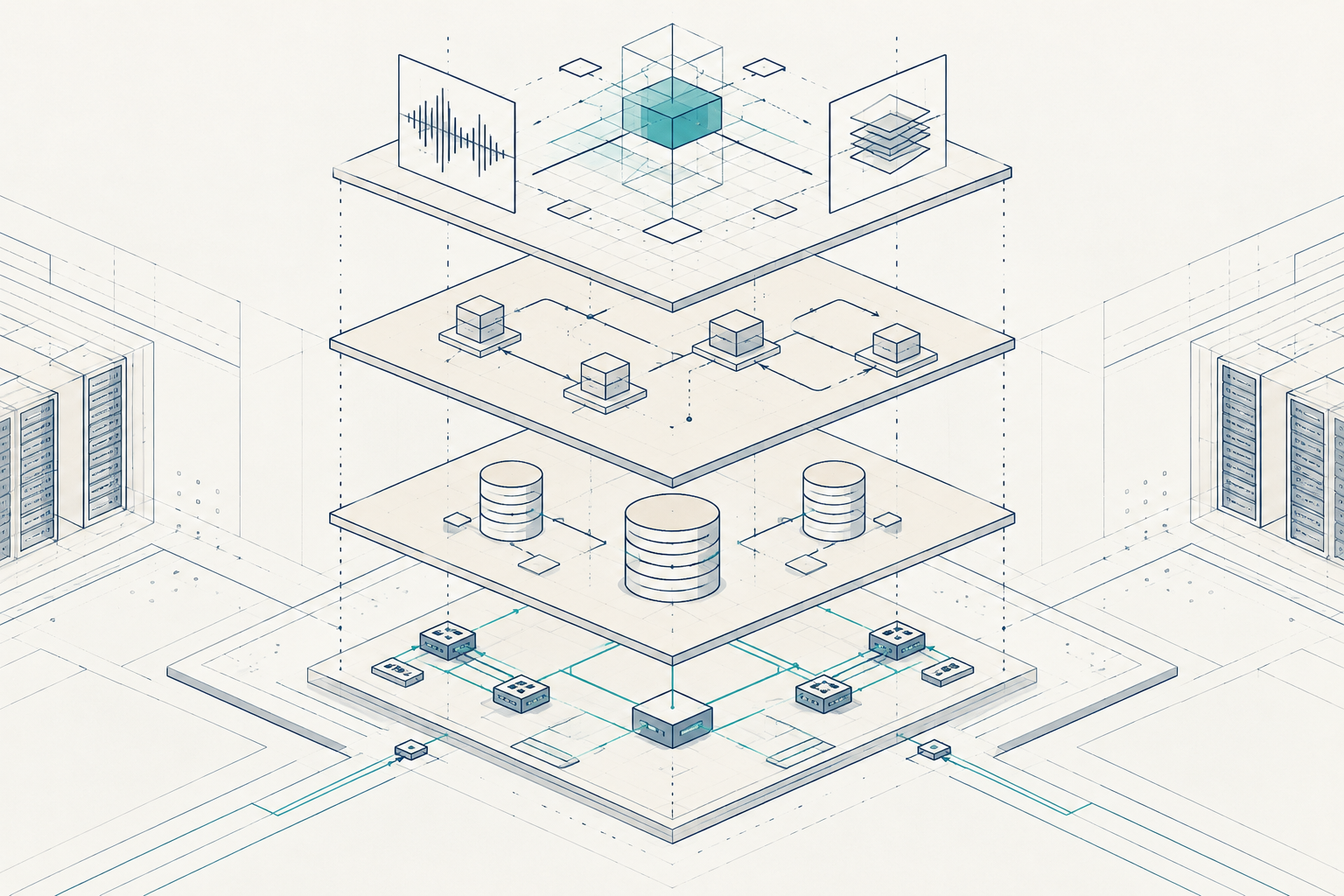
Start with four resource categories. Inference capacity covers model requests, token volumes and any locally hosted accelerators. Execution capacity covers the processes performing workflow steps, tool calls and retries. Persistent storage covers retained state, intermediate artifacts and operational records. Networking covers the paths between users, execution environments, models and enterprise systems.
| Resource category | Inventory first | Planning measure |
|---|---|---|
| Inference | Model location and request pattern | Requests, tokens and queue time |
| Execution | Runtime, concurrency and task duration | Active tasks and CPU/memory demand |
| Persistent storage | State, artifacts and retention | Growth, access rate and recovery needs |
| Networking | Destinations and transfer patterns | Latency, bandwidth and failure rate |
Do not collapse these into a single utilisation figure. A busy GPU can coexist with idle execution workers; saturated workers can delay tasks while a model endpoint has spare capacity. Storage latency can lengthen every task without noticeably increasing GPU use. Each condition requires a different intervention.
Clastiq Orchestrator’s verified scope makes this resource separation relevant to private-cloud planning. It does not establish that agent-specific scheduling, state management or recovery policies are built into the product. Operators must define those application requirements and validate how their chosen runtime implements them.
Inventory workflows before sizing infrastructure
The first deliverable should be a workload register, not a hardware bill. For each proposed agent service, record its business owner, trigger, expected task volume, completion target, model dependency, enterprise destinations, data classification and maximum permitted action. Separate advisory work from actions that change business records.
Record waiting time as well as processing time. A workflow that waits for human approval for several hours should not automatically reserve the same execution resources throughout that period. Whether it can release resources depends on its runtime design, including how state is stored and execution resumes. Test that behaviour rather than assuming it.
Distinguish interactive requests from background work. Employees waiting for an answer have different service expectations from a nightly document-processing queue. Putting both into one unrestricted pool can make an otherwise adequate infrastructure estate feel unreliable. Classifying work creates a basis for admission limits, queue priorities and maintenance windows.
Radon is relevant here because its verified remit includes visual workflows and AI-agent services connected to enterprise systems on approved infrastructure. Teams can use the workflow definition as the basis for an infrastructure review. They should still document runtime requirements explicitly; a visual workflow does not remove responsibility for capacity, permissions or failure handling.
Give provisioning decisions named owners
Agent deployments cross boundaries that enterprises often manage separately. The AI team may choose a model, the application team may own workflow logic, infrastructure may provision resources, and an enterprise-system owner may control the destination API. Without a responsibility map, a slow task becomes an argument about whose dashboard is correct.
Assign an owner and an approver to every resource category. The application owner specifies concurrency, state and completion requirements. Infrastructure translates those requirements into available compute, storage and network capacity. Security and data owners approve access boundaries. The owner of each connected enterprise system establishes acceptable call volumes and operating windows.
Provisioning responsibility must include change authority. Who can raise an agent’s concurrency ceiling? Who approves a new network destination? Who can extend retention or switch the model endpoint? A change that looks local can increase costs or exposure elsewhere. Raising execution concurrency may overwhelm a downstream system without materially changing inference demand.
Clastiq Lite’s team self-service AI and GPU sharing can support a shared-resource operating model, but self-service should not be confused with unlimited authority. Define which requests teams may make independently and which need review. Verify implementation details during evaluation rather than treating quotas, approvals or accounting features as supplied product capabilities.
Worked example: size the bottleneck, not the headline
The following numbers are illustrative planning assumptions, not product benchmarks. Suppose an internal agent service receives 1,200 tasks during an eight-hour working day. Each task occupies an execution slot for an average of 90 seconds, including model and tool waits. Assume requests arrive at 2.5 times the daily average during the busiest interval.
The average arrival rate is 150 tasks per hour. At 90 seconds per task, average concurrent occupancy is 150 × 90 ÷ 3,600, or 3.75 execution slots. At the assumed peak arrival rate of 375 tasks per hour, occupancy rises to approximately 9.4 slots. An initial test allocation of 12 slots provides headroom against that simplified peak estimate.
Twelve slots at a constant 90-second duration have a theoretical capacity of 480 tasks per hour. That is not a production throughput promise: duration variability, retries and downstream limits can reduce it. The arithmetic establishes a starting point for load testing, not permission to skip one.
Now assume each task makes two model calls, averaging 2,000 input tokens and 500 output tokens per call. Daily inference demand is 4.8 million input tokens and 1.2 million output tokens. If inference is external, these calls do not establish a local GPU requirement. If models are hosted privately, model-specific testing must translate that demand into accelerator capacity and latency targets.
Suppose each task also retains 0.5 MB of state and artifacts for 30 days, with the same workload every day. Logical retained volume is 1,200 × 0.5 MB × 30, or 18 GB using decimal units. Backups, replication, indexes and operational logs are additional; they must not silently disappear from the storage estimate.
Finally, assume four downstream API calls per task. Peak demand is 1,500 calls per hour, averaging 25 per minute during the peak interval. A destination limited to 20 calls per minute can support only 300 tasks per hour under these assumptions. Adding workers or GPUs cannot remove that bottleneck. Burst behaviour still needs testing even if the hourly averages fit.
Make shared capacity an operating agreement
Shared infrastructure needs rules about contention. Separate guaranteed service commitments from opportunistic work. A departmental experiment should not displace a production workflow simply because it submits more tasks. Equally, reserving infrastructure permanently for occasional work can leave expensive capacity unused.
For a Clastiq Orchestrator deployment, review compute, GPU, storage and network requirements together while retaining separate capacity measures. For Clastiq Lite, establish how teams request and share AI and GPU resources. In both cases, specify the intended operating policy first and confirm which controls are available in the evaluated configuration.
A small workload manifest can make review concrete. This YAML is an illustrative planning artifact, not a Clastiq or Radon configuration format:
workload: internal-service-agent
owner: enterprise-applications
execution:
  test_concurrency: 12
  mean_task_seconds: 90
inference:
  location: approved-external-endpoint
  calls_per_task: 2
state:
  retention_days: 30
downstream:
  calls_per_task: 4
  approved_calls_per_minute: 20
The manifest exposes the mismatch in the worked example: the downstream allowance cannot sustain the assumed peak. Resolve it through an agreed higher allowance, queueing, reduced call count or a revised completion target. Do not hide the mismatch by allocating more infrastructure upstream.
GCC deployment checklist: map data paths explicitly
Although Google’s announcement is global, GCC deployment planning needs an explicit location and responsibility review. A private execution environment does not necessarily mean private inference, and a regional model endpoint does not establish where every artifact, support record or backup resides. Map actual flows rather than assigning a single location label to the whole service.
For an Oman-based organization or a group operating across GCC markets, start with the workload inventory. Identify which legal entity owns each workflow, which teams use it and which data categories it processes. Determine applicable residency, transfer and retention obligations with the organization’s legal and security teams. Do not assume identical requirements across jurisdictions or sectors.
Next, document provisioning responsibility by location. Identify who approves the private-cloud resources, model destination, enterprise-system connection and recovery location. Record whether a dependency is locally operated or accessed across a wider network. Test the resulting latency from the intended deployment site rather than relying on a provider’s regional presence as a performance proxy.
Then define shared-capacity boundaries. Decide whether separate companies or departments may share execution infrastructure and which data or service requirements require separation. Shared GPU access is one question; shared state stores and network permissions are different questions. Approval of one should not imply approval of the others.
Include an outage scenario in the checklist. If a model endpoint or enterprise destination becomes unreachable, should work queue, expire or require manual handling? Avoid assuming automatic cross-border failover is acceptable. Any alternative destination needs its own review of data handling, permissions and operational responsibility before an incident occurs.
Governance follows actions and state
Agent governance is not limited to checking a generated answer. Operators need to understand what the service may read, what it may change and which intermediate records survive the task. Define permissions around specific workflow steps, with human review where consequences justify it.
Retries deserve particular attention. If an enterprise operation succeeds but its acknowledgement is lost, repeating the task can duplicate a change. Application teams should establish how they detect completed actions and reconcile uncertain outcomes. Infrastructure availability does not solve this application-level problem.
Persistent state also creates lifecycle obligations. Record what is retained, why it is needed, who can access it and when it is deleted. A short user interaction can generate a much longer-lived operational record. Retention should reflect business and legal requirements rather than whatever storage happens to be available.
For Radon-based work, these questions belong in workflow design and deployment review. For Clastiq-based infrastructure, they inform the resource and network requirements submitted by the application team. This division keeps governance attached to accountable decisions without implying unverified product controls or certifications.
Measure completion, queues and recovery
Evaluate the service at three levels. Business measures include successfully completed tasks and the share needing human correction. Application measures include queue age, completion latency, retries and failed tool calls. Infrastructure measures include execution occupancy, inference demand, storage growth and network performance.
Report both typical and tail behaviour. A satisfactory average can conceal a small group of tasks that wait excessively or repeatedly fail. Compare measurements by workflow and workload class so that background jobs do not obscure interactive performance. Include the downstream systems in the investigation.
Use a staged acceptance test: representative inputs, controlled peak traffic and deliberate dependency failures. Measure whether queued tasks recover correctly and whether uncertain actions are escalated. Google’s preview timing leaves room for this work now. A documented workload and acceptance plan will remain useful whether the eventual execution platform is private, managed or a combination.
What to do this week
- Inventory three candidate workflows. Record volumes, task duration, model calls, retained state and enterprise destinations. Separate inference requirements from execution requirements.
- Assign provisioning owners. Name the decision-maker for compute, GPU, storage, networking and each downstream connection, including who can approve capacity changes.
- Run one capacity calculation. Use measured durations where available, estimate peak occupancy and check downstream limits before requesting additional resources.
- Review GCC data paths. Document execution, inference, storage and recovery locations; obtain the necessary organizational review for each path.
- Prepare a bounded pilot. Evaluate Clastiq Orchestrator against the private-cloud resource plan, Clastiq Lite where team AI and GPU sharing is relevant, and Radon where enterprise-connected agent workflows are needed. Set completion, queue and recovery acceptance criteria first.
Product scope and destinations: Clastiq and Radon.