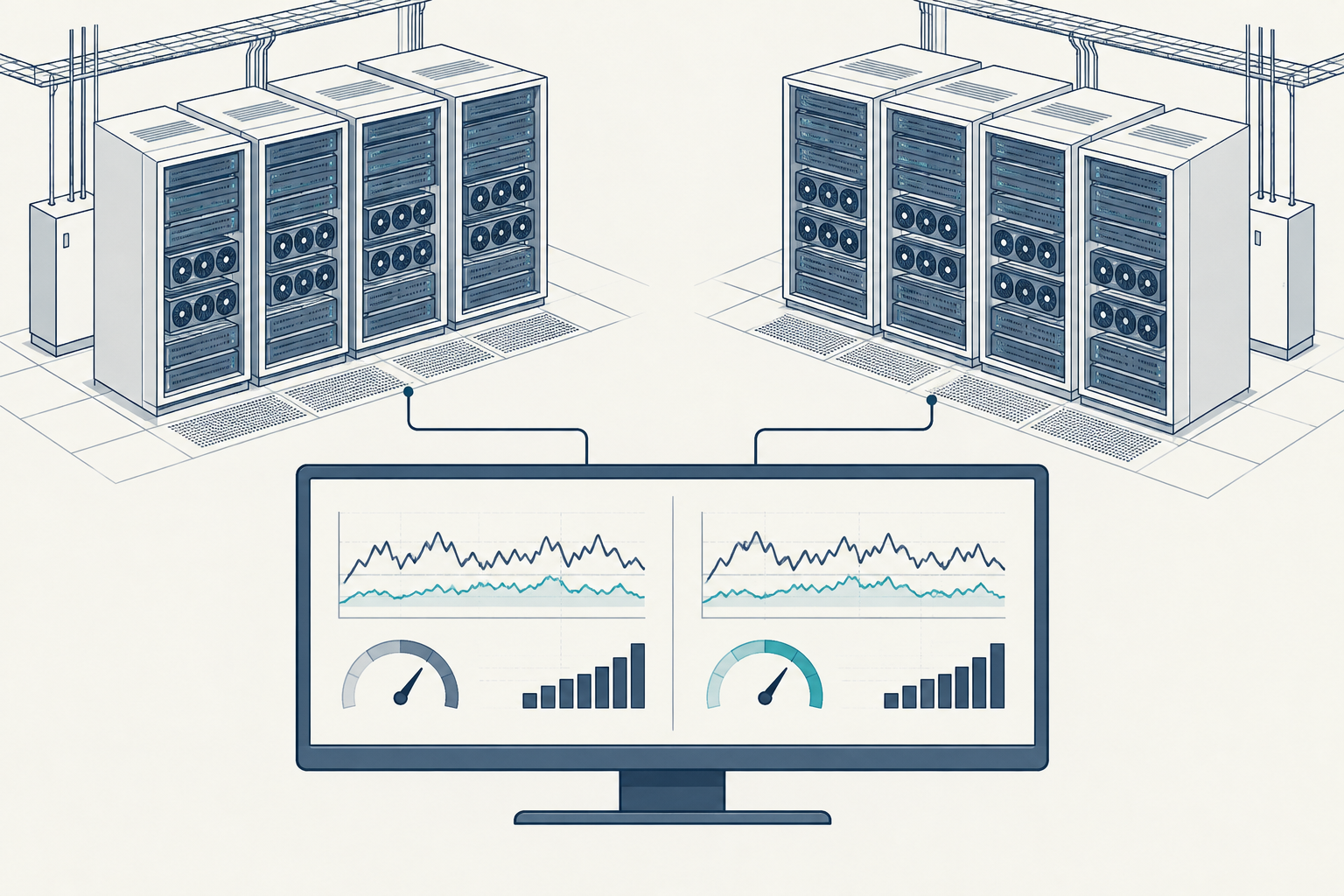
LLM-PowerTrace changes the measurement question
LLM-PowerTrace, described in the supplied research brief as submitted on October 28, 2026, introduces time-resolved, per-GPU power measurements across fine-tuning and inference workloads. Its relevance to infrastructure operators is the measurement approach: GPU electricity consumption needs to be examined over time and against useful work, not inferred from a utilization percentage. The submission date and scope here follow the supplied brief; no experimental results or numerical findings from the paper are asserted.
For teams paying for underused on-premises GPUs, this creates a practical evaluation question. Does consolidating workloads reduce energy per completed task while preserving service levels, or does contention extend execution enough to erase the benefit? A second question follows: does consolidation synchronize power spikes that make rack-level demand harder to manage?
Neither answer is available from utilization alone. A busier GPU can be more productive, less responsive, or both. Operators need completed work, latency, energy and peak-demand measurements collected over the same test window.
For Cognition-AI, based in Muscat, Oman, the product connection is infrastructure orchestration. Its rFactorial product family includes Clastiq Orchestrator for private-cloud orchestration across compute, GPU, storage and networks, and Clastiq Lite for team self-service AI and GPU sharing. Power-aware scheduling is an evaluation proposal in this article, not a claimed existing capability of either product.
Start with the bill and the service contract
An idle GPU has several costs, only some of which change when workloads move. Hardware acquisition, financing, support and reserved facility capacity generally remain after consolidation. Electricity consumption may fall, but only if measured power falls across the relevant equipment. Releasing an allocation is not equivalent to powering down a server.
That distinction matters when asking whether the organization is paying for idle on-prem GPUs. Consolidation can create capacity for queued work, avoid an expansion, or allow equipment to enter an approved lower-power state. Those are different outcomes and should appear separately in the business case.
Define the service contract before choosing a configuration. For interactive inference, record the allowed time to first token, inter-token latency, end-to-end latency and error rate. For fine-tuning, define the completed training work, evaluation acceptance criteria and deadline. A faster run that changes the learning outcome is not a like-for-like improvement.
Set a capacity objective too: serve a stated workload mix without adding hardware, rather than merely raise utilization. This prevents an apparently successful experiment from concealing longer queues or reduced output quality.
Build a comparison that can survive review
Use three configurations where feasible: dedicated allocation, consolidation with software sharing, and hardware partitioning on supported GPUs. Keep model versions, precision, input distributions, output limits, datasets and acceptance criteria fixed. Record any necessary batch-size changes as experimental variables rather than quietly treating them as equivalent.
Separate offline throughput tests from online arrival-pattern tests. An offline benchmark can keep every device busy continuously; production requests may arrive in bursts. Replay a representative arrival distribution, including quiet periods, because idle capacity and transition periods are central to this question.
Run warm-up separately, then collect repeated trials long enough to capture queue growth, checkpointing and workload completion. Alternate configuration order where possible to reduce thermal and background-load bias. Include model loading in a separate cold-start test if users regularly start and stop environments.
| Measure | Record | Decision relevance |
|---|---|---|
| Useful work | Accepted requests or validated training work | Prevents utilization-only conclusions |
| Latency | Queue time and p50/p95/p99 response metrics | Exposes interference |
| Energy | GPU and facility-relevant kWh | Measures electricity consequences |
| Demand | Short-window peak and billing-window maximum | Identifies capacity and tariff exposure |
| Reliability | Errors, retries and failed jobs | Captures hidden rework |
Define pass/fail thresholds before testing. A configuration that saves energy but violates a mandatory latency limit fails for that service, even if it remains suitable for batch work.
Choose sharing according to isolation requirements
GPU time-slicing, Multi-Instance GPU technology and Multi-Process Service solve different problems. They should not be interchangeable labels in a procurement document or a Kubernetes configuration review.
Time-slicing lets workloads take turns using GPU execution resources. In common Kubernetes device-plugin configurations, advertising additional shared GPU resources does not create equivalent physical devices or guarantee a fixed fraction of compute and memory. It can increase access for intermittent workloads, but contention and memory exhaustion remain operational concerns.
MIG partitions supported GPUs into hardware-backed instances with defined compute and memory resources. Available profiles constrain placement and model fit. It offers stronger resource isolation than time-slicing, but does not guarantee application latency or independently partition every shared host, storage or network resource.
MPS supports concurrent CUDA processes through a service architecture. Depending on the GPU, software version and configuration, it can provide controls over execution resources and memory. It is not automatically a hard tenant-security boundary, nor a substitute for checking the specific Kubernetes implementation and failure behavior.
For searches about Kubernetes GPU sharing with hard limits, the answer must name the resource being limited. A CPU limit, namespace quota or replicated GPU resource count does not establish a hard GPU memory or compute guarantee. Verify device support, plugin behavior and isolation requirements before admitting production tenants. Consult the technical material at Clastiq for deeper GPU-sharing guidance rather than treating this comparison as a deployment recipe.
Instrument power without mistaking it for energy
Collect timestamped device power, GPU identity, workload identity and application metrics. Synchronize clocks across hosts. Preserve sampling intervals and missing-data flags so that apparent spikes or savings can be checked against the raw record.
A basic NVIDIA-host collection command is useful for an initial experiment:
nvidia-smi \
  --query-gpu=timestamp,uuid,power.draw,utilization.gpu,memory.used \
  --format=csv \
  -lms 1000 > gpu-power.csv
This samples available telemetry once per second. It does not provide application latency, tenant-level energy attribution or rack power. Device support and sensor update behavior vary; a one-second polling interval cannot reconstruct shorter events. Validate the fields on the test hardware and stop collection explicitly at the end of the measurement window.
Integrate sampled watts over elapsed time to estimate watt-hours, using an appropriate numerical method and handling gaps explicitly. Dividing total energy by accepted completed work gives energy per useful unit. Include energy spent on failed requests and retries in the numerator.
Measure host or rack power where available. GPU telemetry excludes some or all CPU, memory, storage, networking, fan and power-conversion consumption. If facility overhead is estimated rather than measured, disclose the assumption and do not mix its result with device-only figures.
Track both short-window peaks and the demand interval relevant to the facility or tariff. A one-second maximum is not interchangeable with a fifteen-minute average maximum, and not every electricity contract charges for demand.
An illustrative consolidation result
Consider an illustrative one-hour inference trial on four identical GPUs. Both configurations accept the same request stream and complete 12,000 successful requests with the same output-length distribution and quality checks. These are hypothetical numbers, not LLM-PowerTrace findings or Clastiq benchmarks.
In the dedicated configuration, four GPUs each average 180 watts, consuming 0.72 kWh altogether. In the consolidated configuration, two GPUs each average 260 watts while the other two remain powered but unallocated at 45 watts each. Total GPU energy is therefore 0.61 kWh: two times 260 plus two times 45 watts, sustained for one hour.
The consolidated configuration saves 0.11 kWh, or approximately 15.3%, at the GPU measurement boundary. Energy per successful request falls from 0.060 Wh to approximately 0.0508 Wh. At an illustrative electricity rate of $0.10 per kWh, the saving is only $0.011 per trial hour, before other equipment and facility overhead.
Suppose p95 end-to-end latency rises from 1.8 seconds to 2.2 seconds against a 2.5-second limit. That metric passes, but p99 latency, errors and queue growth still require review. If the aggregate one-second power peak rises from 820 watts to 900 watts, lower energy has not produced a lower short-window peak.
The operational conclusion is conditional. Consolidation preserved this workload's completion count and passed the stated p95 limit while releasing allocations on two GPUs. It did not eliminate their idle draw, demonstrate rack-level savings or establish suitability for more tenants. The larger benefit may be accommodating another approved workload without purchasing hardware, but that requires a second interference test.
Test fine-tuning and inference together carefully
Mixed workloads introduce another trade-off. Fine-tuning may sustain high compute demand while inference needs short response times. Checkpoint writes, data loading and shared network traffic can create interference that a GPU-only dashboard misses.
Start with separate baselines, then overlap the workloads under a defined policy. Record inference tail latency and the fine-tuning job's time to accepted completion. Include checkpoint overhead and restart cost. If production procedures permit pausing training, test the real pause-and-resume sequence rather than assuming preemption is instant or free.
Compare energy across the full completion horizon. A configuration that looks efficient for one hour may leave training unfinished and consume additional energy later. Conversely, delaying a flexible job could reduce simultaneous peaks without changing its total energy substantially.
Avoid attributing shared-device energy precisely to individual jobs without a validated method. Aggregate energy for the workload bundle is often the more defensible initial measure. Internal chargeback can use a disclosed allocation rule, but that rule is accounting policy, not physical measurement.
Place the experiment within an orchestration workflow
Clastiq Orchestrator's verified role is private-cloud orchestration across compute, GPU, storage and networks. That provides the product context for evaluating resource placement and capacity policies. Clastiq Lite's verified role is bringing self-service AI and GPU sharing to teams. Neither description establishes a built-in power optimizer, telemetry integration or support for a particular sharing mechanism.
The practical workflow begins with an inventory of GPU models, memory sizes, host dependencies and workload owners. Operators then define dedicated and shared test pools using capabilities confirmed in their environment. They collect power and application measurements through separately validated instrumentation, review results, and promote only configurations that pass the agreed service and isolation checks.
For each candidate policy, document who may request shared capacity, which workloads require dedicated allocation, and how exceptions are approved. Define a rollback trigger, such as sustained tail-latency failure or repeated memory exhaustion. Maintain a known-good dedicated configuration so that recovery does not require designing a new deployment during an incident.
The Clastiq local-inference rack-test article is a related operational reference for planning local-infrastructure evaluation. Use the power experiment to extend the measurement scope, not to imply that either reference establishes product support for automated power-aware placement.
Govern shared capacity before scaling it
Resource sharing is also an access and accountability decision. A laboratory workload and a confidential production service may need different placement rules even when both fit into the same GPU memory. Determine trust boundaries, data-handling requirements, administrative access and acceptable failure domains before consolidation.
Keep an experiment manifest containing software versions, model identifiers, GPU configuration, workload inputs, test duration, thresholds and approvals. Restrict collected prompts or training samples where they contain sensitive information; power analysis usually needs workload identifiers and timing rather than content.
Agree how teams receive capacity and how idle reservations are reviewed. Reclaiming an unused reservation can improve access without guaranteeing any electricity reduction. Report allocation efficiency separately from energy efficiency so that teams are not rewarded for generating unnecessary work merely to appear busy.
Publish the failed tests alongside successful ones. Knowing that a particular workload pair breaches a latency target is useful scheduling evidence, not an embarrassment to hide.
Why this matters for GCC and MENA capacity planning
For organizations in Oman and across GCC and MENA markets, evaluating existing on-premises capacity before expansion can separate genuine hardware shortages from allocation problems. This is particularly relevant where private-cloud placement is an organizational requirement rather than a temporary preference.
Use local electricity tariffs, actual facility headroom and measured cooling overhead. Do not assume a regional energy price or apply a single overhead factor to every site. Seasonal conditions and equipment loading can change the relationship between GPU draw and facility consumption; the comparison should state its operating conditions.
The expansion decision should combine service-level evidence, capacity released, electricity consequences and operational effort. A small power saving may still accompany a useful deferred purchase. Equally, a sharing configuration that requires continual intervention or weakens required isolation may be the wrong choice despite higher utilization.
What to do this week
- Select one inference service and one fine-tuning job; document accepted work and service limits.
- Inventory GPU sharing support and identify workloads that require dedicated isolation.
- Capture synchronized device power, host or rack power where available, and application metrics.
- Compare dedicated and consolidated runs with repeated trials and a fixed workload definition.
- Review energy per completed unit, latency, demand and rollback readiness before expanding the pilot.
Explore Clastiq Orchestrator for private-cloud resource orchestration and the rFactorial product family for its wider product context. Discuss deployment requirements with Cognition-AI at info@cognitionai.cloud; validate sharing mechanisms and instrumentation separately.