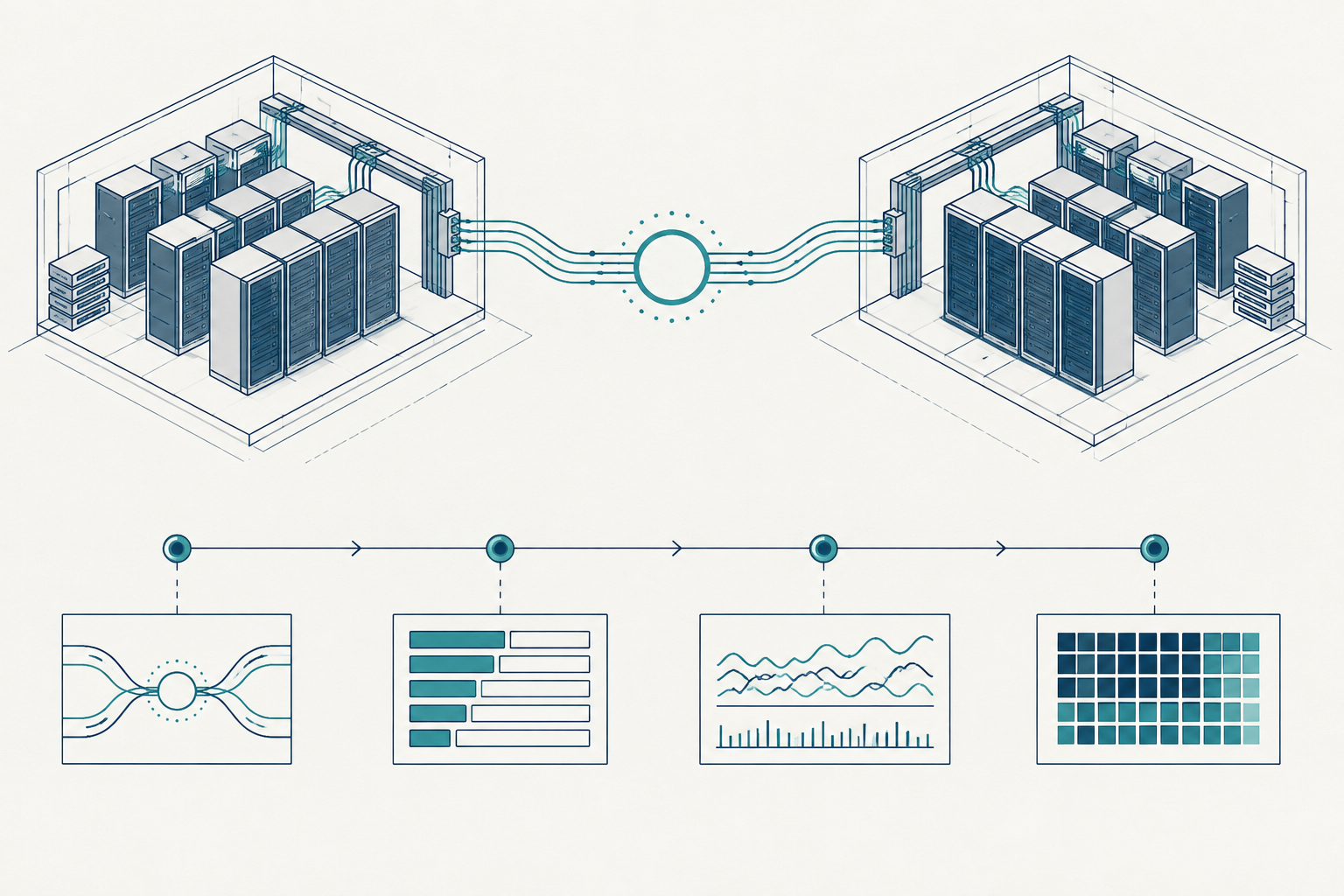
A reconnection fix with a measurable operational consequence
Kueue v0.20.5, released on November 5, 2026, addresses a delay that matters when GPU capacity is distributed across worker clusters. The release avoids unnecessary resynchronization of finished workloads after a worker cluster reconnects, reducing the delay before workloads can be dispatched again. It also changes job-reconciler logging, making dependent alerts, searches and troubleshooting queries part of the upgrade review.
The operational question is not simply whether a cluster reconnects. It is how long available GPUs remain without useful work after connectivity returns. A healthy network connection, a functioning controller and a recovered workload pipeline are different milestones. Measuring only the first can conceal an expensive recovery tail.
For GCC and MENA operators running private AI infrastructure across sites, this is a practical release peg for a recovery drill. Test the interval between reconnection and useful computation, identify which layer consumes that interval, and establish acceptance criteria before treating an upgrade as complete. The release does not provide a universal recovery target; each estate needs evidence from its own workload mix.
Define the failure boundary before measuring recovery
Start by identifying what disconnected. Loss of management-to-worker connectivity is not equivalent to a worker-cluster outage. Existing jobs might continue computing while new dispatches stall. Alternatively, the same network incident might also interrupt storage access, image downloads or application dependencies. Those cases require different interpretations of idle GPUs.
Record which connections the drill interrupts and which remain available. Include controller-to-cluster access, workload data paths, registry access and telemetry delivery. Do not describe a broad network partition as a dispatch-only test. If the test blocks observability, delayed metrics must not be mistaken for delayed computation.
Next, define capacity that is genuinely eligible for recovery. A GPU assigned to a continuing job is not stranded capacity. A GPU on a cordoned node, behind an unhealthy device plugin or reserved for another tenant is not automatically available to the waiting queue. The useful denominator is capacity that could serve the selected workload under the configured placement, quota and isolation rules.
This distinction prevents a misleading recovery report: all nodes are reachable, but only some devices are usable by the jobs that are waiting.
Measure the path from connectivity to useful work
Use a recovery timeline with explicit events rather than one controller-health indicator. Capture connectivity restoration from an independent probe where possible, then correlate dispatch, worker-side scheduling and application progress. Keep timestamps synchronized and retain workload identifiers across clusters.
| Milestone | Evidence to collect | What it distinguishes |
|---|---|---|
| Worker connection restored | Reachability and controller observations | Network recovery from dispatch recovery |
| Workload dispatched | Workload state and controller events | Queue processing from worker execution |
| Pod running | Pod conditions and container timestamps | Placement and startup delays |
| Useful computation resumed | Application progress and device activity | A running container from productive GPU work |
A process can hold GPU memory without advancing a training step or completing an inference request. Device activity therefore needs an application-level companion signal. For training, that might be successful step completion; for batch inference, completed records; for interactive inference, successful requests within the service objective.
Report both typical recovery and the slow tail. Where drill volume supports percentiles, calculate them across comparable repetitions. With only a few tests, publish individual observations and the maximum instead of presenting a fragile percentile as established performance. Preserve failed recoveries in the results; excluding them makes the system appear more reliable than it is.
Build a drill that isolates the release change
Run the comparison in a non-production environment or an approved maintenance window with a bounded blast radius. Use representative completed-workload history, because the release specifically addresses unnecessary resynchronization of finished workloads. A clean cluster containing almost no history might fail to expose the behavior the patch changes.
Hold other variables steady: controller resources, worker count, queued jobs, storage placement, image-cache state and GPU configuration. Compare the previous deployed version with v0.20.5 using the same interruption pattern. Record exact component versions and manifests so that a changed device plugin or container image does not become an invisible confounder.
Begin with a small canary queue and a known application that reports progress. Interrupt only the intended connection, restore it, and observe dispatch through useful execution. Then repeat with a larger completed-workload history and a realistic waiting queue. Include jobs already running during the interruption, checking that recovery does not create duplicate externally visible effects.
The following commands provide a basic observation starting point, not a complete recovery measurement system. Replace the context and namespace values with approved targets; the workload resource requires Kueue to be installed in that context.
kubectl --context "$MANAGEMENT_CONTEXT" get workloads.kueue.x-k8s.io -A
kubectl --context "$WORKER_CONTEXT" get nodes
kubectl --context "$WORKER_CONTEXT" -n "$TEST_NAMESPACE" get pods -o wide
kubectl --context "$WORKER_CONTEXT" -n "$TEST_NAMESPACE" get events \
  --sort-by=.metadata.creationTimestamp
Export observations during the drill. Kubernetes events are troubleshooting evidence, not a durable audit archive or a substitute for application completion records.
An illustrative capacity-recovery calculation
Consider a hypothetical estate with 32 eligible GPUs and enough queued work to occupy all of them. These numbers are illustrative, not Kueue or Clastiq product benchmarks. Assume every device is idle when connectivity returns, and the same application and data are used before and after the upgrade.
In the baseline drill, 16 GPUs begin useful computation after eight minutes and the remaining 16 after twelve minutes. Stranded capacity after reconnection is therefore (16 × 8) + (16 × 12) = 320 GPU-minutes, or 5.33 GPU-hours.
In the comparison drill, the first 16 resume after three minutes and the remaining 16 after five minutes. Stranded capacity becomes (16 × 3) + (16 × 5) = 128 GPU-minutes, or 2.13 GPU-hours. The reduction is 192 GPU-minutes: 3.2 GPU-hours per comparable incident, or 60% less post-reconnection stranded capacity.
At an illustrative internal allocation rate of US$4 per GPU-hour, the recovered capacity is valued at US$12.80 per incident. Ten comparable incidents would represent 32 GPU-hours and US$128 of allocated capacity value. That is not necessarily a cash saving: hardware ownership, depreciation and many support costs remain unchanged.
The stronger business measure may be work completed before a deadline. If the queued workload cannot use those recovered intervals, the theoretical capacity gain will not translate directly into throughput. Measure completed work alongside recovered GPU-hours.
GPU sharing changes the recovery denominator
Operators searching for Kubernetes GPU sharing with hard limits need a separate answer from faster dispatch. Kueue admission and dispatch behavior does not, by itself, establish per-workload GPU memory isolation or compute partitioning. Recovery improvements and execution isolation belong to different layers.
With GPU time slicing, multiple workloads can share access to a device, but a scheduling allocation should not be interpreted as a hard fraction of GPU memory or a guaranteed throughput share. More admitted consumers can increase contention precisely when a reconnect releases a backlog. Validate whether critical jobs remain responsive during that surge.
MIG, on supported NVIDIA hardware, provides hardware partitioning with defined profile resources. Its operational trade-off is fragmentation: available partitions may not match the profiles waiting jobs require. Count eligible capacity by profile, not simply by physical GPU count. A recovered device with the wrong partition layout may still be unusable for the backlog.
MPS supports concurrent CUDA execution and has configuration-dependent resource controls, but it should not be treated as interchangeable with MIG’s hardware partitioning. Validate the actual implementation, application compatibility and trust requirements before describing any configuration as providing hard limits. None of these mechanisms alone guarantees application throughput.
For broader infrastructure context, use Clastiq’s guide to lessons for GPU estates and the technical material on Clastiq’s site. Keep the recovery runbook focused on the sharing mode actually deployed rather than reproducing a general comparison guide.
Review logging as a compatibility surface
The job-reconciler logging changes in v0.20.5 deserve their own acceptance test. Do not assume that an alert still works because the controller is healthy. A rule that depends on message wording, a field, a severity level or a particular event frequency can silently stop matching after an upgrade.
Inventory dashboards, saved queries, log-derived metrics and incident automations that consume these logs. Compare representative records from the deployed and candidate versions. Establish which identifiers still support correlation from a management-side workload to a worker-side job and its pods. Avoid guessing new field names from the release summary; inspect actual output.
Test both positive and negative paths. A deliberately delayed canary should trigger the expected alert, while an ordinary reconnection should not generate an unnecessary incident. Confirm that the notification contains enough context to identify the queue, cluster and affected workload without exposing sensitive application data.
Where possible, base recovery objectives on state transitions and application outcomes, using logs to explain failures. Log text is valuable diagnostic evidence, but it is a brittle sole definition of whether GPUs have returned to useful work.
Set acceptance criteria across infrastructure boundaries
Agree on acceptance criteria before running the drill. An illustrative local objective might require the canary workload to resume useful computation within five minutes of reconnection, with no duplicate completed outputs and no missed recovery alert. This is a proposed test threshold, not a release guarantee or a product benchmark.
Break the budget into observable stages. If dispatch improves but image pulling consumes the saved time, investigate registry reachability and image distribution. If pods run but cannot load data, inspect storage access and network policy. If devices are allocated but application progress stalls, inspect contention, initialization and application errors.
Define rollback conditions as well as success conditions. Unexpected duplicate execution, loss of workload correlation or an alerting blind spot may justify stopping a rollout even when median recovery improves. Assign an owner to each failure boundary so an incident does not bounce indefinitely between platform, network and application teams.
Governance also applies to the drill. Approve the interruption scope, use test data where possible, restrict credentials and specify evidence retention. Recovery artifacts can reveal project names, internal topology or dataset locations. Store enough evidence to reproduce the conclusion without creating an unnecessary secondary disclosure path.
Connect the runbook to private-cloud orchestration
Cognition-AI, based in Muscat, Oman, owns the rFactorial product family. Within that family, Clastiq Orchestrator provides private-cloud orchestration across compute, GPU, storage and networks. That documented scope is relevant because useful GPU recovery depends on all four layers, not only the component dispatching workloads.
The practical connection is an operating model: map each recovery milestone to the infrastructure resource, configuration and responsible team that enables it. Confirm compute readiness, GPU eligibility, storage access and network reachability before declaring recovered capacity usable. Clastiq Lite brings self-service AI and GPU sharing to teams; those workflows likewise need clear recovery expectations and sharing policies.
This does not establish a documented Kueue integration, automatic remediation capability or built-in recovery dashboard for Clastiq. Operators should verify implementation details against their deployment rather than infer them from the orchestration scope. The release supplies a testable infrastructure question, not evidence of an unannounced product feature.
For GCC and MENA estates, make the drill reflect actual site boundaries and approved data locations. A workload must not be redirected to an unapproved environment merely to improve its recovery time. Regional operating teams should document who can authorize failover, which datasets may move, and when restoring local capacity is preferable to moving execution.
What to do this week
- Inventory the recovery path. Record Kueue versions, worker connections, GPU sharing modes, eligible queues and dependencies on storage and registries. Identify which link the initial drill will interrupt.
- Capture a baseline. Run a bounded canary test with representative finished-workload history. Record reconnection, dispatch, pod startup and useful-work timestamps, including failures and already-running jobs.
- Validate the upgrade and logging. Repeat the same test with v0.20.5. Replay relevant alert queries against candidate logs and prove that a delayed workload produces an actionable notification.
- Publish capacity and isolation results. Calculate stranded GPU-minutes, completed work and the slowest observed recovery. Separate physical devices, MIG profiles and shared allocations rather than combining incompatible units.
- Approve operational thresholds. Set recovery budgets, rollback conditions, evidence retention and named owners. Schedule a follow-up drill that exercises a different dependency without expanding the blast radius unnecessarily.
Explore Clastiq Orchestrator for the documented private-cloud orchestration scope and the rFactorial product family for its broader context within Cognition-AI. Deployment-specific questions can be directed to info@cognitionai.cloud.