A small ConfigMap fix with an operational consequence
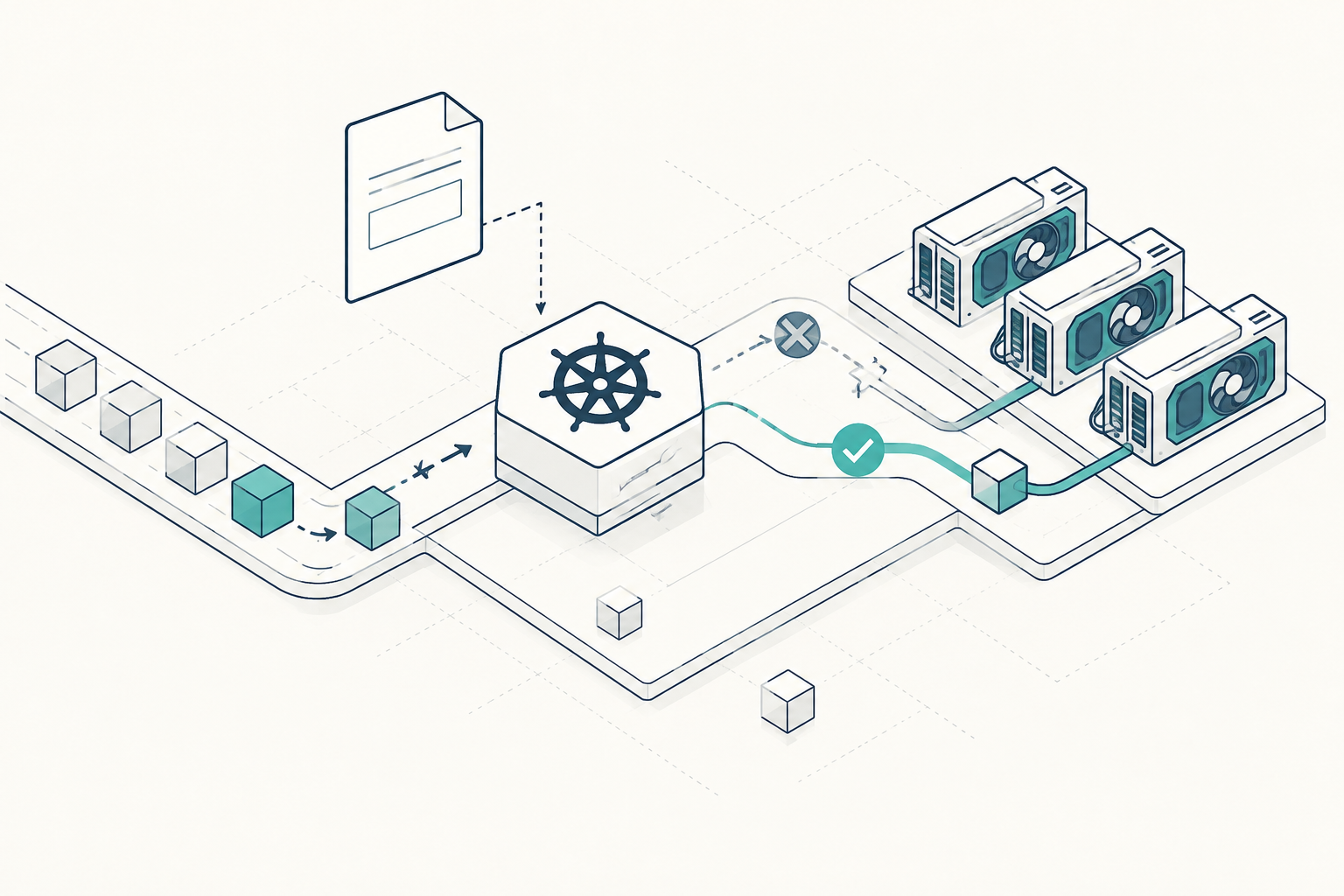
KAI Scheduler v0.16.14, released October 26, 2026, fixes a binder panic when updating an existing GPU-sharing ConfigMap containing nil data. The immediate change is narrow: an update path must handle a configuration object whose data map has not been initialized. The operational question is broader: can affected workloads bind successfully, recover after failure and actually use their assigned shared GPU?
For operators, this deserves a regression test rather than a version check alone. Installing a release establishes which code is running. It does not establish that the original failure condition was exercised, that pending work recovered or that GPU access remained correct after recovery.
This article uses the v0.16.14 release as the change reference. It does not assume a particular KAI deployment layout, ConfigMap naming convention or sharing backend. Those details must come from the deployed configuration and the matching project documentation.
The connection to rFactorial is operational, not an asserted integration. Clastiq Lite provides self-service AI and GPU sharing within Clastiq Orchestrator’s broader private-cloud orchestration scope across compute, GPU, storage and networks. A dependable self-service experience needs evidence that configuration edge cases cannot silently strand users’ work.
Establish exactly what the regression must prove
The reported condition has three important parts: the ConfigMap already exists, its data is nil, and the binder attempts to update it. Testing only ConfigMap creation misses the existing-object path. Testing only a populated ConfigMap misses the missing-data condition. Launching a pod that never reaches the relevant binder operation proves neither.
In Go, a nil map and an allocated empty map can behave differently when code writes entries. At the Kubernetes API boundary, however, omitted data and an empty data object may not remain distinguishable after serialization and decoding. Treat manifest variants as inputs to inspect, not as guaranteed distinct internal states.
Build a focused unit regression around the update function, using an existing object with nil data and asserting both that execution does not panic and that the intended entries are written. Where the project’s test structure permits, verify preservation of unrelated entries as a separate case. An error-free call that loses valid configuration is not a successful repair.
Then add a cluster-level test. Its purpose is to establish that the running controller reaches the repaired path and completes the expected workload lifecycle. Keep these layers separate: a unit test pinpoints the defect; an integration test checks the surrounding machinery.
Reproduce safely with a controlled fixture
Use a disposable cluster or a dedicated test environment matching the relevant production versions, sharing configuration and workload shape. Do not delete data from a live GPU-sharing ConfigMap to manufacture the failure. That object may participate in coordination, and its consumers may extend beyond the pod being tested.
First identify the ConfigMap used by the tested binder path. Record its namespace, ownership metadata, labels, current data and the component responsible for reconciling it. Establish which supported setup procedure creates the object and which workload causes an update. Avoid guessing resource names from examples found in unrelated deployments.
The following creates an inert fixture with no data field. It illustrates the object shape only; it does not trigger KAI behavior without the matching test harness and expected object identity.
kubectl create namespace gpu-sharing-regression
kubectl apply -f - <<'EOF'
apiVersion: v1
kind: ConfigMap
metadata:
  name: sharing-nil-data-fixture
  namespace: gpu-sharing-regression
EOF
kubectl -n gpu-sharing-regression get configmap \
  sharing-nil-data-fixture -o json
Inspect the returned object rather than assuming the submitted YAML determines the internal representation. For the actual regression, arrange the expected ConfigMap through the project’s test harness or a documented setup procedure. Confirm that the update path executes; merely storing an empty object is not a reproduction.
Run the same scenario against the pre-patch and patched builds in isolation. Preserve logs, object snapshots and workload outcomes for both. If the older build does not reproduce the panic, investigate the fixture before declaring the patch validated.
Keep the test matrix small and meaningful
A useful matrix distinguishes the reported defect from adjacent behaviors without turning one patch into an unbounded qualification exercise. Begin with cases that expose object existence, data initialization and repeatability.
| Case | Configuration state | Required evidence |
|---|---|---|
| Reported edge | Existing ConfigMap, nil data in the test object | Update completes without panic and writes expected entries |
| Normal update | Existing ConfigMap with valid data | Required changes occur without losing unrelated entries |
| Creation path | Expected ConfigMap absent | Documented creation or error behavior remains intact |
| Repeat operation | Successful update invoked again | State remains valid; no duplicate or stale allocation |
| Recovery | Work pending after a controlled failure | Work progresses without an undocumented manual repair |
For each case, record the exact build, Kubernetes version, relevant configuration and expected result before execution. Distinguish test assertions from observations. “The pod eventually ran” is an observation; “all admitted test jobs completed within the agreed recovery window, without duplicate execution” is an assertion that can fail clearly.
Add simultaneous workload submissions only after the minimal reproduction is understood. Concurrency can expose update conflicts and retry behavior, but it also makes causal diagnosis harder. A failure under load should be classified separately unless evidence connects it to the nil-data path.
Observe binding failures, not just restarts
A panic is a strong signal, but a restart count alone is an incomplete operational indicator. Capture the binder’s logs and identify how the panic is handled in the deployed process. Depending on component boundaries and recovery behavior, the visible consequence could be a process restart, a failed operation or stalled work.
Follow one test workload end to end: submission, scheduling decisions, binding, container startup, GPU initialization and application completion. Use consistent timestamps and workload identifiers so that Kubernetes events, component logs and application output can be correlated. Preserve previous container logs where a restart occurs and retention permits.
Pending status is not proof of this bug. Resource scarcity, admission policy, affinity, device availability and unrelated controller failures can also prevent progress. Require evidence tying a stalled workload to the relevant ConfigMap update and binder failure before assigning the cause.
Measure at least the number of affected submissions, submission-to-binding latency, submission-to-application-ready latency and completion rate. Keep failed and timed-out attempts in the denominator. Reporting latency only for successful attempts can make a broken service look faster by excluding its worst outcomes.
After patching, inspect configuration state as well as workload state. Look for entries left behind by failed operations and compare them with actual running work. Do not remove suspected stale records blindly; use documented reconciliation or cleanup procedures and retain evidence of the mismatch.
Check recovery without disguising manual intervention
Recovery should be a distinct acceptance test. Start with work waiting after the controlled failure, apply the intended recovery procedure and observe whether it progresses. Record any resubmission, controller restart, configuration edit or workload deletion required to restore service.
A patch that prevents new panics may not automatically repair state created by earlier failures. That does not invalidate the fix, but it changes the rollout runbook. Separate prevention of recurrence from remediation of existing damage, and assign an explicit owner to each.
Use a bounded observation window derived from the environment’s normal startup behavior and service objectives. Do not invent a universal recovery target. If normal initialization takes several minutes, a short timeout can falsely classify healthy recovery as failure; an excessively long timeout can hide operationally unacceptable delays.
Rollback also needs state awareness. Before rollout, document the supported downgrade approach and any configuration compatibility constraints. Reverting an image is not necessarily equivalent to restoring a known-good system, especially when objects changed during the failed attempt. Validate the rollback procedure in the same disposable environment.
Prove GPU access and understand its limits
Successful binding is necessary but insufficient. The test application should initialize the intended GPU runtime, execute a small representative operation and produce a verifiable result. Check the device visibility expected under the configured sharing mechanism, rather than assuming every container should see an entire physical device.
Next, run two eligible workloads concurrently. Confirm that both receive the intended access and that a workload outside the approved policy does not obtain access through the tested path. Observe memory pressure, execution progress and failure reporting. Include a bounded contention test where permitted, with safeguards against disrupting other tenants.
This is where operators must distinguish time slicing, MIG and MPS. Time slicing allows workloads to take turns using a GPU but does not, by itself, provide hard per-workload GPU-memory isolation. Advertising more schedulable shares is not the same as partitioning memory or guaranteeing latency.
MIG partitions supported NVIDIA GPUs into hardware-backed instances with defined resources, subject to supported profiles and platform configuration. MPS enables concurrent execution through NVIDIA’s multi-process service; its controls and isolation characteristics depend on the implementation and configuration. Neither term should be treated as interchangeable with Kubernetes resource accounting.
For Kubernetes GPU sharing with hard limits, specify the resource requiring enforcement: device memory, compute capacity, execution time or tenant access. A Kubernetes request or limit for an advertised GPU share does not independently establish a hard memory boundary. Verify the backend’s documented enforcement and test its failure behavior.
Keep this regression focused rather than reproducing a full sharing-design guide. Use the Clastiq site to find its in-depth guidance, and the DeepSeek context-costs insight as a related cost-planning reference, while checking implementation-specific claims against upstream documentation.
Make reliability visible in utilisation and cost
Consider an illustrative operating window, not a product benchmark. A team has four on-prem GPUs available for eight hours, giving 32 GPU-hours of capacity. Under its chosen sharing arrangement, a normal workload mix produces an average busy fraction of 60%, equivalent to 19.2 busy GPU-hours across that window.
Suppose a configuration-path failure prevents that workload mix from starting across all four GPUs for the first two hours. Assuming the same 60% busy fraction during the remaining six hours, observed busy time becomes 4 × 6 × 0.60 = 14.4 GPU-hours. The gap is 4.8 busy GPU-hours, and window-wide utilisation falls from 60% to 45%.
If the illustrative internal allocation rate is $3 per available GPU-hour, the window still costs 32 × $3 = $96. Allocated cost per busy GPU-hour rises from $96 ÷ 19.2 = $5.00 to $96 ÷ 14.4 ≈ $6.67. Restoring the expected workload window would reverse that increase, but it would not automatically reduce the infrastructure bill.
That distinction matters when paying for idle on-prem GPUs. Depreciation and many operating costs continue while jobs wait. Reliability work can recover usable capacity and reduce queueing without creating an immediate cash saving. Busy time also is not useful throughput: compare completed valid jobs, workload mix and queue age before drawing an economic conclusion.
Connect self-service to governance
For Cognition-AI, based in Muscat, Oman, the relevant product connection is rFactorial’s infrastructure offering. Clastiq Orchestrator covers private-cloud orchestration across compute, GPU, storage and networks; Clastiq Lite brings self-service AI and GPU sharing to teams. No KAI integration, particular sharing backend or specific enforcement mechanism is asserted here.
The practical workflow is straightforward: a team requests approved capacity, runs its workload and receives an observable outcome. Operators define who may request shared resources, which workloads may coexist, what isolation is required and how failures are escalated. Those are operating requirements to validate, not capabilities to infer from the phrase “GPU sharing.”
Governance should also cover configuration ownership. Identify who can edit coordination objects, how changes are reviewed and where regression evidence is retained. Broad edit permissions can undermine a carefully tested service. Apply least privilege through the environment’s supported controls, without assuming a particular product supplies every control discussed here.
What to do this week
- Pin the v0.16.14 change reference and inventory relevant deployments. Record deployed versions and whether the affected GPU-sharing update path is used.
- Build the existing-ConfigMap, nil-data regression in isolation. Require a reproducible pre-patch failure and a patched success, or document why reproduction remains incomplete.
- Capture binding, startup and completion evidence. Include failed attempts, configuration snapshots and any operator intervention in the results.
- Test recovery and concurrent shared-GPU access. Validate the required isolation boundary rather than treating a successful bind as proof of safe sharing.
- Approve rollout only with an owner, acceptance thresholds and a tested rollback procedure. Compare queue age, valid completions and idle capacity after deployment.
For the product context, explore Clastiq Orchestrator and the rFactorial product family. Use the regression evidence to define requirements for self-service AI and GPU sharing, while keeping product claims separate from the behavior of any particular scheduler.