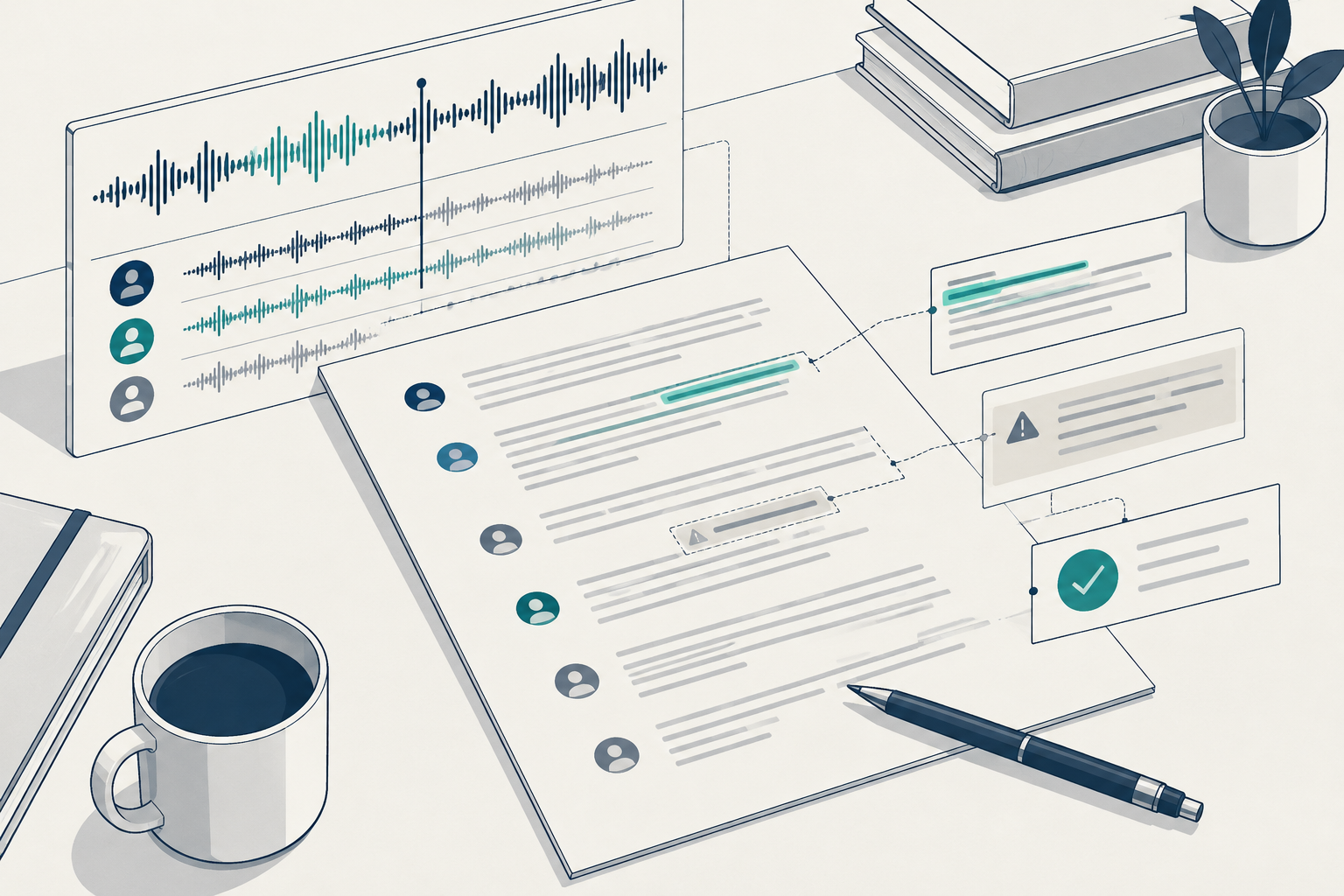
IBM’s speech update shifts the test downstream
IBM released Granite Speech 5.0 updates on October 21, 2026, covering transcription, translation and improved speaker attribution. Its release announcement describes a new 2B model, but the listed transcription languages do not include Arabic. For organizations evaluating speech systems, these changes create a specific test: whether better speech processing reduces the work required to turn conversations into dependable professional documents.
That is a different question from whether a transcript contains fewer incorrect words. Meeting minutes must preserve decisions, responsibilities and unresolved issues. Clinical drafts must preserve relevant details without turning uncertainty into a confident assertion. A readable transcript can still lead to an unreliable document if it assigns a statement to the wrong person or drops a qualification.
The relevant rFactorial product is Rovetta, which converts conversations into structured meeting minutes or clinical drafts for professional review. The Granite announcement offers a reason to evaluate an upstream speech model, not evidence that Rovetta uses it. The operational question is how to measure a candidate model’s contribution across the complete conversation-to-reviewed-document workflow.
Treat the release as a candidate, not a deployment decision
Separate IBM’s announced capabilities from the capabilities verified in your environment. Transcription, translation and speaker attribution should have distinct acceptance tests. Success on one does not establish success on the others, and a release-level improvement does not establish suitability for a particular recording environment or professional vocabulary.
Before running an evaluation, record the exact model identifier, revision, license terms, supported tasks and listed languages. Check whether the model’s output structure provides what the proposed workflow needs. Do not assume that speaker attribution means identifying named people, or that translation support implies transcription support for every source language. Keep the downloaded artifacts and configuration traceable.
Use the existing workflow as the baseline. That may be manual documentation, an established transcription service or another locally evaluated model. Comparing only two candidate models can obscure whether either improves the actual work. The baseline should include the time professionals already spend checking recordings, correcting drafts and resolving ambiguity.
Define the document before judging the transcript
For meeting minutes, define the required fields before evaluation begins: meeting purpose, decisions, action items, responsible people, deadlines and open questions. Agree on what should be excluded, such as conversational repetition. An omission is meaningful only relative to the document’s intended purpose; minutes are not supposed to reproduce every spoken word.
For clinical drafts, the responsible clinical team should define required content and review rules for the relevant documentation task. Separate what someone reported from what a professional concluded. Preserve uncertainty, negation and temporal context. A statement about a previous medication must not become a statement about current use merely because the draft reads more smoothly.
This specification is the bridge to Rovetta’s verified role. The product’s output is a structured draft for professional review, not an automatically authoritative record. Evaluate whether that draft makes checking easier without concealing uncertainty. Features such as source-linked playback or revision logging should be treated as requirements to verify or provide elsewhere, not assumed Rovetta capabilities.
Build a test set that represents difficult work
Use recordings that reflect the intended deployment, with appropriate permission and handling controls. Include quiet rooms, remote participants, overlapping speech, weak microphones and different speaking styles. Sample the professional vocabulary that actually appears in the work. A set of clean demonstrations will underestimate the correction burden of ordinary meetings and consultations.
Create separate strata for routine material and difficult cases. The difficult set should deliberately include similar-sounding names, abbreviations, specialist terminology, dates, quantities, interruptions and corrections made mid-sentence. Keep a held-out acceptance set that is not used to tune prompts or terminology guidance. Otherwise, improvements may reflect familiarity with examples rather than repeatable performance.
For each recording, prepare a checked reference transcript and a reference document specification. A transcript alone cannot establish whether the generated minutes retained every decision. Have qualified reviewers adjudicate disputed reference items. Where the audio itself cannot support a reliable interpretation, mark the item unresolved rather than inventing a definitive answer for scoring.
Keep meeting and clinical results separate. Their error consequences and reviewer qualifications differ. Also report performance by recording condition and language rather than publishing one blended average. Strong results on clear, single-language meetings can hide poor results in noisy or mixed-language conversations that matter more to a particular team.
Score errors by their effect on review
Word error rate can help diagnose recognition performance, but it cannot be the only acceptance measure. A misspelled filler word and an incorrect patient name may each contribute an error while having very different consequences. Score document-level defects alongside transcript accuracy, with a severity scheme agreed before reviewers see the candidate outputs.
| Evaluation area | Test material | Measure to record |
|---|---|---|
| Names | Similar names and unfamiliar spellings | Incorrect or unresolved names per document |
| Specialist terms | Abbreviations and domain vocabulary | Meaning-changing substitutions |
| Speaker attribution | Interruptions and overlapping turns | Material statements assigned incorrectly |
| Omissions | Decisions, qualifications and negations | Required facts absent from the draft |
| Reviewer corrections | Full draft review | Active minutes and edits by severity |
Names need more than a spelling check. Test whether a name is attached to the correct action, statement or record. Where participants have approved a reference list, evaluate with and without it under documented conditions. Do not silently give the candidate information that the baseline did not receive and then attribute the difference solely to model quality.
Specialist terminology should be tested in context. Expanding an abbreviation incorrectly may produce fluent but misleading prose. Reviewers should distinguish cosmetic corrections from changes that alter meaning. Record whether a term was audible, whether the transcript captured it, and whether the document-generation step subsequently changed it. These are different failure points requiring different remedies.
Speaker attribution deserves its own audit. A system may separate turns reasonably well while still confusing people during interruptions. In meeting minutes, that can assign an action to the wrong owner. In clinical documentation, it can confuse a patient’s statement with a professional’s interpretation. Measure attribution errors on material statements, not merely the percentage of turns labeled consistently.
Omission testing should work from a checklist of required facts. Include negative statements, uncertainty, deferred decisions and explicit corrections. A draft that captures an early proposal but omits its later rejection is not an acceptable summary. Reviewers should also flag unsupported additions: plausible content that neither the recording nor authorized contextual material establishes.
Run a controlled comparison across the workflow
Hold the document template and downstream generation configuration constant when comparing transcription candidates. Otherwise, a new prompt or a different summarization model may explain the apparent improvement. Where translation is involved, evaluate it as a separate stage and retain the source-language evidence for qualified review. Translation should not become an invisible intermediary.
Randomize draft order and conceal candidate labels from reviewers where practical. Use comparable recording groups or a counterbalanced design to reduce familiarity effects. A reviewer who has already checked one version of a conversation will usually check the next version faster. Record that exposure rather than treating the second review as independent evidence of efficiency.
Capture active review time, elapsed turnaround, correction counts, unresolved items and final acceptance. Active review time excludes interruptions unrelated to the task; elapsed turnaround includes queues and handoffs. Both matter, but they answer different questions. Also record the time spent maintaining terminology lists, resolving escalations and operating the candidate workflow.
A small evaluation record can make these distinctions explicit. The following illustrative JSON is a proposed test-harness format, not a Rovetta interface or Granite command:
{
  "recording_id": "meeting-017",
  "candidate_revision": "record-exact-revision",
  "document_type": "meeting_minutes",
  "review_seconds": 720,
  "meaning_changing_edits": 2,
  "material_omissions": 1,
  "unresolved_items": 0,
  "accepted_after_review": true
}
Store detailed corrections in a controlled record linked to that identifier. Avoid copying sensitive transcript excerpts into general-purpose telemetry. The evaluation needs enough evidence to explain failures, but it does not need unrestricted duplication of the underlying conversations.
An illustrative workload calculation
Consider a hypothetical evaluation covering 100 comparable meeting recordings, each 30 minutes long. The baseline requires an average of 18 active review minutes per draft, or 1,800 minutes in total. The candidate workflow requires 12 minutes per draft, or 1,200 minutes. The gross reduction is 600 minutes: ten reviewer hours across 50 hours of recorded conversation.
Now include candidate-specific overhead. Suppose terminology maintenance takes 90 minutes and additional exception handling takes 60 minutes during the evaluation. Total candidate effort becomes 1,350 minutes. Compared with the baseline’s 1,800 minutes, the net saving is 450 minutes, or 7.5 hours. That is a 25% reduction in measured labor, not the 33.3% suggested by draft-review time alone.
At an illustrative loaded labor rate of $60 per hour, the net labor saving is $450 for those 100 recordings. Incremental inference, storage and operational costs would still need to be deducted. These figures are hypothetical evaluation arithmetic, not IBM or Rovetta benchmarks. They also assume the baseline has no additional overhead excluded from the comparison; real accounting must include overhead symmetrically.
The time result is usable only if quality passes an independent gate. Suppose the candidate saves those hours but leaves two material attribution errors in supposedly accepted minutes, while the baseline leaves none. The operator should investigate and revise the workflow rather than declare a productivity win. Faster review can reflect either easier verification or insufficient scrutiny.
Report the distribution as well as the average. A small number of recordings that require extensive reconstruction can dominate workload and delay delivery. Median review time, a high-percentile review time and the proportion of documents requiring escalation expose that operational tail. Calculate these separately for routine and difficult recordings.
Arabic requires a separate acceptance boundary
IBM’s listed transcription languages for the new 2B model do not include Arabic. That omission is a deployment constraint for an Arabic transcription requirement, not proof that every Arabic utterance will fail. Do not present unsupported-language experiments as validated production coverage, and do not infer Arabic capability from the announcement’s broader discussion of translation.
This matters to Cognition-AI’s home market in Muscat, Oman, and to GCC/MENA organizations handling Arabic, English and mixed-language conversations. Even an English-language meeting can contain Arabic personal names, place names or institutional terminology. Test those entities explicitly. A workflow may perform adequately on the surrounding English while repeatedly corrupting the names that make its minutes actionable.
For mixed-language work, define an approved route before rollout. Options include retaining the established transcription process for those recordings or evaluating another appropriately supported candidate separately. Require reviewers qualified in the source language. The important boundary is operational: staff should know which recordings the evaluated workflow covers and which require a different process.
Keep professional review visible and accountable
The review workflow should identify who can accept a draft, how unresolved items are handled and where the approved document is stored. Distinguish draft status from final status throughout any handoff. A neatly formatted document should not acquire authority simply because it has been exported or forwarded to another team.
Set retention and access rules for audio, transcripts, generated drafts and correction histories separately. These artifacts can carry different exposure risks and may need different retention periods. Confirm the applicable organizational and legal requirements before selecting a deployment arrangement. Openly available model weights do not by themselves establish privacy, appropriate licensing or suitability for sensitive professional records.
Clinical review must remain with appropriately qualified professionals under the organization’s policies. Evaluation should test whether reviewers can detect and correct errors, not merely whether they approve a draft. Use independently checked samples after review to identify residual defects and automation bias. Approval rates without residual-error checks can reward a workflow that encourages over-trust.
For Rovetta, the practical objective is a repeatable path from conversation to reviewed structured document. Measure acceptance quality, reviewer workload and exception handling together. If the candidate speech layer helps only clean English meetings, limit the initial scope accordingly. A bounded deployment with explicit exclusions is more useful than an unqualified claim of improved transcription.
What to do this week
- Select one Rovetta-relevant document type: meeting minutes or a defined clinical draft. Specify mandatory fields, unacceptable errors and the qualified reviewer role before testing.
- Assemble a permissioned evaluation set covering names, specialist terms, speaker overlap, omissions and difficult audio. Reserve held-out recordings and mark unsupported-language cases explicitly.
- Record the Granite model revision, license and language boundaries. Compare it with the existing workflow while holding the document template and downstream generation settings constant.
- Instrument active review minutes, correction severity, unresolved items and post-review residual errors. Include maintenance and exception handling in the workload calculation.
- Agree on a limited acceptance decision, fallback route and re-evaluation schedule. Review Rovetta’s verified product scope when mapping the proposed workflow to product requirements.